
JP 225 forecast: decline from the high reaches 18%
The JP 225 stock index has hit a new six-month low within the downtrend and is now attempting to establish support. The JP 225 forecast for today is negative.
JP 225 forecast: key takeaways
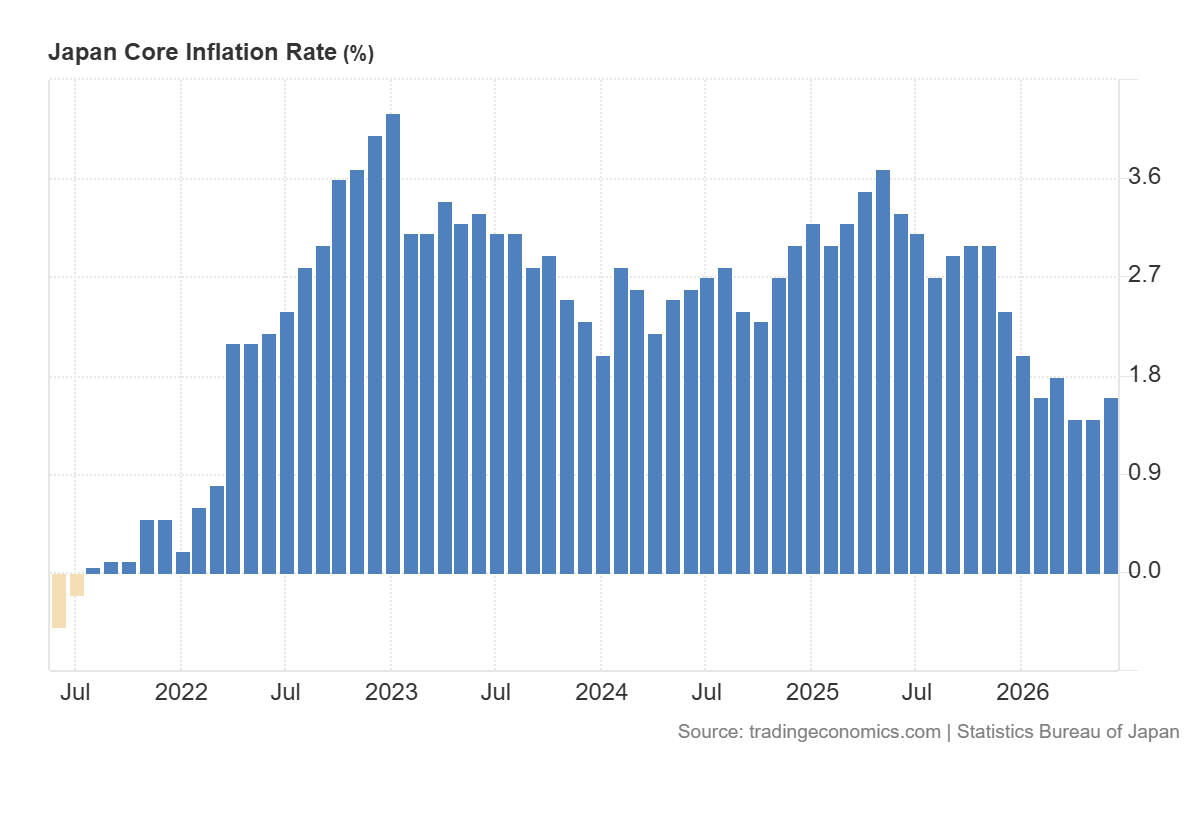
- Recent data: Japan’s core inflation rate rose by 1.6% in June
- Market impact: the effect on the Japanese stock market is mixed
JP 225 fundamental analysis
The increase in Japan’s core consumer price index from 1.4% to 1.6% year-on-year indicates a slight increase in inflationary pressure. However, the actual reading fully matched the market forecast and remained below the Bank of Japan’s 2% target for the fifth consecutive month. Therefore, the release itself was not a surprise and is unlikely to trigger a prolonged independent move in the JP 225 index. The initial market reaction is likely to be restrained, as traders had already priced in an increase to 1.6%.
For the JP 225 index, the news is mainly neutral or moderately negative. On the one hand, accelerating inflation confirms that price pressure in the Japanese economy has not disappeared completely. This may support expectations of further interest rate hikes by the Bank of Japan. In June, the central bank had already raised its short-term policy rate target to around 1.0%, so any further increase in inflation will be viewed as an additional argument in favour of continuing the gradual tightening of monetary policy.
JP 225 technical analysis
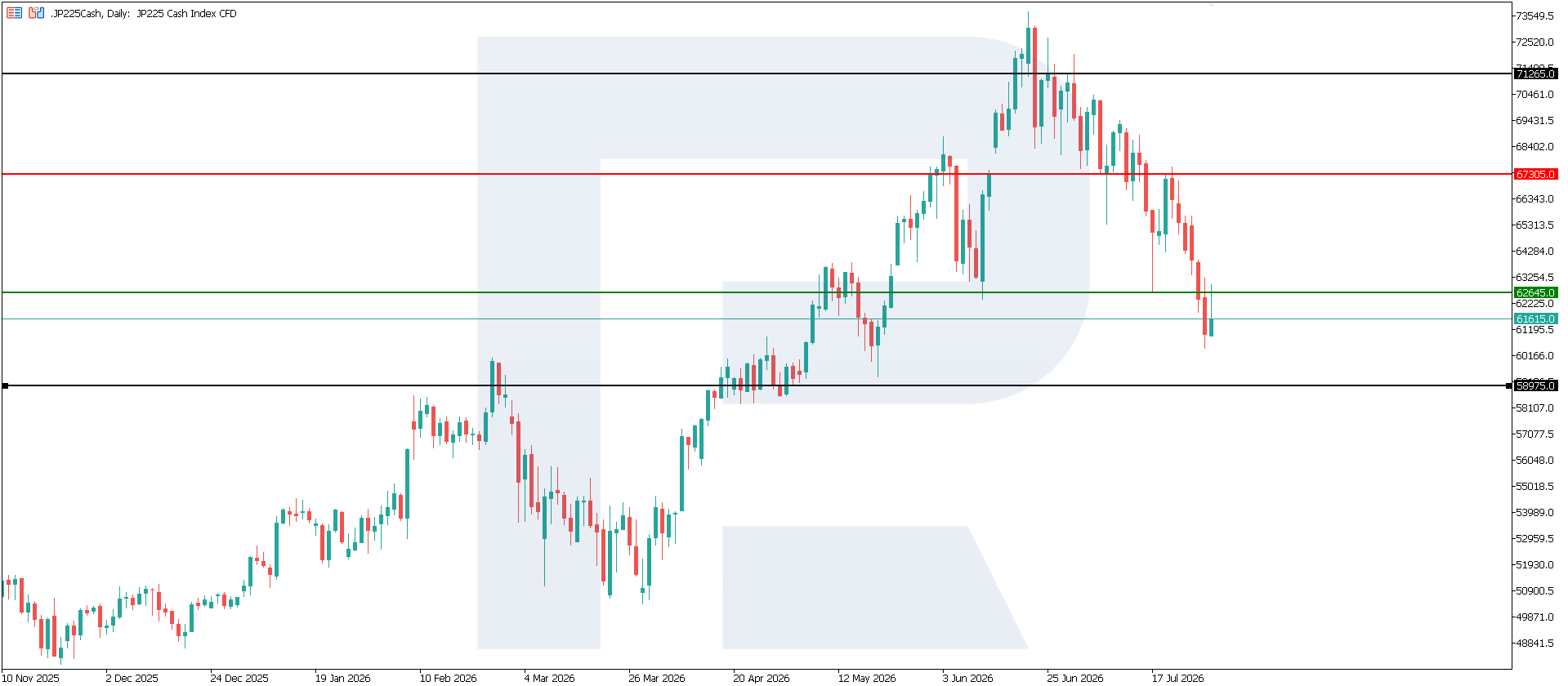
The JP 225 index continued to decline. The new support level at 62,645.0 was broken, while the nearest resistance is located at 67,305.0. The pace of the decline is not slowing, and the trend may become medium-term. The index may also enter a sideways channel. If the decline continues, the next target could be 58,975.0.
The JP 225 price forecast outlines the following scenarios:
- Pessimistic JP 225 scenario: if the price consolidates below the broken 62,645.0 support level, the index could fall to 58,975.0
- Optimistic JP 225 scenario: a breakout above the 67,305.0 resistance level could drive the index up to 71,265.0
Summary
The baseline scenario suggests a limited reaction in the JP 225 index, as the 1.6% result had already been expected by the market. In the short term, the release may exert moderate pressure on the index through expectations of further interest rate hikes and a potential strengthening of the yen. Financial companies may outperform the broader market, while exporters, real estate companies, consumer sectors, and highly leveraged businesses may underperform. The next downside target for the JP 225 could be 58,975.0.
Editors’ picks
 EURUSD forecast 2026–2027: technical analysis, price levels & predictions
EURUSD has pulled back from the 2026 high of 1.1915 and is now trading near 1.1450 — below both EMA65 and EMA200 — with the active scenario shifting from bullish to bearish. The ECB raised rates to 2.40%, but the Fed holds at 3.75%, and US inflation (3.5%) continues to outpace the eurozone (2.8%). A confirmed break below 1.1280 opens the next downward wave toward 1.1080. We break down the key levels, three trading scenarios with entry triggers, and what Deutsche Bank, Morgan Stanley and UBS are forecasting for EURUSD in 2026.
 Gold (XAUUSD) forecast 2026: predictions based on fundamental and technical analysis
Gold has corrected over 25% from its all-time high of 5,597 USD and is now trading near 4,100 USD — testing a critical support zone. Is this the bottom, or will the downtrend continue? We break down the key levels (support 3,920 USD, breakout trigger 4,500 USD), three trading scenarios with entry levels, and what J.P. Morgan, Goldman Sachs and Deutsche Bank are forecasting for gold in 2026.
Forecasts presented in this section only reflect the author’s private opinion and should not be considered as guidance for trading. RoboForex bears no responsibility for trading results based on trading recommendations described in these analytical reviews.