NVIDIA Funds OpenAI, OpenAI Buys NVIDIA Chips: What the Circular Deal Means for NVDA Stock
NVIDIA is taking on a second job. Alongside selling AI accelerators, the company is now in talks to financially guarantee the data centre that will buy them. Investors sold NVDA shares by 5% on the news, and the daily chart has arrived at a level that decides the next move: support at 195 USD. A confirmed close below it opens the way toward 150 USD.
In Brief
- NVIDIA is discussing a guarantee of up to 250 billion USD for an OpenAI data centre project.
- The company could act at once as equipment supplier, investor in OpenAI, guarantor of the project obligations, and a source of financing for purchases of its own accelerators.
- Market participants describe this structure as circular financing.
- NVDA shares fell 5% on 27 July as investors reacted to the reported terms.
- NVIDIA is acting as a strategic sponsor of the AI ecosystem, supporting demand for its own products.
- The trade idea for NVDA is a sell order on a breakdown of support at 195 USD, with a target at 150 USD.
Trade Idea Parameters
Below are the specific parameters for the NVIDIA trade idea. The ticker for trading via RoboForex MobileTrader and MT5 on RoboForex is NVDA.
| Parameter | Value |
|---|---|
| Instrument | NVIDIA Corp (NASDAQ: NVDA) |
| Ticker in MobileTrader / MT5 | NVDA |
| Idea Date | July 30, 2026 |
| Time Horizon | 1 to 3 months |
| Direction | ↓ Sell (Short) |
| Entry Level (trigger) | 195.00 USD |
| Take Profit | 150.00 USD |
| Stop Loss | 215.00 USD |
| Position Size | No more than 3% of account · Medium risk |
Instant Access to Global Markets with RoboForex MobileTrader
NVIDIA May Guarantee 250 Billion USD for OpenAI
NVIDIA is back at the centre of investor attention, this time over its possible role in funding a large AI data centre for OpenAI.
On 26 July 2026, The Wall Street Journal reported that NVIDIA is in talks to provide a financial guarantee of 250 billion USD for a major data centre in southern Ohio. The project, with capacity of up to 10 GW, is being developed by SB Energy, the energy arm of SoftBank, and OpenAI is expected to be the anchor tenant. Together with the installed accelerators, the total cost of the site could exceed 500 billion USD. The first phase of roughly 800 MW is scheduled for 2028. At that scale, the site could become one of the largest AI data centres in the world.
These are talks at this stage. No final agreements have been announced, and NVIDIA, OpenAI, and the US Department of Commerce had not commented at the time of publication. The figures of 250 billion and 350 billion USD should therefore be treated as amounts under discussion rather than commitments NVIDIA has already accepted.
How the Proposed NVIDIA and OpenAI Deal Is Structured
In simplified form, the arrangement between NVIDIA and OpenAI works like this:
- Banks and investors finance the construction of the centre.
- SB Energy builds the site.
- OpenAI leases the computing capacity.
- NVIDIA supplies the accelerators.
The complication sits with OpenAI's finances. Despite a high business valuation and rapid growth, the company remains unprofitable and holds no investment grade credit rating. For lenders, that raises the risk of financing a capital intensive project over many years. Without additional support, they may demand a higher interest rate, a larger share of the borrower's own capital, or extra guarantees.
NVIDIA would step in as a financial backstop, providing a guarantee of up to 250 billion USD covering the data centre lease and the debt financing of its construction. The guarantee would exclude the NVIDIA accelerators installed at the site. Financing for OpenAI's purchases of NVIDIA accelerators, worth up to 350 billion USD, is being discussed separately.
NVIDIA could therefore hold four roles at once: equipment supplier, investor in OpenAI, guarantor of the obligations tied to the project, and a source of financing for OpenAI's purchases of NVIDIA hardware. Financial guarantees combined with possible funding for purchases of its own products have put market participants on alert, since the arrangement increasingly resembles circular financing.
Why the NVIDIA and OpenAI Structure Is Called Circular Financing
The circular character comes from the way capital moves:
- NVIDIA provides capital or a guarantee to OpenAI.
- OpenAI gains the ability to build data centres.
- A significant share of the funds raised goes toward purchases of NVIDIA systems.
- The money returns to NVIDIA as revenue.
How capital moves in the NVIDIA and OpenAI structure
Circular
financing
financing
1 NVIDIA provides capital or a guarantee to OpenAI
2 OpenAI gains the ability to build data centres
3 A significant share of the funds raised goes toward purchases of NVIDIA systems
4 The money returns to NVIDIA as revenue
Step 4 feeds step 1, and the cycle repeats
On its own, this breaks no accounting rules. Customer financing is widely used in aviation, automotive, industrial, and telecom markets. A supplier helps a client fund an equipment purchase because it lifts sales and speeds up the development of the market. The risk appears when it becomes hard to judge how much demand stands on its own and how much of it is supported by the supplier's own money.
For NVIDIA, the core exposure is that the company starts absorbing part of its customers' financial risk. If OpenAI cannot meet the obligations tied to the project, the guarantees provided could turn into real costs for NVIDIA. The arrangement also reduces the transparency of demand. When NVIDIA helps fund purchases of its own accelerators, it becomes harder to establish how much of the current sales volume would remain without that financial support. Should data centre construction run ahead of genuine demand for computing power, NVIDIA could face slower new orders and losses on previously issued guarantees and investments at the same time.
Why the OpenAI Guarantee Triggered a Sell-Off in NVIDIA Stock
NVIDIA shares fell 5% on 27 July once the reports appeared. What put investors on guard is the steady widening of the company's role, from accelerator supplier to a major participant in financing artificial intelligence infrastructure. Through this deal, NVIDIA would take on part of the credit risk attached to OpenAI and to the project itself. If OpenAI struggles to meet long term lease obligations, or if servicing the related debt runs into trouble, the guarantee NVIDIA has provided could translate into real financial losses.
The scale of the potential guarantee stands out against NVIDIA's balance sheet. As of Q1 of fiscal year 2027, which ended on 26 April 2026, the company held:
- 50.3 billion USD in cash and marketable debt securities
- 30.2 billion USD in marketable shares
- 50.3 billion USD of operating cash flow for the quarter
- 27 billion USD in investment commitments already announced
Potential guarantee against NVIDIA's balance sheet, billion USD
Potential guarantee for the OpenAI project
250
Liquid financial assets (cash, debt securities, marketable shares)
80.5
Cash and marketable debt securities
50.3
Investment commitments already announced
27
Almost 5x the cash and marketable debt securities
More than 3x the liquid financial assets
A potential guarantee of 250 billion USD is almost five times NVIDIA's cash and debt securities. Even counting the portfolio of marketable shares, it exceeds the company's liquid financial assets by more than three times. The guarantee could be issued in stages, through dedicated financial structures, and only as construction progresses. Its maximum size is still too large to set aside.
A second consideration is the quality and independence of demand. When a client buys accelerators without financial support from NVIDIA, the order reflects a real need for computing power more directly. NVIDIA, however, is investing more actively in its customers and infrastructure operators, providing financial guarantees, discussing funding for purchases of its own accelerators, and in some agreements guaranteeing the buyback of unused computing capacity. That makes it harder to establish which share of demand forms independently and which is supported by NVIDIA's own capital.
What unsettled investors was the scale of the potential obligations and the further expansion of NVIDIA's role in financing its own customers. The market has priced in the possibility that part of future accelerator demand will rest on NVIDIA's capital, and that weak returns on the infrastructure could leave the company facing lower new orders alongside losses on investments and guarantees. This increase in financial exposure became one of the main reasons for the sell-off after the news.
Open a Trading Account at RoboForex
Swap-free accounts, spreads from 0, and execution in 0.01 seconds.
Why NVIDIA Finances Its Own Customers
The reason is straightforward: building AI infrastructure has become very expensive. A modern AI data centre needs chips, power plants, cooling, land, transformers, network connections, server racks, storage systems, and enormous credit lines. Even large technology companies are having to raise capital spending sharply.
For younger AI companies the position is harder still. They need powerful computing, and they often lack sufficient capital, a credit rating, and stable cash flow. Without outside support, such companies cannot build infrastructure quickly or purchase NVIDIA accelerators.
NVIDIA therefore acts as a strategic sponsor of the AI ecosystem. The company effectively helps the market build the infrastructure that will then consume its products. It is an aggressive strategy with a clear logic behind it. NVIDIA has several reasons to operate this way:
- maintain strong demand for its products
- accelerate the construction of AI data centres
- reduce dependence on a handful of the largest customers
- widen the client base among AI startups and independent cloud providers
- create new sales channels
- participate in cloud revenue after the hardware is sold
- protect its ecosystem from competitors
For NVIDIA, this is a way to use its leadership in accelerators to strengthen its influence across the whole of AI infrastructure.
What Has to Go Right for the Customer Financing Strategy
The central exposure is that NVIDIA may absorb too large a share of the financial risk of the AI boom. If demand for AI computing keeps growing quickly, the strategy can pay off. NVIDIA would sell more hardware, gain additional benefit from the build-out of cloud infrastructure, and reinforce its market position.
If demand comes in below expectations, the picture changes. NVIDIA's customers could run into difficulties paying for data centres, servicing debt, and filling computing capacity. In that case, financial guarantees, investments, and credit support can turn from a demand tool into a source of direct losses for NVIDIA.
There is a further consideration in how the market values the company. NVIDIA is currently treated as one of the main beneficiaries of the AI cycle, so any sign of slowing demand, or of sales leaning more heavily on customer financing, could compress the valuation premium and put pressure on its multiples.
The emerging secondary market for computing capacity raises a separate question. Meta is already considering leasing part of its AI infrastructure to external clients, and July brought reports of talks with Anthropic on a deal worth up to 10 billion USD. If Meta, xAI, and other large accelerator owners start supplying their capacity to third parties more actively, the same fleet of hardware can serve more end users. That would raise the utilisation of installed infrastructure and, over time, slow the market's need for new accelerators.
For NVIDIA, that scenario carries the risk of a visible slowdown in demand for new accelerators, which could lead to slower revenue growth, sharper price competition, lower margins, and a reset of elevated market expectations. Pressure on the multiples could then produce a substantial downward revaluation of the stock.
NVDA Analyst Ratings
As of July 2026, Barchart analyst ratings for NVDA show a strong tilt toward buying: 46 of the 47 analysts tracked rate NVDA a Buy, and only one rates it a Sell. Worth noting that this consensus was largely formed before the reports on the OpenAI guarantee, and the average target price sits well above the current market price.
Buy: 46
Sell: 1
46 out of 47
recommend Buy (98%)
Hold
0 (0%)
Sell
1 (2%)
Average Target Price
304.32 USD
Minimum Target
180.00 USD
Maximum Target
500.00 USD
NVDA Stock: Technical Picture
On the daily timeframe, NVIDIA shares sit in an important technical zone where several significant levels and indicators come together. The next directional move depends largely on how the price reacts to 195 USD.
The 195 USD level coincides with the 200-period Moving Average. A breakdown through it would signal that the uptrend may be finishing and that a deep correction or a downtrend is starting. The same level also coincides with an ascending trend line, and a break of that line would signal the end of the upward move. Support sits at 195 USD as well, so a breakdown there would reinforce bearish sentiment and could open room for a further decline.
The Stochastic indicator adds a second signal. It is near overbought territory with its lines crossing downward, which raises the probability of a price decline.
Judging by how market participants reacted, the news around the possible NVIDIA and OpenAI deal supports bearish sentiment in NVIDIA shares.
The trade idea for NVDA is therefore to place a sell order on a breakdown of support at 195 USD. The target for the decline is support at 150 USD.
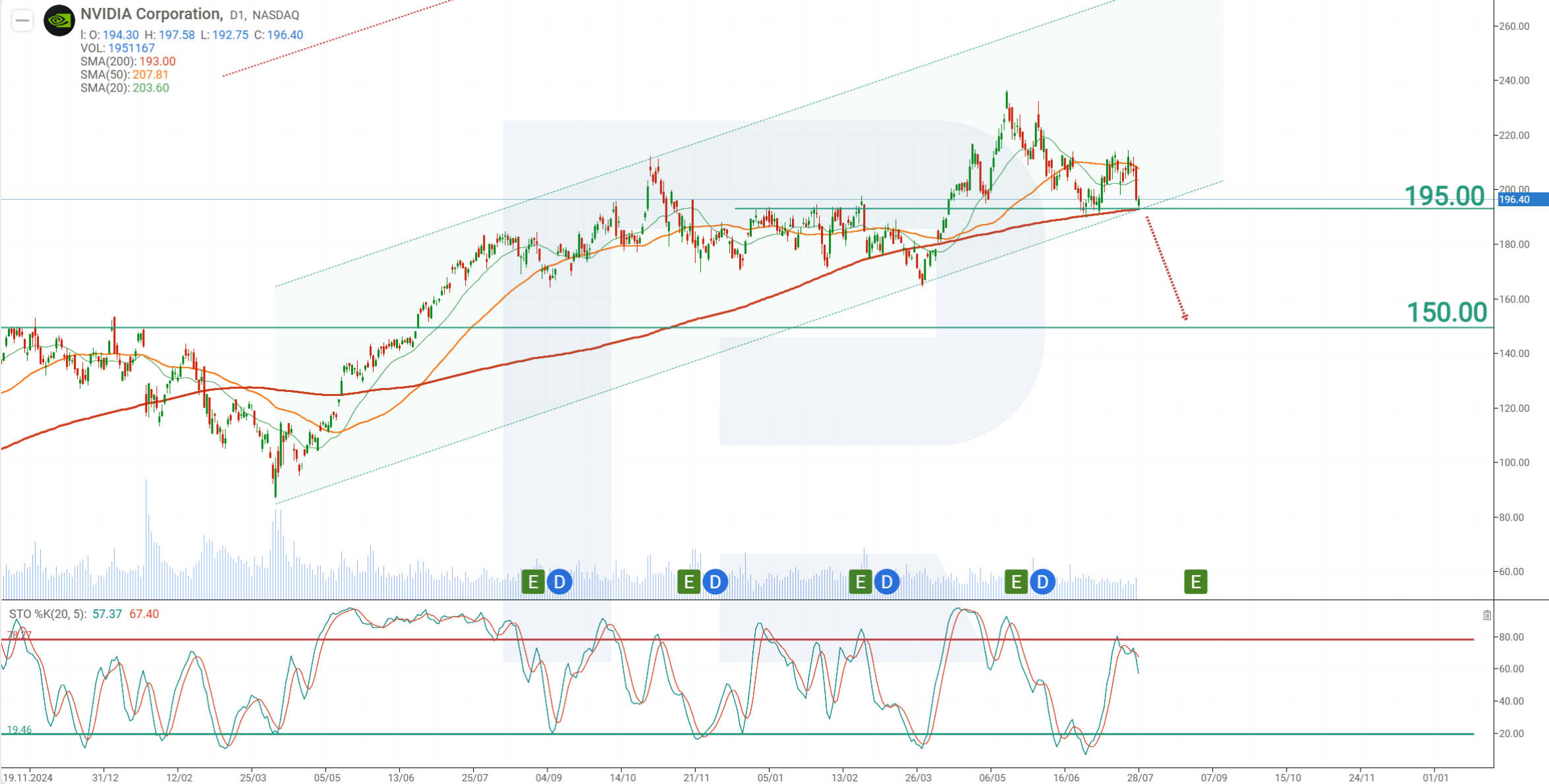
NVIDIA (NVDA) stock technical analysis and forecast 2026. Past results do not guarantee future performance.
- The 200-day Moving Average (MA200) runs through 195 USD, so a close below it would question the long-term uptrend.
- An ascending trend line passes through the same area, which makes 195 USD a combined technical level.
- Stochastic is near overbought territory with a downward crossover, raising the probability of a decline.
- A breakdown of support at 195 USD serves as the trigger for the short scenario, with a target at 150 USD.
Sample Trading Strategy for NVDA Shares
Below is a sample trading strategy for NVDA shares. This example is for educational purposes only and does not constitute investment advice. Investors should assess their own risk tolerance independently.
| Parameter | Value |
|---|---|
| Entry Point | Sell on a breakdown of support at 195.00 USD |
| Take Profit | Support at 150.00 USD |
| Stop Loss | 215.00 USD, which cancels the bearish signal |
| Risk / Reward Ratio | 1 : 2.25, potential profit is roughly 2.25× the risk |
| Position Size | No more than 3% of account |
Sample Calculation for 10 NVDA Shares
| Scenario | Calculation | Result |
|---|---|---|
| Sell 10 shares at 195.00 USD | 10 × 195.00 USD | 1,950 USD |
| If target reached (150.00 USD) | (195.00 − 150.00) × 10 | +450 USD (+23.1%) |
| If stop triggered (215.00 USD) | (215.00 − 195.00) × 10 | −200 USD (−10.3%) |
| Risk / Reward | 200 / 450 | 1 : 2.25 |
A risk/reward ratio of 1:2.25 sits in the acceptable range for position trading. Keep in mind that markets are volatile: NVDA shares can move both for and against an open position.
Trade with RoboForex MobileTrader
Live charts, deposits and withdrawals, analytics and copy trading, all in one app.
Should You Sell NVIDIA Stock on This News?
On its own, a possible guarantee for OpenAI is not yet sufficient grounds for selling NVIDIA shares. The deal has not been signed, and obligations of 250 billion USD do not mean immediate spending of that amount. The probability of a decline in the share price has nevertheless risen noticeably.
NVIDIA is tying its sales growth ever more closely to financial support for its own customers. Should AI demand begin to slow, the company could face lower orders, losses on investments and guarantees, and pressure on margins at the same time. The developing market for leasing already installed AI capacity adds a second consideration. If Meta, xAI, and other owners of large clusters start renting them out more actively to third parties, the need for new NVIDIA accelerators could grow far more slowly.
NVIDIA shares therefore carry more risk than they did before this news. Investors sitting on large gains have a reasonable case for taking partial profits, and buying aggressively into the current decline looks premature. For traders, the actionable level is 195 USD: a confirmed breakdown activates the short scenario toward 150 USD, while a hold above it keeps the existing uptrend in place and cancels the setup.
* The information in this article reflects the personal opinions of the authors. It should not be construed as trading advice or a call to action. The authors and RoboForex bear no responsibility for trading results based on the recommendations and reviews contained in this material. Past performance is not a guarantee of future results. Trading stocks and CFDs involves a high risk of capital loss.