AI Portfolio Generator Buys Walmart and Healthcare, Sells Nasdaq 100 and EUR/USD
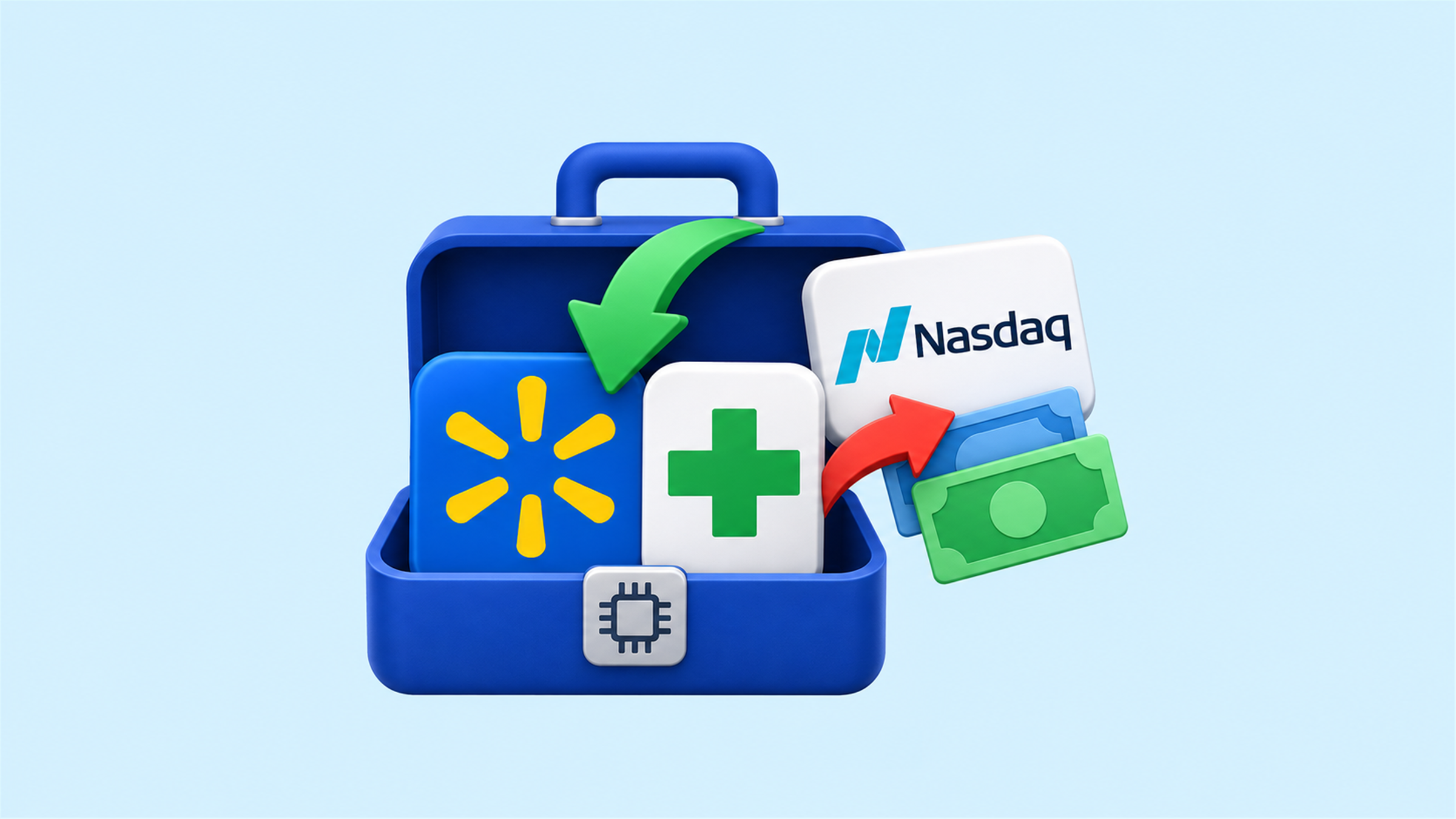
In the fifth round of our public experiment, the AI portfolio generator builds four trades around Walmart and the healthcare sector. The AI model GPT-6.1 Sol builds a portfolio for a 10,000 USD demo account in StocksTrader with a horizon of two weeks. It buys Walmart and a healthcare fund, sells a fund that tracks the Nasdaq 100 and sells EUR/USD. All four positions open at market at the US open on 23 November and close no later than 4 December. The result goes up on this page next to a US 500 position of the same size.
Previous AI portfolio
The fourth AI portfolio, 9 to 20 November, closed with a loss of 370.34 USD. All five trades hit their Stop Loss. A US 500 position opened next to it lost 147.45 USD, so the AI finished 222.89 USD behind the index. The AI's stops sat too close to the prices of volatile stocks, and ordinary swings during a session were enough to close the trades. In the new portfolio the stops are wider. The planned risk grows to 598.16 USD, or about 6% of the deposit.
The total result of all four rounds since the start of the experiment:
Total result of the four AI portfolios since the start of the experiment
AI portfolios
-308.76 USD
US 500 positions
-760.76 USD
Horizon
Two weeks, 23 November to 4 December 2026, nine US trading sessions
Deposit
10,000 USD on a demo account in StocksTrader
Built by
GPT-6.1 Sol: direction, size, Take Profit and Stop Loss
Benchmark
The US 500, 1.94 lots, the same size as the portfolio
AI Portfolio Status
| Stage | Status |
|---|---|
| Portfolio built | 23 November 2026, on prices from the 20 November close |
| Positions opened | 23 November 2026 at the US open, all four |
| Positions closed | No later than 4 December 2026, at the US open |
| Result | Published on this page when the portfolio closes |
Open a RoboForex Account
Buy and sell stocks, ETFs, currencies and indices from one account.
How the AI Portfolio Experiment Works
GPT-6.1 Sol does the whole selection. It assesses the market, picks the instruments and the direction of each trade, splits the budget, and calculates the position size, Take Profit and Stop Loss. Our part is technical: we check the quotes in StocksTrader, open the positions on the demo account and record the result.
The request sent to the AI, translated from the original:
Prompt
Build a portfolio for 23 November to 4 December for a 10,000 USD deposit. Consider both buys and sells. Entry is at market at the start of the main US session. Use Friday's prices for the article. Set the stops with volatility in mind, then calculate the sizes. Explain every idea and compare the result with the US 500.
The portfolio follows six rules:
- Fixed horizon. Positions open at market on Monday 23 November at the US open. US exchanges are closed on 26 November for Thanksgiving and trade a shortened session on 27 November, so the two weeks hold nine sessions. Everything still open is closed on Friday 4 December at the US open, whatever the result.
- Early exit on profit or loss. If the total net profit of the AI portfolio reaches 850 USD, or the total net loss reaches 700 USD, all remaining positions are closed at once. The limits count closed trades, open positions, commissions, swaps and dividend adjustments. The US 500 position stays outside them.
- Wider stops. New in this cycle: after the previous round the AI sets Stop Loss levels with each instrument's volatility in mind. The planned risk is 598.16 USD, against 338.52 USD last time.
- Levels follow the entry. Take Profit and Stop Loss are recalculated from the actual entry prices, with distances close to the planned percentages.
- No second attempt. A position closed at its Stop Loss is not reopened, losing trades are not averaged down and stops are not widened.
- Leverage. Up to 1:2 on stocks and ETFs, up to 1:50 on currencies and crypto.
Market Backdrop for the Next Two Weeks
- US stocks. In the week to 20 November the US 500 lost about 8.6% and the Nasdaq Composite about 10%. Buying the whole market and hoping for a quick rebound is risky, and selling after such a fall is risky too. The new portfolio combines selective buys with a small sale of the Nasdaq 100 through QQQ. It is a bet on differences between sectors, with no assumption that every stock moves the same way.
- Rates and the dollar. The Fed rate stays in the range of 3.75% to 4.00%, and the ECB deposit rate is 2.50%. The gap supports the idea of selling EUR/USD, but the market has already priced it in, and it does not guarantee a further fall in the pair. The key new data are PCE inflation on 25 November and US employment on 4 December.
- Company reports. Walmart has already published its results and raised its forecast for the financial year. That is a concrete reason to buy ahead of the holiday shopping season. Pressure stays on the technology sector, so the AI uses QQQ for the sale in place of a short position in one company. A strong rebound in QQQ after the sell-off is one of the main risks of the portfolio.
- Gold and crypto. Gold is not treated as automatic protection: the GLD fund fell 9.2% in the week to 20 November. This time the AI opens no direct position in gold, oil or BTC. The extra tactical risk goes into the QQQ and EUR/USD sales.
How the AI Split the Risk
How the AI split 598 USD of planned risk across three blocks
598 USD
4 trades
Core block
333.06 USD · 56% of the planned risk
- WMT, buy170.10 USD
- XLV, buy162.96 USD
A company with a raised forecast and a healthcare fund.
Tactical block
139.10 USD · 23% of the planned risk
- QQQ, sell139.10 USD
A sale of the Nasdaq 100 fund, two units.
Currency block
126.00 USD · 21% of the planned risk
- EUR/USD, sell126.00 USD
A bet on continued dollar support.
Hover over a block, or tap it, to see what is inside.
- Core block: buy WMT and XLV. Walmart is a company with a raised forecast and steady sales. XLV spreads the money across healthcare companies. The AI counts on both recovering and keeping their relative strength against the technology sector.
- Tactical block: sell QQQ. The fund tracks the Nasdaq 100. The trade counts on continued pressure on the largest growth companies. Two units limit the cost of a mistake, and the wide stop allows a sizeable rebound. It is a separate short trade that offsets the dependence of the buys on the market only in part.
- Currency block: sell 7,000 EUR against the dollar. US rate expectations and demand for the dollar can support a fall in the pair. Slower US inflation or tougher ECB expectations can reverse the move. The risk of the currency trade is 126 USD.
AI Portfolio Positions
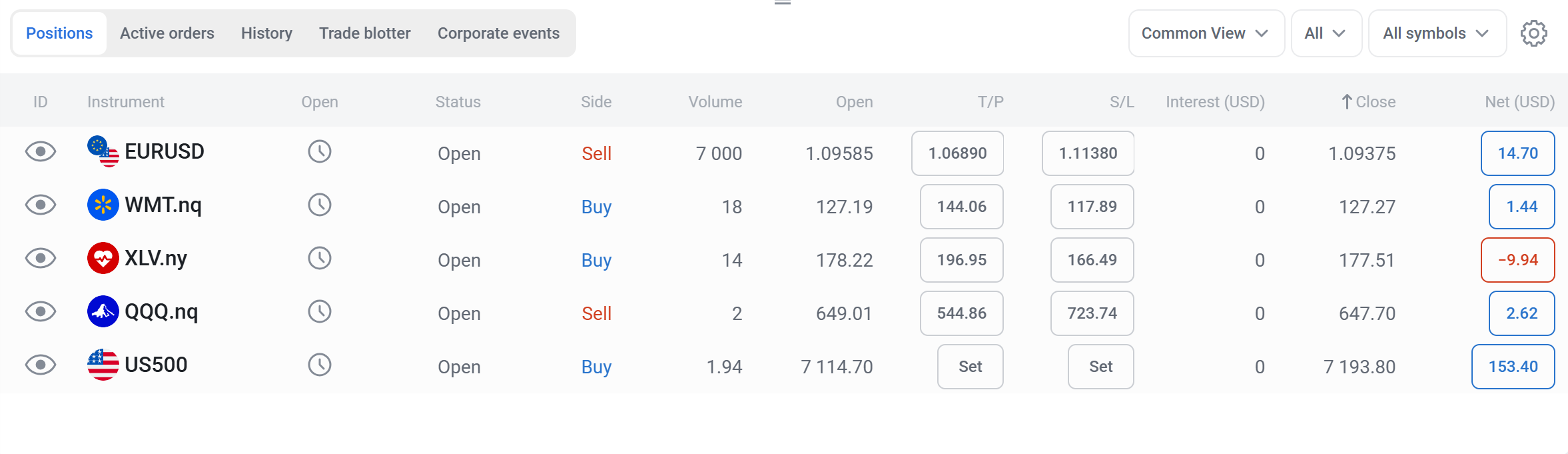
Prices in this table are reference prices from the close on 20 November, and the EUR/USD price is a reference level of 1.0970. The positions open at market at the US open on 23 November, so the actual entries will differ. They will be listed under the table, with Take Profit and Stop Loss recalculated from them. Charts for every stock are on the RoboForex stock charts page.
| Instrument | Trade | Price | Take Profit | Stop Loss | Volume | Size, USD |
|---|---|---|---|---|---|---|
| WMT | ↑ Buy | 127.95 | 144.96 (+13.29%) | 118.50 (-7.39%) | 18 shares | 2,303.10 |
| XLV | ↑ Buy | 177.24 | 195.86 (+10.51%) | 165.60 (-6.57%) | 14 units | 2,481.36 |
| QQQ | ↓ Sell | 608.45 | 510.00 (-16.18%) | 678.00 (+11.43%) | 2 units | 1,216.90 |
| EUR/USD | ↓ Sell | 1.0970 | 1.0700 (-2.46%) | 1.1150 (+1.64%) | 7,000 EUR | 7,679.00 |
Percentages show the change in the price from the reference entry and are rounded. When the trades open, Take Profit and Stop Loss are recalculated from the actual execution prices.
Build Your Own Portfolio in StocksTrader
Buy or sell the stocks from this portfolio on one platform.
Why the AI Picked Each Trade
WMT. Walmart revenue for the third quarter of its 2027 financial year rose 5.2% to 188.8 billion USD, and global online sales rose 17%. The forecast for adjusted earnings per share for the year was raised to 2.84 to 2.89 USD from 2.80 to 2.87 USD. The buy counts on support for the price after the report and during holiday demand. Inventories grew 8.1%, so their turnover and later discounts remain a risk for margins.
XLV. The fund holds healthcare companies from the US 500, including pharmaceuticals, biotechnology and medical equipment. It lost 6.1% in the week, while QQQ lost 10.5%. The relative strength supports the idea of a recovery, but the absolute move is still negative. The buy is a short-term scenario and does not confirm a trend reversal.
QQQ. The fund fell 10.5% in the week and 5.67% on 20 November. The position counts on further falls in the Nasdaq 100. After such a sell-off a quick rebound is possible, so the stop sits 11.4% above the entry and the size is limited to two units.
EUR/USD. The sale counts on continued support for the dollar. Eurozone inflation near 4% raises the risk of tougher ECB expectations and a rebound in the euro.
Portfolio Targets and Stop Levels
The combined size of the four trades is 13,680.36 USD at the reference prices. Stocks and ETFs account for 6,001.36 USD and EUR/USD for 7,679 USD. Size is not margin: at 1:2 on stocks and ETFs and 1:50 on the currency, the trades reserve about 3,154.26 USD of the deposit.
If all four Take Profit levels are reached and the portfolio is not closed early, the gross profit comes to about 952.76 USD, or 9.53% of the deposit. In practice the early exit at 850 USD would close the portfolio first. If all four Stop Loss levels are hit exactly at their prices, the loss comes to 598.16 USD, or 5.98%. A gap or slippage can make the loss larger.
Closing rule
If the total net profit of the AI portfolio reaches 850 USD, or the total net loss reaches 700 USD, the available positions close at once and the rest at the first opportunity. Otherwise everything still open closes on Friday 4 December at the US market open, whatever the result. Positions closed at a Stop Loss are not reopened, losing trades are not averaged down and stops are not widened. The US 500 position closes at the same moment as the portfolio, when it is open for trading.
Five dates carry most of the risk. Every release is on the economic calendar.
PCE, Thanksgiving and the jobs report are the tests before 4 December
- 23 NovemberNowPortfolio opensAll four positions at market at the US open, together with the US 500 benchmark.
- 25 NovemberGDP and PCEThe second estimate of US GDP for the third quarter and October PCE inflation, before the market opens.
- 26 and 27 NovemberThanksgivingUS exchanges are closed on the 26th and trade a shortened session on the 27th, so liquidity can be thinner.
- 1 DecemberInflation and JOLTSPreliminary eurozone inflation for November and US JOLTS for October.
- 4 DecemberJobs report and closeUS employment for November comes out an hour before the planned close, and the result goes up here.
Three Trades With the Best Target-to-Stop Ratio
The ratio compares the distance to the target with the distance to the stop. QQQ comes last at about 1.4 to 1. The other three:
- WMT, about 1.8 to 1. The target is 17.01 USD per share away and the stop is 9.45 USD away. For 18 shares that is 306.18 USD of potential gross profit against 170.10 USD of risk. The trade has a fresh company reason, the raised forecast. The target of 144.96 USD is a scenario, and reaching it within nine sessions is not guaranteed.
- XLV, about 1.6 to 1. The target is 18.62 USD per unit away and the stop is 11.64 USD away. For 14 units the potential profit is 260.68 USD against 162.96 USD of risk. The calculation counts on a recovery in healthcare with its relative strength intact. A further fall in the market can hit the wide stop.
- EUR/USD, about 1.5 to 1. The target is 0.0270 away and the stop is 0.0180 away. For 7,000 EUR that is 189 USD of potential profit against 126 USD of risk. The result depends on new data on inflation and employment and on how rates and the dollar react.
AI Portfolio vs the US 500
To check how well the AI built the portfolio, we compare it with a simple alternative: a long position in the US 500 of the same size, 13,680.36 USD, the combined size of the four trades. At the reference level of 7,070 points and 1 USD per point the volume is 1.94 lots. It opens at market together with the portfolio on 23 November and has no Take Profit or Stop Loss. Its result is taken at the same moment as the portfolio's, when the instrument is open for trading.
Dividends count on both sides: dividend adjustments on the US 500 and any dividends on the stocks and funds in the portfolio.
AI Portfolio Result After Two Weeks
The result is published on this page when the portfolio closes, on 4 December 2026 or earlier if a closing limit is triggered, together with a screenshot of the account history and the outcome of every position.
AI portfolio vs the US 500, 23 November to 4 December 2026
AI portfolio
Published on 4 December
US 500, 1.94 lots
Published on 4 December
The difference between the two, in percentage points, goes here when the portfolio closes.
What This AI Portfolio Tests
The fifth AI portfolio tests wider stops. After a round in which five tight stops all closed with a loss, the AI buys Walmart and a healthcare fund, sells a Nasdaq 100 fund and sells EUR/USD, and accepts a planned risk of about 6% of the deposit. The main tests are PCE inflation on 25 November, the Thanksgiving break and the US jobs report on 4 December.
After four rounds the AI portfolios are down 308.76 USD in total, and the US 500 positions are down 760.76 USD. On 4 December this page will show whether wider stops change the AI's result, and the score after five rounds.
FAQ
What is the AI portfolio experiment?
The AI model GPT-6.1 Sol builds a portfolio for a 10,000 USD demo account in StocksTrader with a horizon of two weeks. The AI chooses the instruments, the direction of each trade, the position sizes and the Take Profit and Stop Loss levels. We open the positions, close them on schedule and publish the result next to a US 500 position of the same size.
How did the previous AI portfolio do?
The fourth AI portfolio, 9 to 20 November 2026, closed with a loss of 370.34 USD, and all five trades hit their Stop Loss. A US 500 position opened next to it lost 147.45 USD, so the AI finished 222.89 USD behind the index. After four rounds the AI portfolios are down 308.76 USD in total and the US 500 positions are down 760.76 USD.
What did the AI put in this portfolio?
Four trades in three blocks. Buys of Walmart and the XLV healthcare fund form the core, a sale of the QQQ fund that tracks the Nasdaq 100 is the tactical block, and a sale of EUR/USD is the currency block.
Why are the stops wider this time?
In the previous round all five stops were too close to the prices of volatile stocks, and ordinary swings during a session closed the trades with a loss. The AI now sets stops with volatility in mind. A wider stop reacts less to short swings and allows a larger loss on each trade.
How much can the AI portfolio gain or lose?
All four Take Profit levels would bring about 952.76 USD, or 9.53% of the deposit, before costs, though the early exit at 850 USD would close the portfolio first. All four Stop Loss levels would cost 598.16 USD, or 5.98%, and a gap or slippage can make the loss larger. The portfolio also closes early at a total net loss of 700 USD.
When will the results be published?
On 4 December 2026, after the positions are closed at the US market open. If the portfolio reaches a total net profit of 850 USD or a total net loss of 700 USD earlier, it closes early and the result is published then.
Any forecasts contained herein are based on the author's independent analysis and reflect their personal opinion. These articles should not be construed as trading recommendations or a call to action. The authors and RoboForex accept no responsibility for the results of any trades made on the basis of these recommendations and reviews. Past performance is not indicative of future results. Trading stocks and CFDs involves a high risk of capital loss.