Who Owns Anthropic After the IPO? Amazon and Google LLC Hold 28% of the Capital
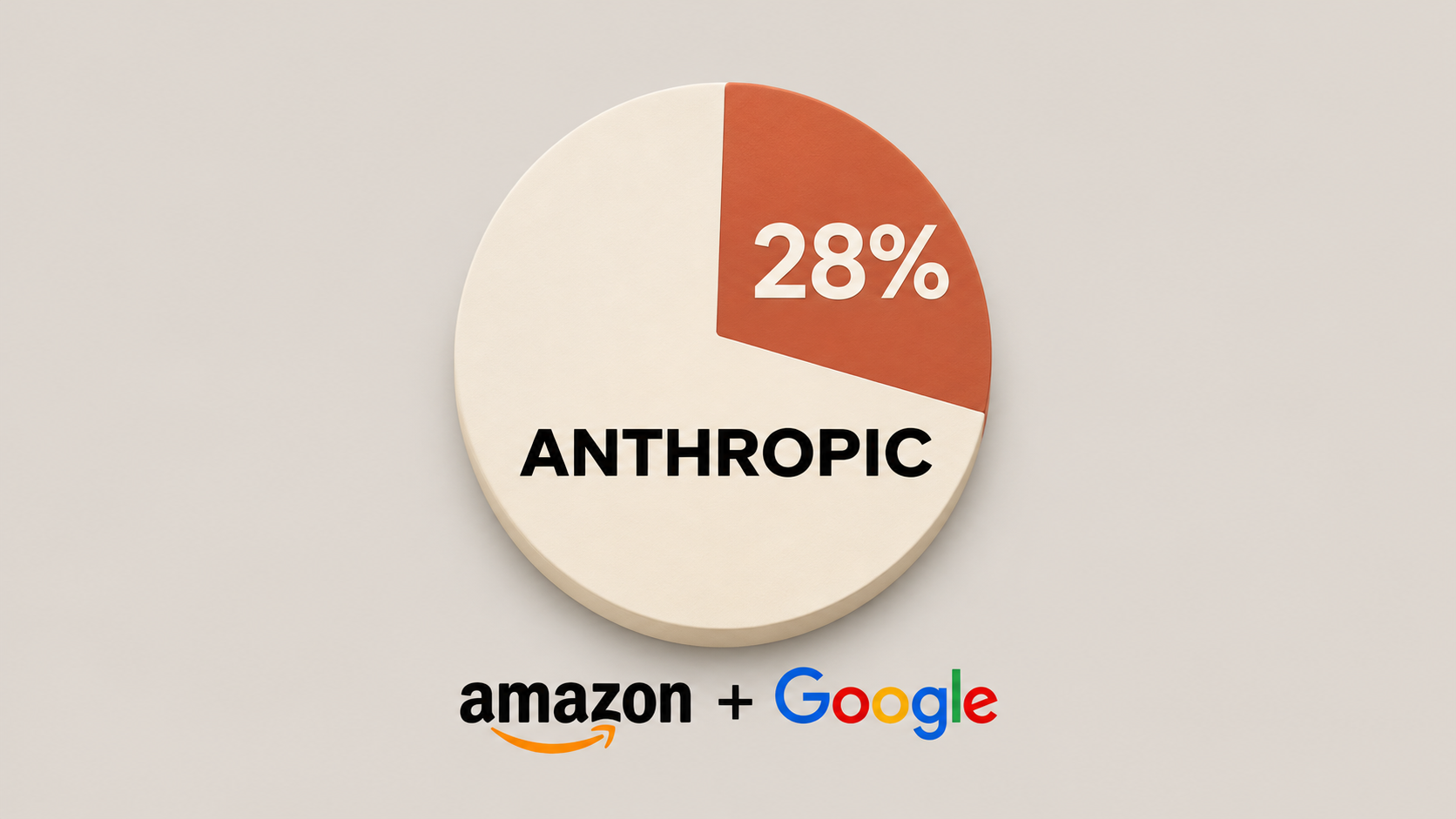
Who owns Anthropic after its IPO? According to the company's final prospectus, filed with the SEC on 19 November 2026, Amazon holds 14.6% of all Anthropic shares and Google LLC 13.4%, both in shares with no vote in ordinary matters. The seven co-founders own about 12.7% of the shares by our count and control the shareholder vote through a single Class F share that carries 50.1% of the voting power.
TL;DR
- Amazon and Google LLC together hold about 28% of Anthropic's 13.2 billion shares, worth about 308 billion USD at the 83 USD IPO price.
- The co-founders control a fixed 50.1% of the votes through one Class F share, and a Long-Term Benefit Trust elects the majority of the board.
- Two things can still change the table: the underwriters' option on 147 million shares and the conversion of Amazon's convertible notes.
Last updated: 20 November 2026
Every holding below comes from the prospectus unless marked as our calculation.
Follow US Stocks in RoboForex MobileTrader
Quotes, charts and orders in one app, on your phone or in Telegram.
Who Owns Anthropic After the IPO?
After the IPO and the private placement, Anthropic has about 13.2 billion shares across all its classes. In the private placement, Google LLC, Nvidia, AMD, Broadcom, Micron, Microsoft and TSMC bought 26.0 billion USD of Class N shares directly from Anthropic at the 83 USD IPO price, outside the public offering. Amazon and Google LLC appear in the prospectus summary, the co-founders in the table of principal and selling stockholders. The largest block belongs to other existing holders, whom the prospectus does not list one by one.
Amazon and Google LLC hold 28% of Anthropic and vote on almost nothing
Share of all shares, %, after the IPO and the private placement, 19 November 2026
All share classes13.2 billion shares
- Class N, no vote in ordinary matters
- Class A, one vote per share
- Class A and N
Other holders151.9%
Amazon14.6%
Google LLC13.4%
Seven co-founders212.7%
IPO buyers7.4%
- Other existing holders own 50.4%, the other private placement buyers 1.5%.
- Each co-founder holds about 237 million to 241 million Class A shares.
- Class N votes only where the law requires it. Amazon and Google LLC hold 66% of that class.
How it is calculated: each holder's shares divided by 13,219,642,276 shares outstanding, with no exercise of the underwriters' option. Every share outside the Amazon and Google LLC lines is our arithmetic.
Source: Anthropic final prospectus (SEC form 424B4). Data as of 19 November 2026.roboforex.com/blog
| Holder | Shares | Class | Value at 83 USD |
|---|---|---|---|
| Amazon (with affiliates) | 1,936,452,353 | N | 160.7 billion USD |
| Google LLC | 1,774,959,745 | N | 147.3 billion USD |
| Seven co-founders | 1,673,460,594 | A | 138.9 billion USD |
| IPO buyers | 980,000,000 | A | 81.3 billion USD |
| Other private placement buyers | 192,771,080 | N | 16.0 billion USD |
| Other existing holders | 6,661,998,504 | A and N | 552.9 billion USD |
Source: Anthropic final prospectus, 19 November 2026. Google LLC's line includes the 120,481,927 shares it buys in the private placement. The co-founder total counts beneficial ownership, which includes options and restricted stock units that vest within 60 days and leaves out the shares Dario Amodei votes by proxy, so the other holders line, the remainder, is slightly understated. The co-founder total, the last row and the values are our arithmetic. At the 19 November close of 97.17 USD reported by CNBC, every value is about 17% higher: Amazon's stake comes to about 188.2 billion USD.
Each co-founder holds between about 237 million and 241 million Class A shares after selling 3,378,378 shares in the IPO. At 83 USD each stake is worth about 19.7 billion to 20.0 billion USD. The holdings belong to Dario Amodei, Daniela Amodei, Tom Brown, Jack Clark, Jared Kaplan, Sam McCandlish and Christopher Olah, as listed in the prospectus.
Other Anthropic Investors
Besides Amazon and Google LLC, the prospectus names the companies that bought in the private placement. Nvidia took 120,481,927 Class N shares for about 10.0 billion USD, the same amount as Google LLC. AMD bought 30,120,481 shares for about 2.5 billion USD, Broadcom, Micron and Microsoft 12,048,192 shares each for about 1.0 billion USD, and TSMC Partners 6,024,096 shares for about 500 million USD. Directors and their affiliates expressed interest in buying up to 305 million USD of Class A shares in the IPO, without a commitment to do so. The other existing holders, about half of all shares, are not named one by one.
Who Controls the Votes
Anthropic separates owning shares from voting them. Class N makes up 42.6% of all shares and carries no vote in ordinary matters, while one Class F share carries more votes than all Class A shares together.
One Class F share outvotes all 7.6 billion Class A shares
Share of all shares and of shareholder votes by class, %, after the IPO, 19 November 2026
- Class A, traded on Nasdaq as ANT
- Class N, no vote in ordinary matters
- Class F, one share held by the co-founders
Shares
Class A 57.4%Class N 42.6%
Votes
Class A 49.9%Class F 50.1%1
- The Class F share has no economic rights. Its 50.1% elects every director except the Class T directors.
- Class T is one share held by the Long-Term Benefit Trust. It elects the Class T directors, a majority of the board.
How it is calculated: 7,583,103,996 Class A and 5,636,538,278 Class N shares out of 13,219,642,276, our arithmetic. The Class F and Class T shares are too small to show. The vote split is fixed, as set out in the prospectus.
Source: Anthropic final prospectus (SEC form 424B4). Data as of 19 November 2026.roboforex.com/blog
The prospectus describes four classes that matter for control:
- Class A, the shares that trade on Nasdaq under ANT, carry one vote each, but all of them together are capped at 49.9% of the voting power.
- Class F is a single share held by the Founder LLC, a company of the seven co-founders. It carries a fixed 50.1% of the votes on matters put to shareholders, including the election of all directors except the Class T directors, and has no economic rights.
- Class N, which includes the shares of Amazon, Google LLC and the private placement buyers, votes only where the law requires it.
- Class T is one share held by the Long-Term Benefit Trust. It elects and removes the Class T directors, who make up a majority of the board.
So the two largest shareholders have no say in ordinary votes. On top of the Class F share, each co-founder votes their own Class A shares, about 1.6% of the voting power each according to the prospectus, or about 11% for the seven together by our arithmetic. Control of the board is split: the Class F vote elects every director except the Class T directors, and the Long-Term Benefit Trust elects the Class T directors, who form the majority.
What Existing Shareholders Paid for Their Shares
The prospectus gives a direct measure. Shareholders from before the IPO, Amazon, Google LLC and the co-founders included, hold 11,950,037,913 shares, 90.4% of the total after the deal, for which they paid 11.49 USD a share on average. New investors paid 83 USD, about 7.2 times as much.
Fortune estimated that Amazon and Google LLC together have a paper gain of about 260 billion USD on about 51 billion USD invested. This article does not recalculate that figure.
Our post on Nvidia's earnings and the Anthropic IPO set out the Amazon and Google LLC stakes from the filing of 17 November, before the IPO grew from 825 million to 980 million shares. The final prospectus gives 14.6% and 13.4%.
What the Banks Earned From the Anthropic IPO
Underwriters are the banks that buy the shares from the company and resell them to investors, so they hold none after the IPO. For this IPO they kept 0.56122 USD per share, about 0.68% of the 83 USD price. On 980 million shares that comes to about 550.0 million USD: 536.7 million USD paid by Anthropic and 13.3 million USD by the selling co-founders. The banks earn nothing on the 26 billion USD private placement.
Goldman Sachs and Morgan Stanley placed 41% of the 980 million IPO shares
Share of the IPO shares allocated to each underwriter, %, top 10 of 22 banks
Underwriting fee550.0 million USD
- 1Goldman Sachs20.5%
- 1Morgan Stanley20.5%
- 3J.P. Morgan10.0%
- 3Citigroup10.0%
- 5Barclays7.0%
- 5Wells Fargo7.0%
- 7Bank of America3.0%
- 7Deutsche Bank3.0%
- 7RBC3.0%
- 7UBS3.0%
- The two lead banks each placed 200.9 million shares. The other 12 banks share the remaining 13.0%.
Fee if split by allocation, million USD
| Goldman Sachs, Morgan Stanley | 112.7 each |
| J.P. Morgan, Citigroup | 55.0 each |
| Barclays, Wells Fargo | 38.5 each |
| Each 3% bank | 16.5 |
How it is calculated: the fee is 0.56122 USD per share. Fees by bank are our arithmetic, 550.0 million USD times each bank's share of the 980 million shares.
Source: Anthropic final prospectus (SEC form 424B4). Data as of 19 November 2026.roboforex.com/blog
Fortune reported 113 million USD each for the two lead banks, in line with a split by allocation.
What Can Still Change the Ownership Table
Two mechanisms in the prospectus can move the percentages above.
The first is the underwriters' option, often called the greenshoe: the banks may buy up to 147 million more Class A shares at 83 USD within 30 days of the prospectus date. Exercised in full, it would raise the total to 13,366,642,276 shares and bring Amazon's share from 14.6% to about 14.5%.
The second is Amazon's convertible notes, loans that can turn into shares. Converted in full without the cap on how large a stake Amazon can reach by converting, they would give Amazon 3,484,128,662 Class N shares, or 23.6% of all shares. Amazon has chosen to keep the cap. Whatever cannot convert because of it converts into Class N shares at the end of each fiscal quarter, within the cap, and anything still left at maturity is repaid in cash.
Lock-up agreements, which bar existing shareholders from selling for a set period, decide when the large blocks in the last row of the table can reach the market. Our article on the Anthropic IPO lockup lists the release dates.
How to Follow Anthropic’s Shareholders
Changes to these stakes become public in SEC filings: the underwriters' option closes within 30 days of the prospectus date, and Amazon's quarterly conversions follow Anthropic's fiscal quarters. Our Anthropic IPO guide covers the business behind the shares, and the largest IPOs in history put the offering in context. You can follow US stocks on StocksTrader and on the RoboForex stock charts.
Conclusion
Amazon and Google LLC own the largest named stakes in Anthropic and vote on almost nothing. The co-founders own a little less and hold the deciding vote, while the Long-Term Benefit Trust picks most of the board. The next change to the table can come from the underwriters' option on 147 million shares, open for 30 days from the prospectus date.
FAQ
Who owns Anthropic?
After the 19 November 2026 IPO, Amazon holds 14.6% of all Anthropic shares and Google LLC 13.4%, according to the final prospectus. The seven co-founders hold about 12.7% by our count and IPO buyers about 7.4%. Other existing holders own 50.4% and the other private placement buyers 1.5%.
Does Amazon own Anthropic?
Amazon owns part of it: 1,936,452,353 Class N shares, 14.6% of all shares, worth about 160.7 billion USD at the 83 USD IPO price. Class N shares carry no vote in ordinary matters, so Amazon does not control the company.
Who controls Anthropic?
Control is split. The seven co-founders hold 50.1% of the shareholder votes through one Class F share held by their Founder LLC, which elects every director except the Class T directors. The Long-Term Benefit Trust elects the Class T directors, who make up a majority of the board.
Can you buy Anthropic shares?
Yes. Anthropic's Class A shares have traded on Nasdaq under the ticker ANT since 19 November 2026. Each carries one vote, but all Class A shares together are capped at 49.9% of the voting power. IPO buyers hold about 7.4% of all shares.
How much did banks earn from the Anthropic IPO?
The underwriters kept 0.56122 USD per share, about 550 million USD on 980 million shares. Goldman Sachs and Morgan Stanley each took 20.5% of the shares. If the fee is split in line with the allocation, each earns about 113 million USD, the figure Fortune also reported.
- Anthropic IPO: the business, the financials and the valuation behind the listing.
- Anthropic IPO Lockup: when existing shareholders can start selling.
- Largest IPO in History: how the Anthropic offering compares with earlier records.
Any forecasts contained herein are based on the author's independent analysis and reflect their personal opinion. These articles should not be construed as trading recommendations or a call to action. The authors and RoboForex accept no responsibility for the results of any trades made on the basis of these recommendations and reviews. Past performance is not indicative of future results. Trading stocks and CFDs involves a high risk of capital loss.