Why Is the Dow Down? UnitedHealth, AI Stocks and 5% Yields Take It Below 50,000
Why is the Dow down? The Dow Jones Industrial Average closed at 49,097 on Thursday, 19 November, after a fall of 1,101 points, or 2.2%. It was the index's first close below 50,000 since 10 June and the end of a four-day slide that took 3,250 points, or 6.2%, off the Dow since 13 November. Three members, UnitedHealth, Goldman Sachs and Caterpillar, account for 1,241 of those points, because the Dow weights its stocks by share price.
TL;DR
- The Dow lost 6.2% from 13 to 19 November, more than the S&P 500's 5.1%. The 19 November session alone took 1,101 points, about a third of the total.
- UnitedHealth took 458 points off the Dow in the week, more than any other member, after a proposed Medicare audit rule. Nvidia fell further in percentage terms and took only 100 points.
- The Dow is 9.7% below its record close of 54,349. A close below about 48,914 would mark a 10% correction. The Fed meets on 8-9 December with a 0.25 point hike fully priced.
Last updated: 20 November 2026. Market figures run to the 19 November close.
Why Is the Dow Down Today?
The fall came in four sessions, and each one had a different leader. The table uses closing prices. The points each stock took off the Dow are our calculation from those closes and the Dow divisor, explained in the next section.
| Date | Dow | S&P 500 | Dow members down | Largest Dow drags, points | What stood out |
|---|---|---|---|---|---|
| 16 November | -739 (-1.4%) | -1.9% | 22 of 30 | Caterpillar -177, Goldman Sachs -149 | Technology led the fall: Nasdaq -2.5%, Nvidia -4.1% |
| 17 November | -849 (-1.6%) | -1.0% | 25 of 30 | UnitedHealth -133, Salesforce -121 | UnitedHealth -5.4% the day after a proposed Medicare audit rule |
| 18 November | -561 (-1.1%) | -0.2% | 20 of 30 | UnitedHealth -236, Amgen -83 | UnitedHealth -10.2%; the Nasdaq rose 0.4% |
| 19 November | -1,101 (-2.2%) | -2.0% | 29 of 30 | Goldman Sachs -152, Caterpillar -127, UnitedHealth -115 | AMD short report and Anthropic's debut; an early gain turned into a broad sell-off |
Two sessions explain most of what makes this week different. On 18 November the Dow lost 1.1% while the S&P 500 slipped 0.2% and the Nasdaq rose. That gap came from one stock: UnitedHealth fell 10.2% and took 236 of the Dow's 561 points, 42% of the day's fall. FXStreet put its share at about two fifths the same evening.
On 19 November the selling reached almost everything. Twenty-nine of the 30 Dow members fell, and the session turned during the day: the S&P 500 traded 1.3% above its previous close at its high and finished 2.0% lower. The VIX, a gauge of expected swings in the S&P 500, closed near 28.4, up from 19.3 a week earlier.
Follow Stock Indices in RoboForex MobileTrader
Quotes, charts and orders in one app, on your phone or in Telegram.
How Many Points Did UnitedHealth Take Off the Dow?
The Dow adds up the share prices of its 30 members and divides the total by a number called the Dow divisor. That makes it a price-weighted index: a 1 USD move in a 900 USD stock and a 1 USD move in a 100 USD stock shift the Dow by the same number of points, whatever the size of the two companies. The S&P 500 weights companies by market value instead.
The divisor in use since Alphabet joined the index on 29 June is 0.16825. We checked it against market data: the 30 closing prices on 19 November add up to 8,260.49 USD, and 8,260.49 divided by 0.16825 gives the Dow's close of 49,097. So every 1 USD move in any member is worth about 5.94 Dow points.
UnitedHealth closed at 407.46 USD on 13 November and at 330.48 USD on 19 November, a fall of 76.98 USD, or 18.9%. At 5.94 points per dollar, that took 458 points off the Dow, 14% of its weekly loss and more than any other member.
Who took the Dow's 3,250 points, 13-19 November
UnitedHealth330 USD, -18.9%
-458
Goldman Sachs848 USD, -7.5%
-410
Caterpillar537 USD, -10.5%
-373
Salesforce183 USD, -15.9%
-205
Amgen439 USD, -5.8%
-160
Nvidia146 USD, -10.4%
-100
Dow points, 13 November close to 19 November close. The other 22 members took about 1,240 points together. Our calculation: change in share price in USD divided by the Dow divisor, 0.16825. Closing prices: Yahoo Finance.
The chart shows the other side of price weighting. Nvidia lost 10.4% over the same days, more than Goldman Sachs' 7.5%, yet it took 100 points off the Dow against Goldman's 410, because one Nvidia share costs about 146 USD and one Goldman share about 848 USD. In the S&P 500, Nvidia is one of the largest weights. In the Dow, its low share price keeps its weight small, and the most expensive members carry the moves.
UnitedHealth has done this before. On 27 January 2026 a 69 USD fall in the stock took 422 points off the Dow, which closed 409 points lower that day, according to Investopedia via Yahoo Finance.
Why UnitedHealth Fell
On 16 November the Centers for Medicare & Medicaid Services (CMS) published a proposed rule it calls CRUSH. One part changes how CMS audits Medicare Advantage, the private Medicare plans that insurers such as UnitedHealth run. CMS would apply audit findings from a sample of patient records to the whole plan, starting with payment year 2018, and estimates this would recover about 9 billion USD of overpayments per payment year, according to its fact sheet. UnitedHealth fell 5.4% on 17 November and 10.2% on 18 November. The rule is still a proposal, open for public comment.
The AI Part of the Sell-Off
AI stocks had been under pressure since Nvidia announced on 12 November that Jensen Huang had resigned as chief executive and director, with chief financial officer Colette Kress as interim CEO, according to the company's press release. Nvidia shares closed 4.3% lower that day. Quarterly results on 17 November beat estimates, MarketWatch reported, and the stock still kept falling, to 145.98 USD on 19 November. Our article on why Nvidia stock is down covers the CEO change in detail, and the three scenarios for Nvidia's next CEO set out what each outcome could mean for the stock.
On 19 November short seller Hunterbrook Capital published a report alleging that AMD kept supplying firmware to IEIT Systems, a Chinese server maker on a US blacklist, and noted that customers in China and Hong Kong bring in over 20% of AMD's revenue, CNBC reported. A short seller profits when a share price falls. AMD said the claims "misrepresent AMD's business practices and relationships". The stock traded as much as 4.7% higher during the session and closed 7.7% lower.
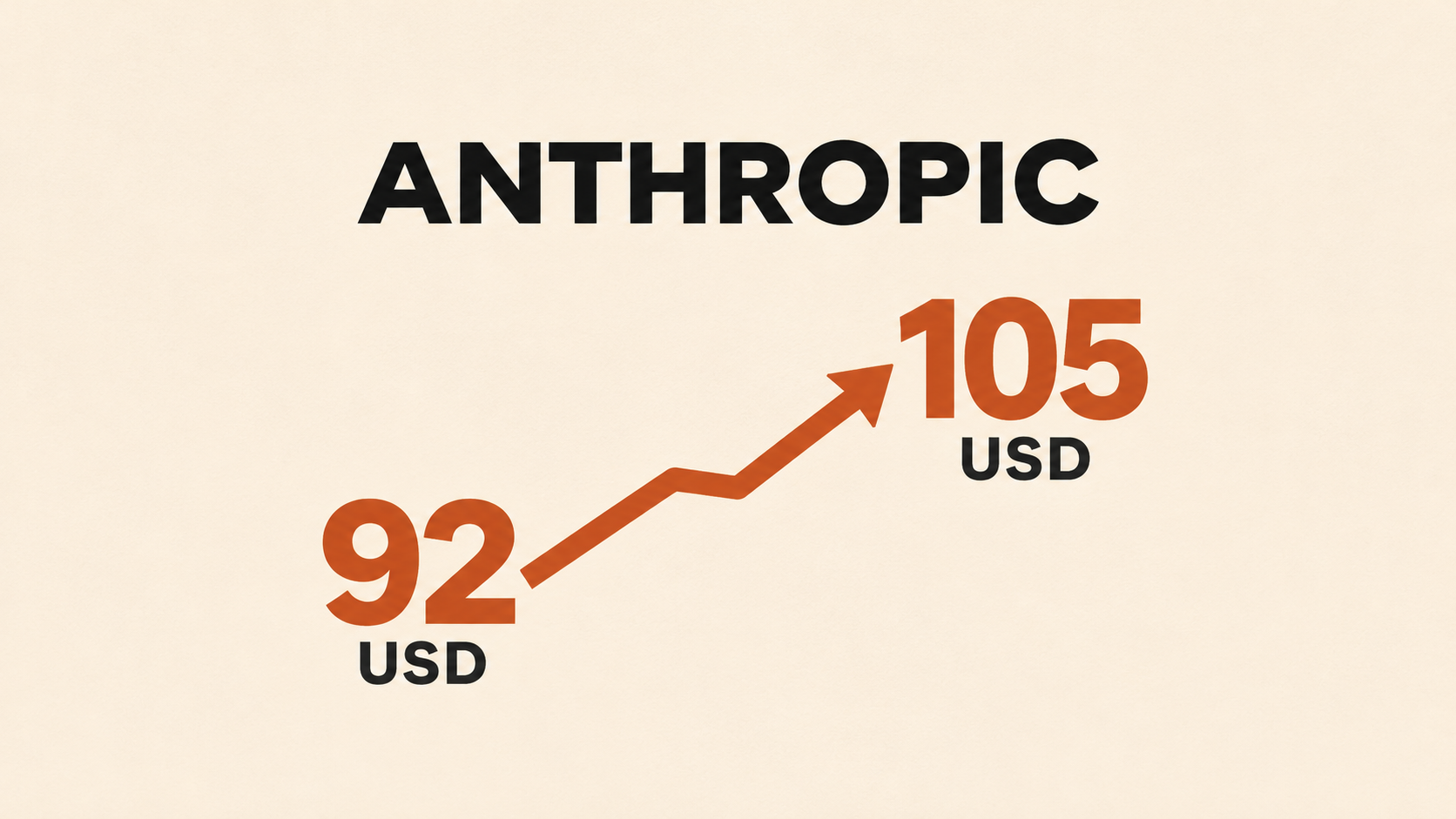
The same day Anthropic began trading on Nasdaq under the ticker ANT. The shares were priced at 83 USD, opened at 111.50 USD and closed at 97.17 USD, 17% above the offer price, according to CNBC. Yahoo Finance and FXStreet reported that some retail investors sold Nvidia and AMD to buy the new shares. Our report on Anthropic's Nasdaq debut has the pricing details, and the Anthropic IPO guide covers the offering as a whole.
The AI selling spread to Asia the next morning. South Korea's Kospi, where chipmakers carry large weights, fell 5.21% on 20 November, The Korea Times reported.
The Rate Part of the Sell-Off
Bond yields set the background for the week. The 10-year US Treasury yield first closed above 5% on 16 September and has mostly stayed above that level since. It ended 19 November at 5.04%, according to US Treasury data. High yields make future company profits worth less today and give investors a bond return that competes with stocks. Our article on why Treasury yields are rising explains what pushed them there.
Yields eased during the sell-off itself: the 10-year fell from 5.12% on 16 November to 5.04%, and the 2-year from 4.83% to 4.76%. So the daily losses in stocks this week did not follow a jump in yields. The pressure comes from the level of rates and from what the Fed signals next.
The Federal Reserve raised its target range to 3.75-4.00% in September and held it in October, when two voters wanted another 0.25 point increase. The minutes of that meeting, published on 18 November, say almost all officials judged that a further increase would likely be appropriate, and a couple said a move larger than 0.25 points could be considered in December if inflation data disappoint. Chicago Fed President Austan Goolsbee said on 13 November that the Fed "has definitely got work to do" on inflation, CNBC reported. According to FXStreet, traders fully price a 0.25 point hike at the meeting on 8-9 December.
How Big Is This Fall?
A 1,000-point day sounds larger than it is. With the Dow near 50,000, 1,000 points is about 2%. In 2022, with the index near 33,000, the same number of points meant a fall of 3% or more. By our count from closing data, the Dow has fallen 1,000 points or more on 12 days since November 2021, three of them in 2026: 29 July, 5 November and 19 November.
CNBC studied the nine such drops in the five years before 29 July. The median Dow move was a loss of 1.14% a week later, a gain of nearly 2% a month later and a gain of 9.1% three months later. These are medians of past cases and say nothing certain about this one.
The VIX gives another scale. A reading of 28.4 implies daily moves of about 1.8% in the S&P 500 (28.4 divided by the square root of 252 trading days, our arithmetic), so a 2% day sits within the range options traders were already pricing.
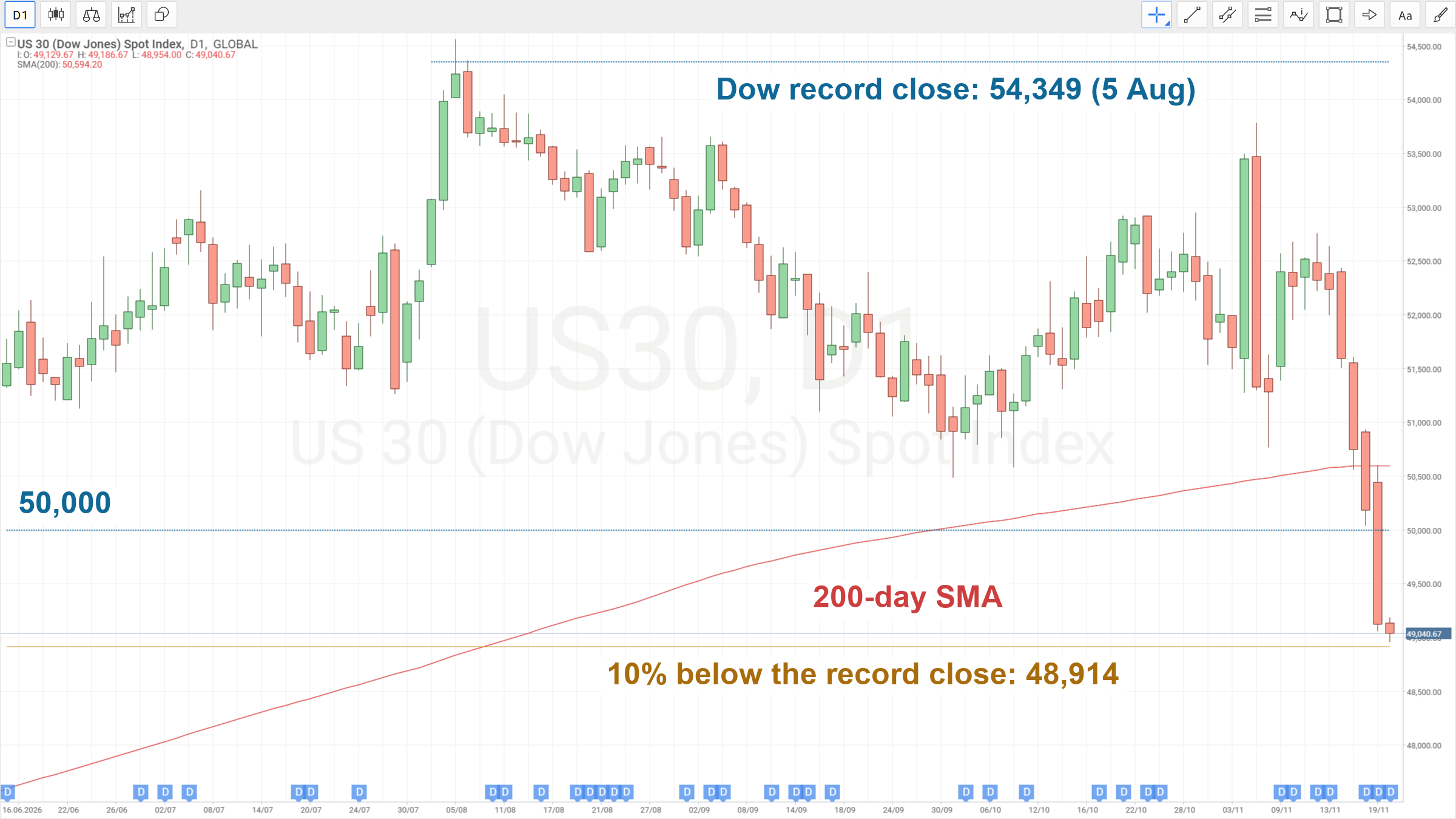
The Dow is close to a correction, the usual name for a 10% fall from a closing peak. Its record close is 54,349, set on 5 August, and the 19 November close left it 9.7% below that. A close below about 48,914 would cross the 10% line. Some reports measure from the intraday high of 54,744, and on that basis the fall already reached 10.3%.
Levels and Dates to Watch
The chart shows the US 30 contract, which tracks the Dow, over the last five months. The 19 November close was the Dow's lowest since 4 May, and the index finished below its 200-day average, the average of the last 200 daily closes.
| Level or date | What it is | What it would show |
|---|---|---|
| Dow 50,000 | Round number; 19 November was the first close below it since 10 June | A close back above it would undo the 19 November break |
| Dow 48,914 | 10% below the record close of 54,349 | A close below it puts the Dow in a correction by the usual definition |
| Dow 50,780 | 200-day simple moving average, the average of the last 200 daily closes (our calculation) | The Dow closed 3.3% below it; a return above it would point to the long-term trend holding |
| S&P 500 7,348 | 200-day simple moving average (our calculation) | The S&P 500 closed 2.3% below it, so the weakness reaches beyond the Dow |
| 8-9 December | Fed meeting with new economic projections (Federal Reserve calendar) | A 0.25 point hike is priced; the projections show how many more officials expect |
Two checks help read the next sessions. If the Dow keeps falling faster than the S&P 500, look at its most expensive members first: Goldman Sachs, Caterpillar, Microsoft, Amgen and Visa all trade above 400 USD and move the Dow most. If both indices fall by similar amounts, as on 19 November, the selling is market-wide, and rate and AI news are the likelier drivers.
You can follow the S&P 500 on the US 500 live chart and see the full list of stock indices available at RoboForex. Our guide to index trading explains how index CFDs work and how they differ from buying shares.
Conclusion
The Dow's 3,250-point week had three layers. A proposed Medicare audit rule hit UnitedHealth, and price weighting made that one stock count for more in the Dow than in the S&P 500. AI stocks reversed after the AMD report and Anthropic's debut, and on 19 November the selling spread to 29 of 30 members. Treasury yields above 5% and a December Fed hike set the background. The next fixed date is the Fed decision on 9 December.
FAQ
Why is the Dow down today?
On 19 November 2026 the Dow fell 1,101 points, or 2.2%, to 49,097, its first close below 50,000 since June. AI stocks reversed after a short seller's report on AMD and Anthropic's market debut, and 29 of the 30 Dow members fell. Over the week the Dow lost 6.2%, with UnitedHealth taking the most points.
Is the Dow in a correction?
Not yet by the usual closing definition. The 19 November close of 49,097 is 9.7% below the record close of 54,349 set on 5 August. A close below about 48,914 would mark a 10% fall. Measured from the intraday high of 54,744, the fall has already reached 10.3%.
How many points did UnitedHealth take off the Dow?
About 458 points from 13 to 19 November, by our calculation from closing prices. The stock fell 76.98 USD, and each 1 USD move in a Dow member is worth about 5.94 points. On 18 November alone it took 236 of the Dow's 561 points.
What is a price-weighted index?
An index that adds up its members' share prices and divides the total by a fixed number, the divisor. The Dow works this way, so a high-priced stock moves it more than a cheaper one. In the week to 19 November, Nvidia fell 10.4% and took 100 Dow points, while Goldman Sachs fell 7.5% and took 410.
When is the next Fed meeting?
The Federal Reserve meets on 8-9 December 2026 and publishes new economic projections. According to FXStreet, traders fully price a 0.25 percentage point increase from the current 3.75-4.00% range.
- Why Is Nvidia Stock Down?: the CEO change and how to split a stock's fall into a company part and a sector part.
- Nvidia Earnings Reaction: Strong Report Calms Investors: the 17 November results and the first market reaction.
- What Is a Trading Index and How to Trade It: how stock indices are built and traded.
- Bitcoin ETF Flows Into the Fed Meeting on 8-9 December: the same Fed date seen from the crypto market.
Any forecasts contained herein are based on the author's independent analysis and reflect their personal opinion. These articles should not be construed as trading recommendations or a call to action. The authors and RoboForex accept no responsibility for the results of any trades made on the basis of these recommendations and reviews. Past performance is not indicative of future results. Trading stocks and CFDs involves a high risk of capital loss.