Market Week Ahead (August 24 – 28): Core PCE Set to Test Fed Rate Expectations

The dollar's direction this week comes down to one release. Core PCE, the inflation gauge the Fed watches most closely, arrives on Wednesday alongside the second estimate of Q2 GDP. Economists expect the monthly figure to accelerate to 0.3% after June's reading of just 0.1%, and that gap is what markets will trade.
Three more events fill out the calendar: the Reserve Bank of Australia's meeting minutes on Tuesday, Canadian GDP on Friday, and Japanese consumer confidence alongside the preliminary annual revision to US Non-Farm Payrolls, also on Friday. Below we work through each release with the technical levels and market sentiment that matter for EUR/USD, AUD/USD, USD/CAD and USD/JPY.
In Brief
- RBA Meeting Minutes (Tuesday, August 25): first look at how policymakers weigh the case for holding the cash rate at 4.35%.
- Core PCE and US GDP, Second Estimate (Wednesday, August 26): the Fed's preferred inflation gauge, the week's defining release for the dollar.
- Canada GDP, Q2 (Friday, August 28): growth data that will shape expectations for the Bank of Canada.
- Japan Consumer Confidence and US NFP Annual Revision (Friday, August 28): a household sentiment read from Japan alongside a preliminary look at how much the past year of US job creation may be revised.
Where the Market Stands Going Into the Week
Last week reset how markets price the path of US interest rates. Fed meeting minutes and a run of comments from regulators left traders weighing how persistent inflation pressure really is, and the dollar came under pressure across the board. That matters for Wednesday: because so much dollar weakness is already in the price, sensitivity to an upside surprise in Core PCE is elevated, and a reading at or above 0.3% would force participants to price in a longer period of tight policy again.
Friday's preliminary annual revision to Non-Farm Payrolls adds a second layer to the same question. Every August, the Bureau of Labor Statistics previews how it plans to adjust a full year of payroll data once more complete tax records arrive, and last year's preview pointed to a downward revision of 911,000 jobs, the largest in over a decade. A repeat anywhere near that scale would support the view that the labour market has been cooling for longer than the monthly headlines suggested, strengthening the case for further Fed cuts later this year.
Currency positioning going into the week raises the bar for every release. EUR/USD and AUD/USD both pushed to fresh local highs in August, USD/CAD has slipped to its lowest level since late July, and USD/JPY consolidates near 159.00 after failing to reclaim 160.00. Each of these pairs enters the week with a directional view already built into the price, so the data has to confirm that view rather than simply avoid contradicting it. A neutral RBA tone on Tuesday or a merely adequate Canadian GDP print on Friday could be enough to trigger profit-taking.
Key Events of the Week
| Date | Event | Instruments | Importance |
|---|---|---|---|
| Tue, Aug 25 | RBA Meeting Minutes | AUD/USD, Australian bonds, ASX 200 | ●● Medium |
| Wed, Aug 26 | US Core PCE + GDP, Second Estimate | EUR/USD, USD Index, US Treasuries | ●●● High |
| Fri, Aug 28 | Canada GDP, Q2 | USD/CAD, Canadian bonds, TSX | ●● Medium |
| Fri, Aug 28 | Japan Consumer Confidence + US NFP Annual Revision | USD/JPY, USD Index, S&P 500 | ●● Medium |
Instant Access to Global Markets with RoboForex MobileTrader
25
Aug
Why It Matters
The minutes from the Reserve Bank of Australia's latest meeting will show how policymakers weigh inflation risk and the outlook for policy from here. What matters most is the reasoning behind holding the cash rate at 4.35% and how long the RBA expects tight financial conditions to remain in place. AUD/USD heads into the release at fresh local highs, so the tone of the document could either extend the rally or trigger profit-taking after a strong August.
Market Reaction
A firm tone that keeps the focus on inflation risk would support the Australian dollar. A softer assessment of growth and prices would widen the odds of an eventual shift toward easier policy and trigger a correction in AUD/USD.
Market Sentiment
Sentiment on the Australian dollar remains firmly bullish. The currency is riding a strong upward impulse, and the market currently sees little reason for the RBA to move toward easier policy any time soon. Much of that view is already reflected in price, however, with AUD/USD sitting at new local highs. A clear reaffirmation of the RBA's firm stance would be needed to extend the advance, while a neutral tone in the minutes may not be enough to keep buyers in control. On the chart, AUD/USD trades near 0.7170 after a strong upward move and is testing the upper Bollinger Band. MACD continues to build a positive impulse, but the stochastic sits deep in overbought territory, raising the odds of a short-term pullback.
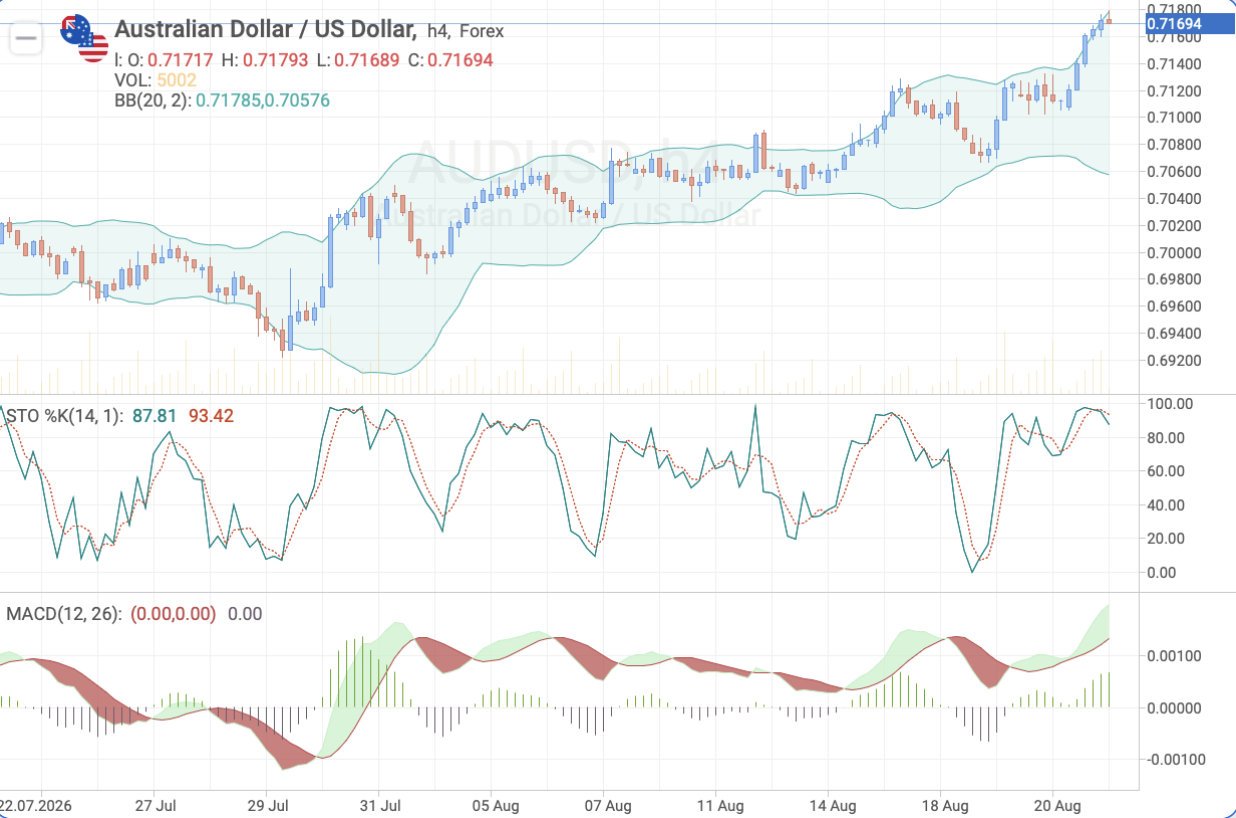
Key Levels — AUD/USD
| Level | Value |
|---|---|
| Resistance | 0.7180 / 0.7200 |
| Support | 0.7120 / 0.7060 |
| Target | 0.7200 |
26
Aug
Core PCE Forecast (m/m)
+0.3%
Previous
+0.1%
GDP Q2, Second Estimate
+1.5%
Previous Estimate
+2.1%
Why It Matters
Core PCE is the inflation gauge the Fed watches most closely, which makes Wednesday's release the single most important data point of the week. Economists expect the monthly figure to accelerate to 0.3% after June's reading of just 0.1%, a pickup that would confirm the path back to the Fed's 2% target remains uneven. The second estimate of Q2 GDP lands alongside it. A downward revision from the prior 2.1% estimate to around 1.5% adds an important layer of context: the Fed has to weigh persistent inflation risk against an economy growing at a more moderate pace than first thought.
Market Reaction
A Core PCE reading above forecast would add to the case for keeping rates elevated for longer and support the dollar. A softer inflation print, especially paired with a downward GDP revision, would widen expectations for Fed easing and support EUR/USD.
Market Sentiment
Sentiment heads into Core PCE after a sizeable dollar decline, leaving markets especially sensitive to an upside surprise. If underlying inflation does accelerate to 0.3% m/m, participants will need to price in a longer period of tight Fed policy once again. A soft PCE print would instead confirm the current scenario of gradual disinflation and let dollar sellers keep the initiative. EUR/USD corrected to 1.1676 after a strong move above 1.1700. The broader uptrend remains intact, though MACD has started turning lower and the stochastic has left overbought territory, signalling some loss of short-term momentum. A move back above 1.1700 opens the way toward 1.1740, while a strong Core PCE print would send the pair toward 1.1640.
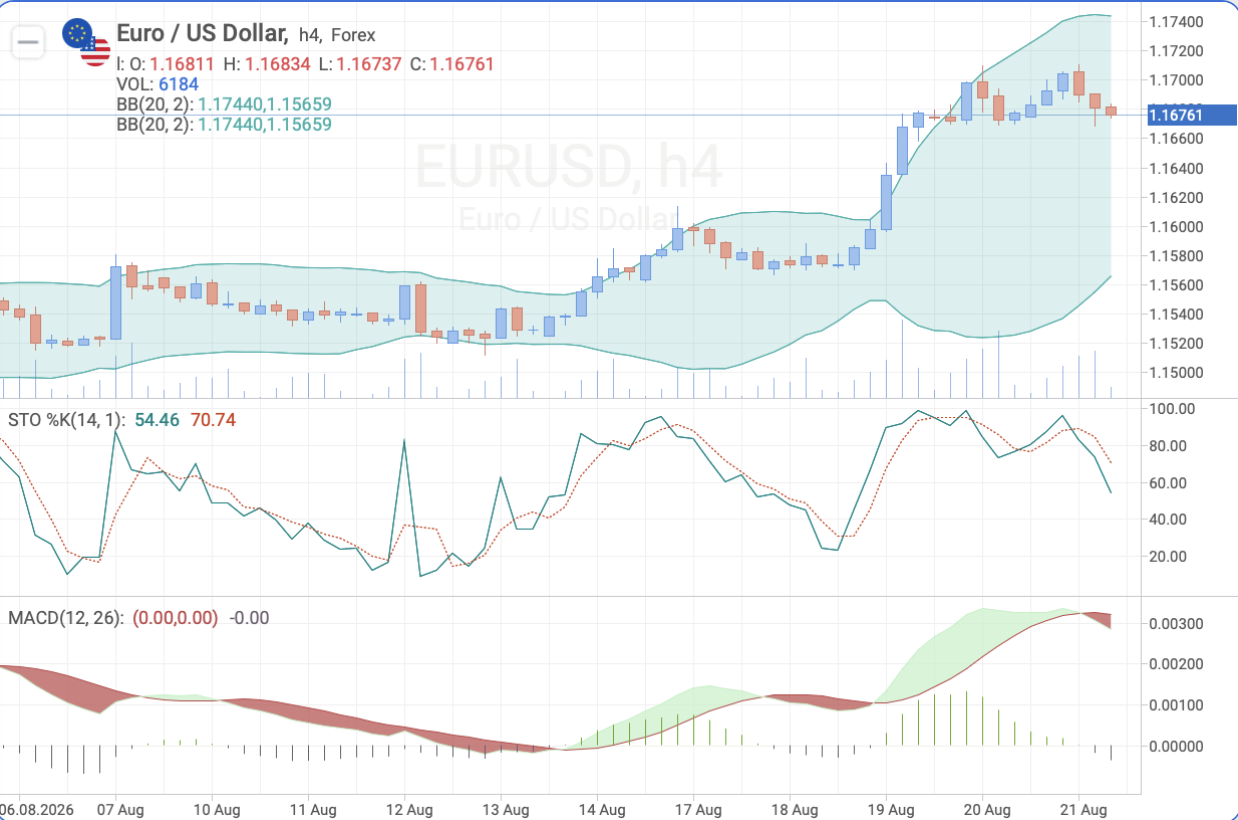
Key Levels — EUR/USD
| Level | Value |
|---|---|
| Resistance | 1.1700 / 1.1740 |
| Support | 1.1640 / 1.1570 |
| Target | 1.1740 |
28
Aug
GDP Forecast (annualized)
+2.5%
Previous
-0.1%
Quarterly Forecast (q/q)
+0.6%
Previous
0.0%
Why It Matters
Friday's release shows how convincingly the Canadian economy rebounded in the second quarter after stagnating in Q1. A quarterly gain of 0.6% would mark a meaningful improvement and ease the pressure on the Bank of Canada to cut rates further. The data carries extra weight for the Canadian dollar after a strong run in recent weeks: USD/CAD has slipped to its lowest level since late July, so the numbers need to confirm the fundamental case for further CAD strength.
Market Reaction
GDP above forecast would support the Canadian dollar and open the way for USD/CAD to extend its decline. A weak result would raise doubts about how durable the recovery really is and trigger a corrective bounce in the pair.
Market Sentiment
The Canadian dollar heads into the release with a clear advantage already built up, so a good result is partly priced in. Extending the move lower in USD/CAD will require confirmation of a genuinely strong recovery, not simply a return to positive growth. A significant miss against forecast, meanwhile, would give the market a reason to take profit on CAD strength after its extended run. USD/CAD holds a well-defined downtrend and trades near 1.3767 after testing the 1.3750 area. MACD remains negative, though the bearish impulse is starting to fade, and the stochastic is recovering from oversold territory. A break of 1.3750 would confirm the move toward 1.3700, while a return above 1.3800 would open room for a correction toward 1.3850.
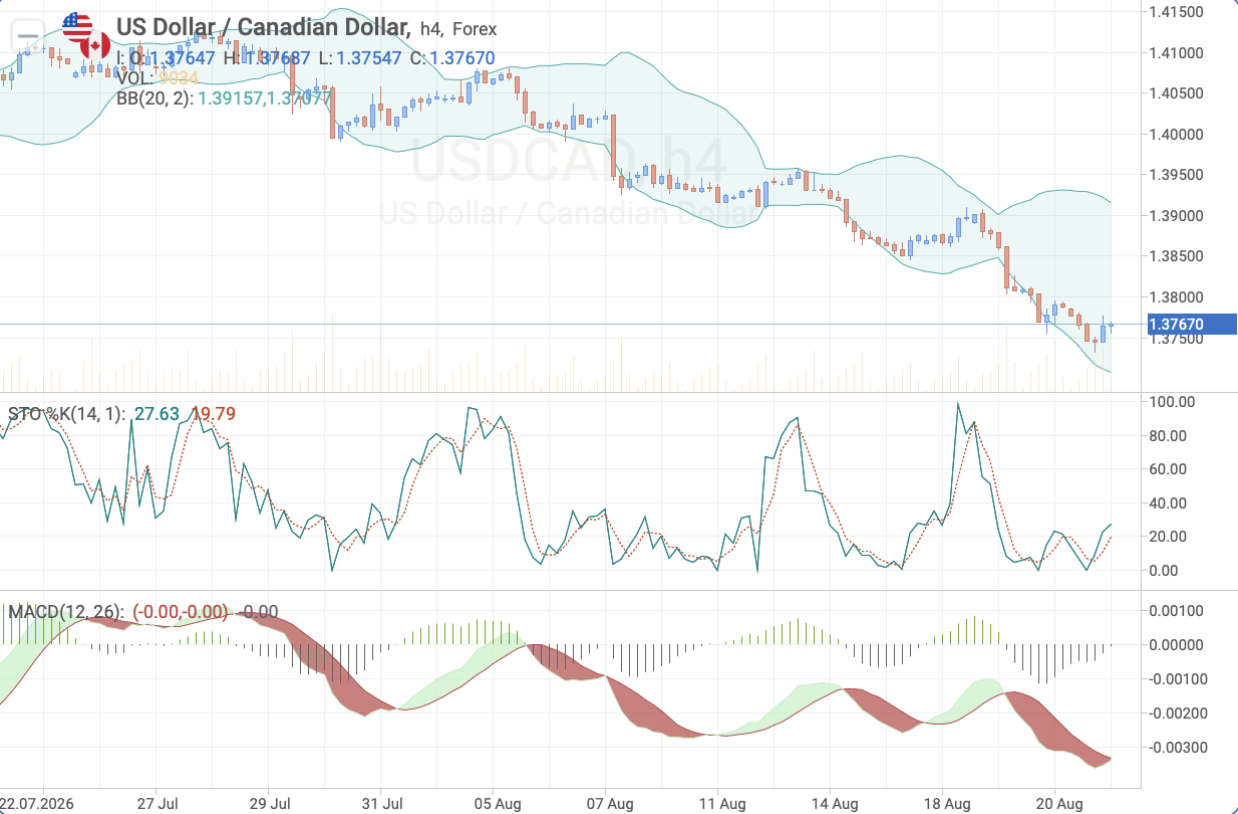
Key Levels — USD/CAD
| Level | Value |
|---|---|
| Resistance | 1.3800 / 1.3850 |
| Support | 1.3750 / 1.3700 |
| Target | 1.3700 |
28
Aug
Japan Consumer Confidence, Forecast
35.0
Previous
34.9
US NFP Annual Revision, Consensus
Not published
Last Year's Preliminary Revision
-911,000
Why It Matters
The Consumer Confidence index shows how Japanese households view the economic outlook against a backdrop of inflation and shifting financial conditions. It is a useful read on domestic demand, one of the factors the Bank of Japan weighs in deciding how quickly to move ahead with policy normalisation. The release lands at an interesting point for the yen: after a sharp rally earlier in August, USD/JPY has partly recovered but remains below 160.00. A strong confidence reading would add to the case for resilient domestic demand and support the yen, while a softer number would ease pressure on the Bank of Japan to tighten further. The same day brings the US preliminary annual NFP revision, a separate release that could add its own volatility to dollar pairs, including USD/JPY, if the scale of the correction rivals last year's minus 911,000.
Market Reaction
A confidence reading well above 35.0 would support the yen and add renewed pressure on USD/JPY. A weak print would widen doubts about the durability of domestic demand and support the pair. A large downward NFP revision on the same day would add its own dollar-negative pressure across the board.
Market Sentiment
USD/JPY has moved into consolidation near 159.00 after a sharp decline, and the market has yet to settle on the next directional move. A sustained yen recovery needs fresh domestic arguments for further Bank of Japan normalisation, so a strong confidence print would work in its favour, though the reaction may be limited given that Fed rate expectations remain the pair's dominant external driver. On the chart, USD/JPY is consolidating near 159.00 after recovering from the 158.00 area. MACD is gradually improving, while the stochastic has climbed above 80, pointing to both a recovering impulse and the risk of near-term overbought conditions. A move back below 158.50 opens the way toward 158.00, while a close above 159.70 to 160.00 would strengthen the case for buyers.
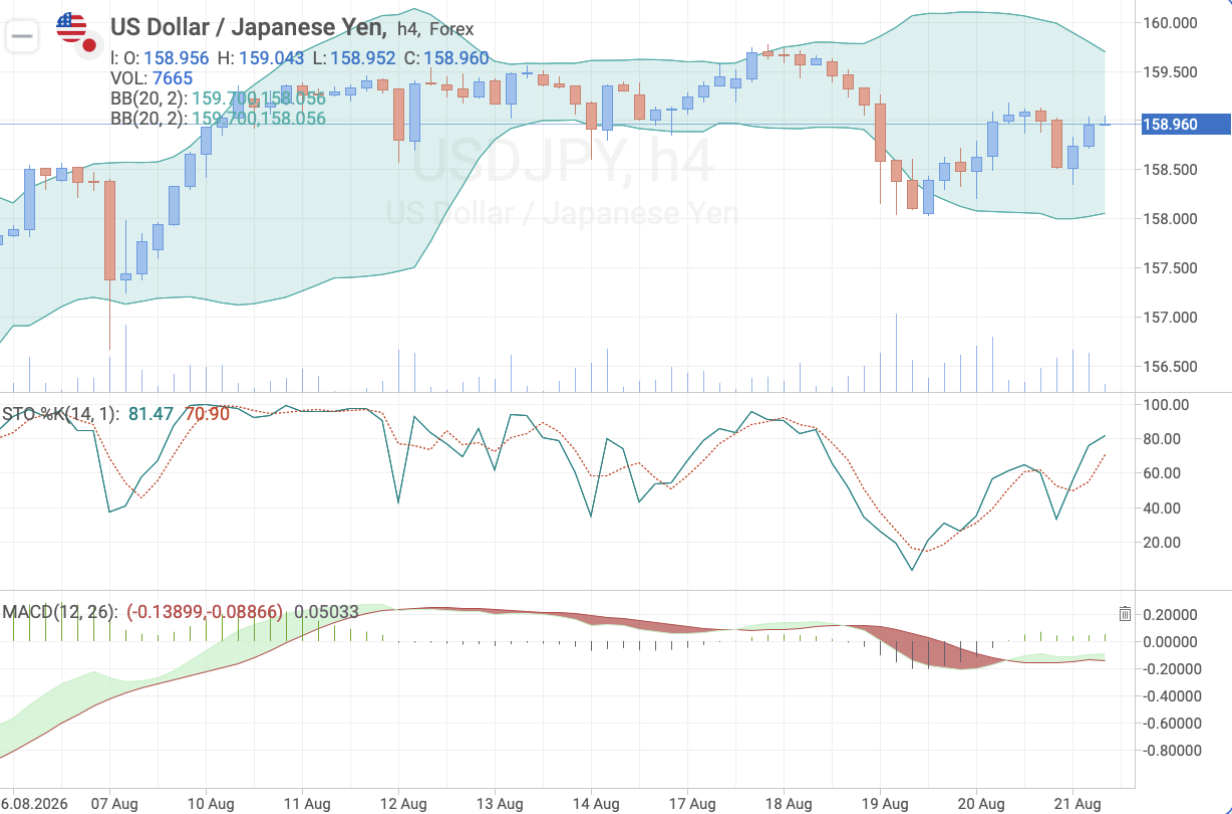
Key Levels — USD/JPY
| Level | Value |
|---|---|
| Resistance | 159.70 / 160.00 |
| Support | 158.50 / 158.00 |
| Target | 158.00 |
Track the forecast and the actual figures for each release, since the gap between consensus and the outcome is what tends to move prices the most. Learn more about how to read the economic calendar and trade the news.
Conclusion
The week's centre of gravity sits on Wednesday, when Core PCE and the second GDP estimate arrive together and set the tone for Fed rate expectations into the final week of August. Tuesday's RBA minutes and Friday's Canadian GDP add two more directional catalysts, while Friday also brings Japanese consumer sentiment alongside a preliminary look at how much the past year of US job creation may be revised.
If Core PCE surprises to the upside, the dollar has room to reclaim some of last week's losses across the board. A soft inflation print, paired with a sizeable downward NFP revision on Friday, would instead reinforce the case for further Fed easing and give EUR/USD, AUD/USD and the broader risk complex room to extend their August advance.
Any information provided in articles on this website is based solely on the personal opinions of the authors. These articles should not be construed as trading recommendations or a call to action. The authors and RoboForex accept no responsibility for the results of any trades made on the basis of these recommendations and reviews. Past performance is not indicative of future results. Trading stocks and CFDs involves a high risk of capital loss.