Is Nvidia a Good Stock to Buy After Huang's Return? An NVDA Trade Idea Above 170 USD
Nvidia (NASDAQ: NVDA) lost 47.5% between 6 October and 20 November 2026, as its closing price fell from 239.24 to 125.53 USD. The November part of the fall came with the scandal around Jensen Huang, and when Nvidia reinstated him as CEO on 23 November the shares rose 31%. Is Nvidia a good stock to buy after that rebound? Only on confirmation: Huang's return settles the leadership question for now, while the SEC probe, the Justice Department inquiry, export rules and Fed rate expectations still weigh on the stock.
This article sets out what still weighs on the stock, who bought the November drop and the price at which the idea turns to buying. The trade idea buys NVDA only if the price breaks resistance at 170 USD. It uses a Buy Stop at 171 USD, a target at 189 USD and a stop-loss at 159 USD over one month.
Drawdown
NVDA fell 47.5% at the close between 6 October and 20 November 2026.
CEO
Nvidia reinstated Jensen Huang as CEO on 23 November, and the shares rose 31%.
Still open
The SEC probe, the Justice Department inquiry, export rules and Fed rate expectations remain.
Buyers
Retail investors bought a net 3.49 billion USD of NVDA from 4 November while some funds sold.
Why Did the CEO Question Move Nvidia Stock So Far?
Huang's exit deepened a sell-off that had started three weeks earlier. From 29 October to 20 November, the period of the scandal, NVDA lost about 41%, and the scandal amplified worries investors already had. An experienced leader who knows the company from the inside handles problems of this size more easily than a newcomer who still has to learn the business.
A replacement at Nvidia's level is hard to find. The open question of when a permanent CEO would arrive raised the risk further, while the problems in front of the company needed answers at once.
Timeline of Nvidia’s November Crisis
The scandal around Jensen Huang gradually moved beyond his private life and reached questions of Nvidia's security, corporate governance and possible violations. The steps below list the key reports in order.
From the first report to Huang's return took 25 days
Key reports, 29 October to 23 November 2026. Sources linked in each step. Blue marks the exit and the return.
- 29 OctoberThe New York Times reported on Huang's close relationship with Alice Huang, head of Megaspeed. The report raised questions about these contacts and possible risks for the company.
- 31 OctoberIntelligence services in the US and other countries suspected Alice Huang of passing information to China. The story turned political, with concerns over the security of Nvidia technology.
- 8 NovemberHuang admitted to marital infidelity and apologised. The Nvidia board announced an independent investigation with outside lawyers. The company said it saw no grounds at that point to believe its secrets or national security had been compromised.
- 9 NovemberDonald Trump said the FBI was looking into Huang's relationships. China rejected the espionage allegations.
- 10 NovemberThe Information linked Huang's relationship to chip sales to China worth at least 7.5 billion USD.
- 11 November
- 12 NovemberNvidia announced that Huang had stepped down as president, CEO and director with immediate effect. Chief financial officer Colette Kress became interim CEO.
- 17 NovemberThe Wall Street Journal reported an SEC investigation into Nvidia. Regulatory risk joined the uncertainty around leadership.
- 20 NovemberReuters reported that Nvidia's accounting is one focus of the SEC investigation. The regulator's specific questions have not been made public.
- 23 NovemberNvidia reinstated Huang as president, CEO and member of the board.
From 29 October to 20 November, through Huang's exit and the SEC reports, NVDA lost about 41%. After the news of his return on 23 November the shares rose 31% and won back a large part of the loss. They still trade 23% below the 29 October level.
Our earlier analysis of why Nvidia stock is down separates the Huang probe from the wider AI sell-off, and the Nvidia CEO return scenarios set out the leadership options before the board's decision.
Instant Access to Global Markets with RoboForex MobileTrader
What Still Weighs on Nvidia After Huang’s Return
The fall in Nvidia stock began before the scandal. Between 6 October and 20 November the NVDA close fell from 239.24 to 125.53 USD, a drop of 47.5%, and investors had concerns well before the leadership crisis. The table lists the main reasons for the decline and their status on 24 November.
Six of the nine factors behind the 47.5% fall were still open on 24 November
Status on 24 November 2026. Sources linked in each row.
| Factor | What it meant for the stock | Status on 24 November |
|---|---|---|
| October to November Valuations of AI companies and the return on investment | The market doubted that future revenue could justify the scale of infrastructure spending and the earlier valuations. | Partly eased. A strong report confirmed current demand for Nvidia, but the long-term payback of customers' projects is still in question. |
| October to November Customer debt and circular financing | Nvidia's investments in buyers of its hardware and its guarantees on their projects made demand and financial obligations harder to assess. | Open. The financial ties remain in place. |
| 28 October Reports of an antitrust inquiry | Justice Department questions about the Hugging Face purchase and Nvidia's sales practices added uncertainty to its expansion plans. | Open. No closure of the inquiry has been reported. |
| 30 October Disappointing reports from Intel and Amazon | The results deepened worries about AI spending and set off a sell-off in chip stocks. | Partly eased. Nvidia's own report reduced fears for its near-term sales. Sector risks remain. |
| 3 to 5 November Results of the US midterm elections | The Democratic win raised expectations of tighter oversight and possible delays to data centre construction. | Open. Nothing confirms these risks have gone. |
| 8 to 12 November The investigation around Huang and his exit | Uncertainty arose over a permanent CEO, the strategy and relations with customers. | Partly resolved. Huang is back, but the internal investigation continues. |
| 10 November Inflation and expectations of a Fed rate rise | Tighter monetary policy makes infrastructure harder to finance and lowers the value of future profit. | Open. On 23 November the head of the New York Fed again called inflation too high. |
| 16 November New export restrictions | The rules cover remote access to advanced computing through data centres in third countries. | Open. The restrictions stay in force. |
| 17 to 20 November Reports of the SEC probe | Questions about accounting and disclosure deepened investors' distrust. | Open. No public report says the probe has ended. |
The Huang scandal was one part of Nvidia's problems. His exit gave the sell-off an extra emotional push and deepened concerns investors already had. His return reduced the uncertainty around leadership, yet on 24 November most of the factors that weighed on the stock were still in place.
No single factor dominates. Regulators' questions about the accounting could hit the stock as hard as delays to data centre construction or tight Fed policy. In the analyst's view, rates matter a great deal for AI infrastructure, which relies more and more on borrowed money: higher rates raise the cost of financing and of servicing debt.
Retail vs Funds: Who Bought the NVDA Drop
Retail investors bought heavily during the November sell-off while some large funds kept cutting their positions. On 12 November, the day Huang's exit was announced, Vanda Research data showed individual investors' net purchases of NVDA reached 111 million USD in the first 30 minutes of trading. That was the largest opening for Nvidia on record. By the close the total had grown to 473.8 million USD, and over the five trading days to 12 November it reached 1.86 billion USD.
The buying went on after that session. Figures published by MarketWatch on 23 November put net retail purchases of Nvidia since 4 November at 3.49 billion USD.
Institutions moved the other way. In a 17 November review, Hedgeweek, citing Goldman Sachs Prime Services, reported continued selling of Nvidia by long-only investors, who hold stocks without short positions. They moved part of the money into the largest cloud providers and other technology companies.
Retail investors were the main source of demand for NVDA through the November fall. They bought shares from funds that were leaving and sat on deep losses right before the news of Huang's return. Retail holders of NVDA have not capitulated, meaning they have not sold out in a mass exit. The analyst reads this as a warning sign: while those holders stay heavily loaded, the rise may prove unstable.
NVDA Analyst Ratings and Price Target
As of November 2026, Barchart analyst ratings for NVDA lean strongly towards Buy. Of the 53 analysts tracked, 44 rate the stock a Buy, 8 a Hold and 1 a Sell. Their average target price is 243.21 USD, and individual targets range from 130 to 425 USD.
Buy: 44
Hold: 8
Sell: 1
44 out of 53
recommend Buy (83%)
Hold
8 (15%)
Sell
1 (2%)
Average Target Price
243.21 USD
Minimum Target
130.00 USD
Maximum Target
425.00 USD
The 243.21 USD average is about 47% above the 165 USD price at the time of writing. The 189 USD target of this idea sits well below it, and the lowest target, 130 USD, is below the current price.
NVDA Trade Idea Parameters
Below are the specific parameters for the NVIDIA trade idea. The ticker for trading via RoboForex MobileTrader and MT5 on RoboForex is NVDA. Live charts of stocks are on the RoboForex stock charts page.
| Parameter | Value |
|---|---|
| Instrument | NVIDIA Corp (NASDAQ: NVDA) |
| Ticker in MobileTrader / MT5 | NVDA |
| Idea Date | 24 November 2026 |
| Time Horizon | 1 month |
| Direction | ↑ Buy (Long) |
| Entry Level (trigger) | 171 USD, Buy Stop |
| Take Profit | 189 USD |
| Stop Loss | 159 USD |
| Risk / Reward Ratio | 1 : 1.5 |
| Risk per Trade | No more than 3% of account · Medium risk |
NVDA Technical Analysis
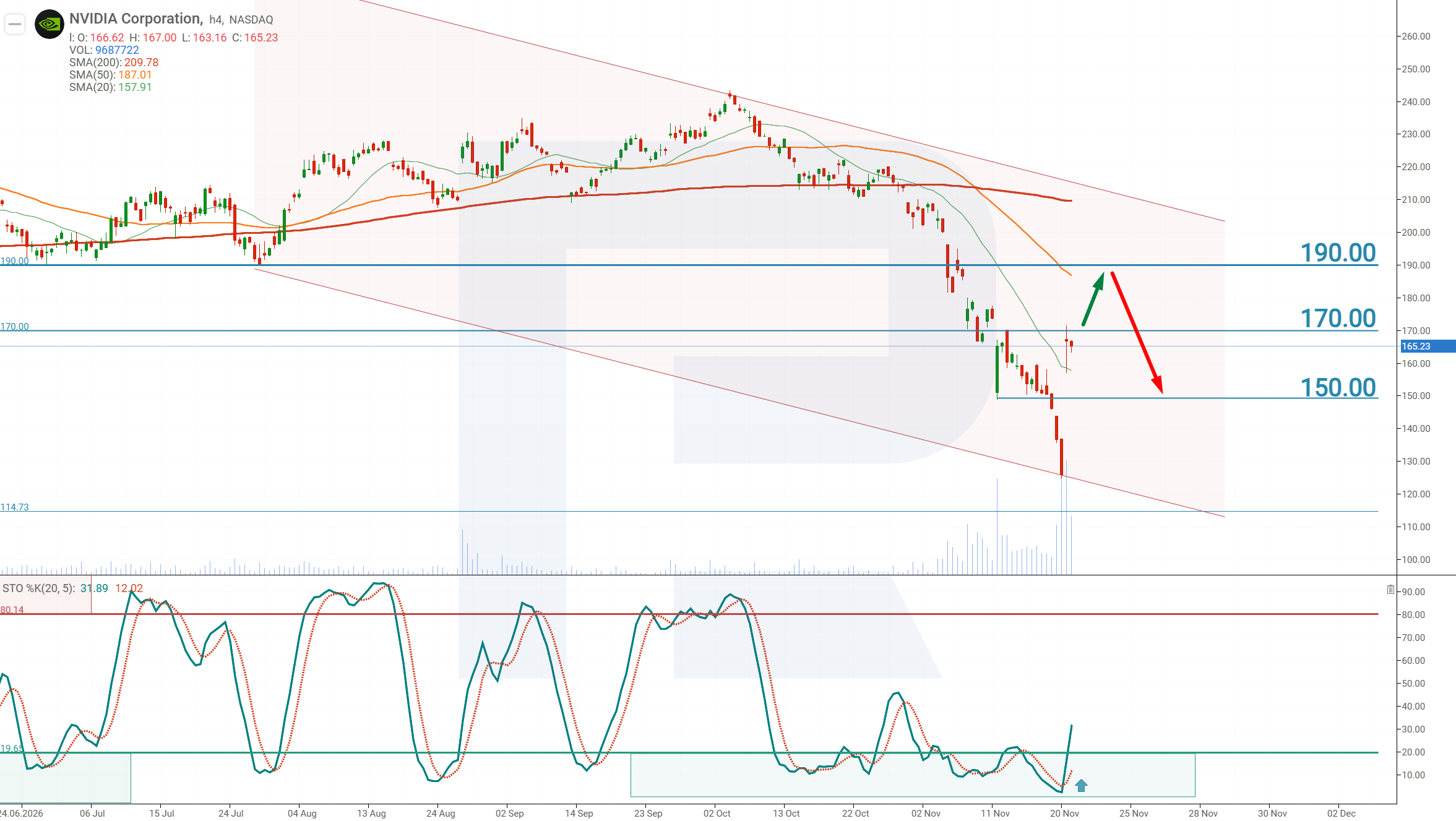
At the time of writing NVDA trades at 165 USD, below resistance at 170 USD.
On the 4-hour chart NVDA trades below its 200-period Moving Average, which sits near 210 USD, so the downtrend still dominates, and the price moves inside a descending channel. The Stochastic oscillator turned up sharply from the oversold zone after the jump on Huang's return: its main line reads about 32 and the signal line about 12. The reading leaves room for a further rise, though for now it looks like a correction inside a downtrend.
Resistance at 170 USD is the level to watch. A break above it would put 190 USD in play. With the downtrend in place and the fundamental pressure unresolved, the decline could resume from 190 USD, and the chart marks 150 USD as the next support on that path.
The idea places a Buy Stop order at 171 USD, just above resistance, so the position opens only if the price breaks 170 USD. The take-profit goes at 189 USD, just below 190, and the stop-loss at 159 USD.
The NVDA technical analysis leads to these conclusions:
- The downtrend still dominates on the 4-hour chart, with NVDA below its 200-period Moving Average.
- Resistance at 170 USD decides the idea. A break above it puts 190 USD in play.
Position management. Once the price has covered 70% of the distance to the target, about 183.60 USD, the stop-loss moves to the 171 USD entry. From there it trails the price at a distance of 5% until the position closes at the take-profit or the stop-loss, whichever comes first.
Open a Trading Account at RoboForex
Swap-free accounts, spreads from 0, and execution in 0.01 seconds.
Sample Calculation for 10 NVDA Shares
Below is a sample calculation built on the parameters above. This example is for educational purposes only and does not constitute investment advice. Investors should assess their own risk tolerance independently.
| Scenario | Calculation | Result |
|---|---|---|
| Buy 10 shares at 171 USD | 10 × 171 USD | 1,710 USD |
| If the target is reached (189 USD) | (189 − 171) × 10 | +180 USD (+10.5%) |
| If the stop-loss is triggered (159 USD) | (171 − 159) × 10 | −120 USD (−7.0%) |
| Risk / Reward | 120 / 180 | 1 : 1.5 |
Percentages are of the position value.
The target pays 1.5 USD for each 1 USD risked, a ratio that suits a position held for weeks. Markets are volatile, and NVDA can move with or against an open position.
Position Size Calculator
A long entry in NVDA at 171.00 USD and a stop-loss at 159.00 USD mean each share risks 12.00 USD. Set your account size and the share of it you are ready to risk. The recommended risk is no more than 3% of the account per trade.
1,000100,000
0.5%3% recommended10%
Shares to buy
risk 300 USD
Position value
4,275 USD
42.8% of the account
Loss at 159.00 USD
−300 USD
3.0% of the account
Profit at 189.00 USD
+450 USD
4.5% of the account
Whole shares, rounded down so the loss stays within the risk you set. The profit figure assumes the whole position closes at the target. Check the margin your account needs for the position. Educational example, not investment advice.
When This Idea Stops Being Valid
- Before the order fills. The Buy Stop at 171 USD fills only if NVDA breaks resistance at 170 USD. A fall to 159 USD before the order fills means the rebound has failed, so the pending order is cancelled. If 170 USD holds as resistance through the one-month horizon, to 24 December 2026, the order expires unfilled.
- After entry. A fall to 159 USD closes the long with a loss of about 7.0% of the position value.
Get MetaTrader 5 From RoboForex
Buy Stop orders, a trailing stop-loss and 4-hour stock charts in one free terminal.
Is Nvidia a Good Stock to Buy? What Huang’s Return Changes for NVDA
Huang's return as CEO removed the sharpest leadership risk and gave the market back some confidence that Nvidia will run steadily. The SEC and Justice Department inquiries, export barriers, the high cost of credit for AI projects and retail holders who have not capitulated can set off new selling. For now the NVDA rebound looks like a correction inside a downtrend.
The idea therefore waits for a breakout. It buys NVDA only on a break above resistance at 170 USD, through a Buy Stop at 171 USD. The target is 189 USD, and a stop-loss at 159 USD closes the trade if the rebound fails.
FAQ
Is Nvidia a good stock to buy after Huang's return?
Only if the price confirms the rebound. The educational example in this article buys NVDA on a break above resistance at 170 USD, through a Buy Stop at 171 USD with a target at 189 USD and a stop-loss at 159 USD. Huang's return on 23 November removed the leadership risk, but the SEC probe, the Justice Department inquiry, export rules and Fed rate expectations are still in place.
Should I buy Nvidia stock now?
The idea waits for confirmation. At 165 USD NVDA trades below resistance at 170 USD and below its 200-period Moving Average on the 4-hour chart, and the SEC probe and export rules are still open. The educational example buys only on a break above 170 USD. For comparison, 44 of the 53 analysts tracked by Barchart rate NVDA a Buy, with an average target of 243.21 USD.
Is Jensen Huang back as Nvidia CEO?
Yes. Nvidia reinstated Jensen Huang as president, CEO and board member on 23 November 2026, eleven days after he stepped down. Colette Kress had served as interim CEO. The board's internal investigation continues.
Why did Nvidia stock fall in October and November 2026?
NVDA lost 47.5% at the close between 6 October and 20 November. Doubts about AI valuations, circular financing with customers, an antitrust inquiry, weak reports from Intel and Amazon, the US midterm results, Fed rate expectations, new export rules, the Huang scandal and an SEC probe all weighed on the stock. Our analysis of why Nvidia stock is down covers the first weeks of the fall.
Is it too late to buy Nvidia stock after the 31% rebound?
At 165 USD NVDA still trades 23% below its 29 October level and below its 200-period Moving Average on the 4-hour chart. The idea treats the rebound as a correction inside a downtrend and waits for a break above 170 USD before buying.
Who bought Nvidia stock during the drop?
Mostly retail investors. Net retail purchases reached 473.8 million USD on 12 November alone and 3.49 billion USD from 4 November, according to Vanda Research and MarketWatch data published on 23 November. Some long-only funds kept selling, according to Goldman Sachs Prime Services.
What do analysts expect for NVDA?
As of November 2026, 44 of the 53 analysts tracked by Barchart rate NVDA a Buy, 8 a Hold and 1 a Sell. The average target price is 243.21 USD, with individual targets from 130 to 425 USD.
How can I trade NVDA at RoboForex?
NVIDIA shares trade under the ticker NVDA in RoboForex MobileTrader and MT5. The idea enters with a Buy Stop order at 171 USD, above the current price, so the position opens only if the shares break resistance at 170 USD.
When does this trade idea stop being valid?
The Buy Stop is cancelled if NVDA falls to 159 USD before the order fills, and it expires if it has not filled by 24 December 2026. After entry, a fall to 159 USD closes the long.
Any forecasts contained herein are based on the author's independent analysis and reflect their personal opinion. These articles should not be construed as trading recommendations or a call to action. The authors and RoboForex accept no responsibility for the results of any trades made on the basis of these recommendations and reviews. Past performance is not indicative of future results. Trading stocks and CFDs involves a high risk of capital loss.