Anthropic Market Cap at the IPO: How Expensive Is ANT at 1.02 Trillion USD?
The Anthropic market cap at the IPO would reach 1.02 trillion USD at the top of the 70 to 78 USD price range, below the 2 trillion USD discussed in September. Buyers would still pay almost 29 times the company's annual revenue. The discount looks large, so it helps to check what it is measured against and how much future growth the price already includes.
TL;DR
- At 78 USD a share Anthropic would be worth 1.02 trillion USD, or about 1.4 trillion USD with potential dilution included.
- The 2 trillion USD figure was an expectation discussed before the IPO. No deal took place at that price.
- The 70 to 78 USD range sits 19 to 32% above the price of the last private round.
- At 1.02 trillion USD the price-to-sales ratio is 28.9, against 17.8 for Broadcom, 13.5 for Nvidia and 6.8 for Meta Platforms.
Last updated: 11 November 2026
This post covers why the valuation came down, how the IPO price compares with the last funding round and how the P/S ratio stacks up against large tech companies. The offering terms and dates are in our post on the Anthropic IPO date, and the full story of the listing is in our Anthropic IPO guide.
Follow Stock Markets in RoboForex MobileTrader
Quotes, charts and orders in one app, on your phone or in Telegram.
Anthropic Market Cap: Why the Valuation Came Down From 2 to 1.4 Trillion USD
Anthropic has to sell investors the scale of its business at a time when the market asks AI companies harder questions about spending. The recent sell-off in tech stocks deepened doubts about how fast huge investment in infrastructure will turn into profit. After the US midterm elections, concerns about possible limits on data centre construction added to the pressure.
Against this background, a lower valuation helps support demand for the offering. The company gets a more convincing price for talks with investors, and buyers get more room for the share price to rise than in an IPO at 2 trillion USD.
A discount to expectations and a lower price in a completed deal are two different things. The 2 trillion USD figure appeared only in discussions of the future IPO, and the market then revised the price it was ready to discuss. By 6 November Bloomberg reported buyer talks at 1.2 to 1.3 trillion USD, as covered in our post on the Anthropic IPO valuation. At 1.02 trillion USD the filed range sits below even those talks.
The two headline numbers use different share counts. The 1.02 trillion USD figure counts the shares outstanding after the IPO and the concurrent private placement. The figure of about 1.4 trillion USD also includes potential new shares from options and employee awards, and it is about 30% below 2 trillion USD.
The growth trend also deserves a closer look. According to the Anthropic prospectus, revenue rose 144% on the previous quarter in Q2 2026, to 11.56 billion USD. In Q3 it reached 16.96 billion USD, a rise of 47%.
That is still strong growth: quarterly revenue is 12.3 times higher than a year earlier. The price asked for Anthropic shares assumes that fast growth continues, so the slowdown matters even with impressive absolute numbers.
Anthropic IPO Price Against the Last Funding Round
The last private round shows the other side of the discount story. In May Anthropic raised funding at a post-money valuation of 965 billion USD.
A direct comparison of this figure with the market cap after the IPO is misleading. The number of shares changes, and different valuations count different sets of potential shares. A fairer test is the price of one share adjusted for conversion.
The filing gives the price of a Series H-1 preferred share at 589.0095 USD. Each one converts into ten common shares, so the comparable price is 58.90 USD. The preliminary IPO range is 70 to 78 USD.
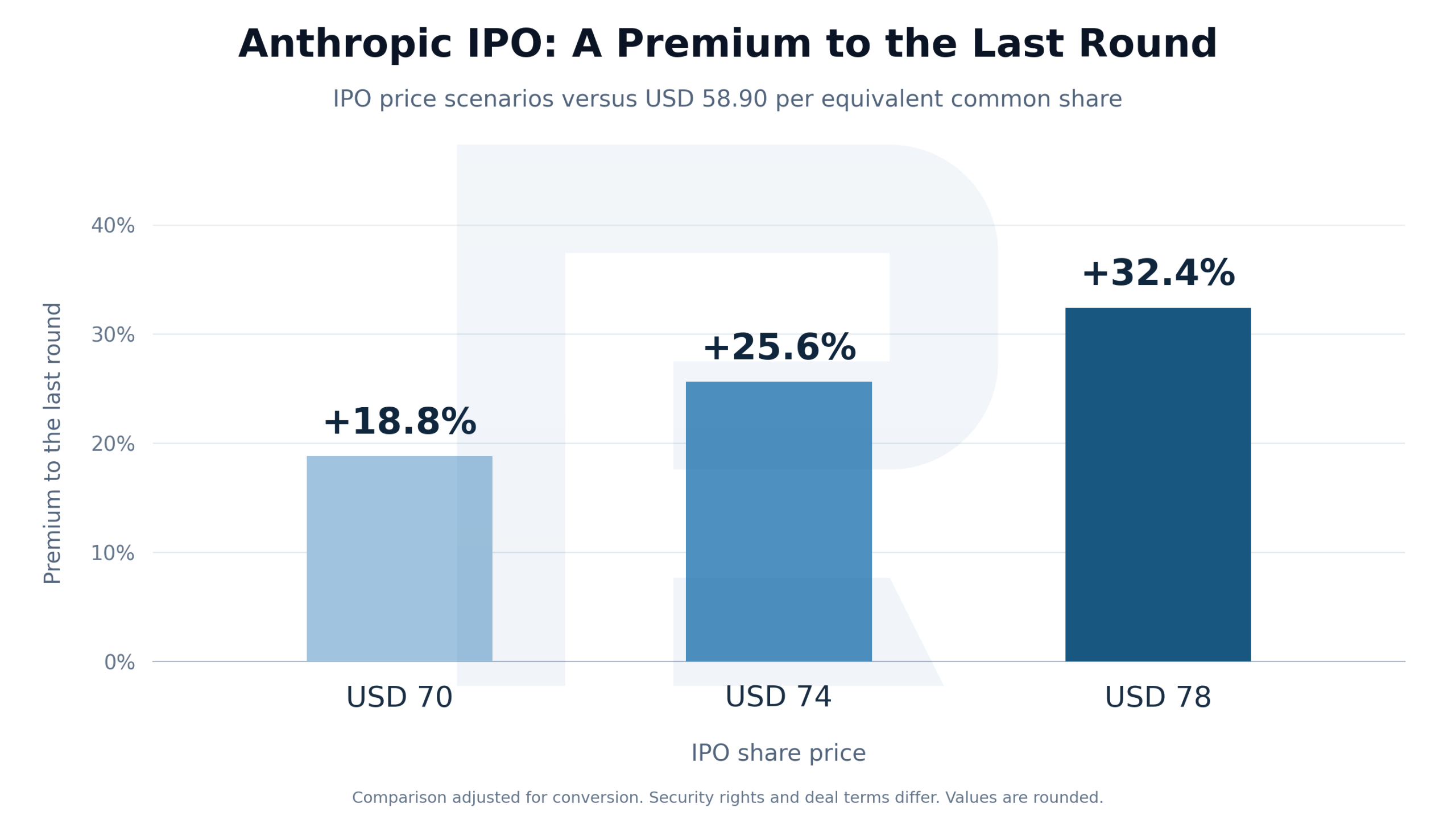
Anthropic therefore offers a discount to earlier IPO expectations and a premium of 19 to 32% to the last round. For those planning to buy Anthropic shares once trading opens, the maths can be tougher still. As an example, with an IPO at 78 USD and an opening at 100 USD, a buyer on the exchange pays 28% more than a participant in the offering. A premium like that quickly eats into the advantage of the lower valuation. Our post on the Anthropic IPO lockup shows who can sell in the first days of trading.
Trade Anthropic Stock on StocksTrader
ANT after the Nasdaq listing, with US stocks and ETFs on one platform at RoboForex.
How Expensive Is Anthropic Stock: P/S Against Tech Giants
Another way to test the IPO is to compare the company's value with its sales. Anthropic's revenue over the last 12 months, from October 2025 to September 2026, comes to 35.282 billion USD. At a market cap of 1.02 trillion USD the P/S ratio reaches 28.9. In other words, the market values the company at almost 29 times its annual revenue.
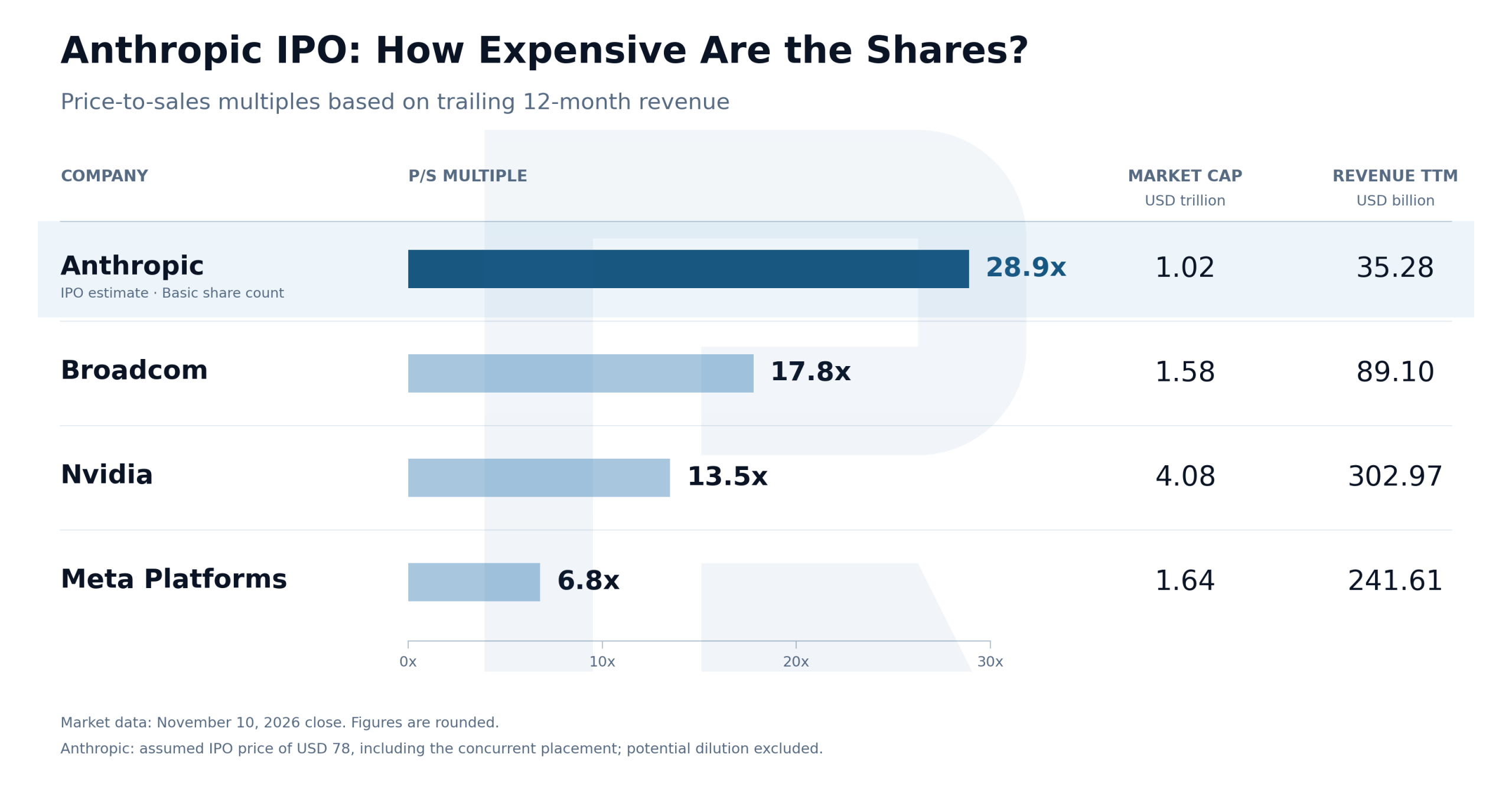
The calculation for Anthropic uses the basic share count after the IPO and the concurrent private placement. Potential extra dilution from options and award plans is left out.
Broadcom trades at a market cap of 1.58 trillion USD on 89.10 billion USD of revenue, Nvidia at 4.08 trillion USD on 302.97 billion USD and Meta Platforms at 1.64 trillion USD on 241.61 billion USD. Buyers of Anthropic shares pay noticeably more for each dollar of revenue. Fast growth gives grounds for such a premium, but to justify it the company will need to raise sales substantially and improve margins. Our post Is Anthropic profitable? covers where its costs stand today.
The main bet for buyers is that Anthropic's revenue keeps growing fast and that efficiency gains let profit grow faster still. If the company delivers on this, a high starting valuation could become a base for further gains in the share price.
Conclusion
The debate about what Anthropic should be worth leaves the scale of the listing intact. For the tech market the event is comparable with the SpaceX IPO. Then investors focused on rockets, satellites and space infrastructure. Now the focus is a developer whose business centres on artificial intelligence.
The Anthropic IPO opens a way to buy a stake directly in a company that builds and sells frontier AI models. For investors it is a way to take part in the long-term development of Claude, enterprise AI services and the automation of knowledge work through shares of the developer itself.
Anthropic has potential: fast-growing revenue and wider use of its products give the business room to develop. A high valuation leaves room for growth too. The entry price will matter most for those who plan to buy ANT shares on the first day of trading.
FAQ
What would Anthropic's market cap be at the IPO?
At 78 USD a share, the top of the filed range, the Anthropic market cap would reach 1.02 trillion USD, based on the shares outstanding after the IPO and the concurrent private placement. With potential dilution from options and employee awards included, the value is about 1.4 trillion USD.
How does the Anthropic IPO price compare with the last funding round?
A Series H-1 preferred share cost 589.0095 USD in May 2026 and converts into ten common shares, so the comparable price is 58.90 USD. The IPO range of 70 to 78 USD is a premium of 19 to 32% to that price.
What is Anthropic's P/S ratio at the IPO?
At a market cap of 1.02 trillion USD and revenue of 35.282 billion USD over the 12 months to September 2026, the P/S ratio is 28.9. At the 10 November 2026 close it was 17.8 for Broadcom, 13.5 for Nvidia and 6.8 for Meta Platforms.
- Anthropic IPO: What the S-1 Shows and Should You Buy ANT Stock?: the listing, valuation scenarios and lessons from past IPOs.
- Anthropic IPO Date and Price: ANT Debut Expected 19 November at 70 to 78 USD a Share: the filed terms, buyers of the placement and the lockup steps.
- Is Anthropic Profitable? Why Q3 Turned Into a Loss and Where SpaceXAI Fits: revenue, costs and the path to profit.
Any forecasts contained herein are based on the author's independent analysis and reflect their personal opinion. These articles should not be construed as trading recommendations or a call to action. The authors and RoboForex accept no responsibility for the results of any trades made on the basis of these recommendations and reviews. Past performance is not indicative of future results. Trading stocks and CFDs involves a high risk of capital loss.