Anthropic IPO: What the S-1 Shows and Should You Buy ANT Stock?
The Anthropic IPO is set to be one of the largest technology listings on record: the developer of Claude plans to list on Nasdaq under the ticker ANT, at a valuation discussed at 1.5 to 2 trillion USD. Revenue is growing fast and Claude is popular with large companies, while the high price and heavy spending on computing raise the risk for buyers of the new shares.
TL;DR
- Anthropic plans to list class A shares on the Nasdaq Global Select Market as ANT. The road show can start on 10 November 2026 at the earliest, and the price range is still blank in the filing.
- Revenue for the first nine months of 2026 reached 33.24 billion USD, against 2.55 billion USD a year earlier. Q3 grew 47% on Q2, while the operating result turned to a 567 million USD loss.
- At 1.5 to 2 trillion USD the company would be priced at 43 to 57 times its revenue for the last 12 months, and it has committed to spend 895.4 billion USD, mostly on computing.
Last updated: 3 November 2026
This article covers what is known about the listing, how Anthropic earns money, what its Q3 2026 results show, what the company needs to earn to justify the price and how similar IPOs traded after their first day. Company figures come from the amended Form S-1/A filed on 2 November 2026.
Follow Stock Markets in RoboForex MobileTrader
Quotes, charts and orders in one app, on your phone or in Telegram.
What We Know About the Anthropic IPO
On 1 June 2026 Anthropic confidentially submitted a draft Form S-1 to the SEC. On 26 October it published its preliminary IPO prospectus, and on 2 November it filed an amended Form S-1/A with its Q3 2026 results.
| Item | What the filings and reports say |
|---|---|
| Exchange and ticker | Class A shares on the Nasdaq Global Select Market, ticker ANT |
| Underwriters | Goldman Sachs and Morgan Stanley lead a group of 22 financial institutions, including JPMorgan, Citigroup and Bank of America |
| Who sells shares | Anthropic offers new shares, and existing shareholders sell part of theirs, including Dario Amodei, Daniela Amodei, Tom Brown, Jack Clark, Jared Kaplan, Sam McCandlish and Christopher Olah. Their share counts are not disclosed yet |
| Retail investors | Part of the offering goes to individual investors through Charles Schwab, Fidelity, Robinhood, Trade-PMR, SoFi and E*TRADE. The size of this part is not stated |
| Use of the money | Operating costs, computing infrastructure, hiring and keeping staff, and possible mergers and acquisitions |
| Valuation | In August The New York Times reported that Anthropic could raise more than 100 billion USD at about 2 trillion USD. In October Reuters reported that some investors were considering about 1.5 trillion USD. The S-1/A still leaves the share price, the share count and the amount raised blank |
When Is the Anthropic IPO?
Under SEC rules, a company that submitted its draft confidentially has to make the filing public at least 15 days before the road show. With the prospectus out on 26 October, the road show can start on 10 November at the earliest. Reuters reported that marketing to investors is expected in the week of 9 November, with pricing possible in mid-November 2026.
How Does Anthropic Make Money?
Anthropic sells access to its Claude models and to the products built on them, including Claude Code, Claude Cowork and Claude Enterprise. Clients connect directly or through the cloud platforms Amazon AWS, Google Cloud and Microsoft Azure. Revenue comes in two ways:
- Pay per use. Clients pay for the number of tokens processed. The price depends on the Claude model and on the amount of computing. Developers and companies that build Claude into their own software, services and workflows use this model.
- Subscriptions. Individuals and companies pay a fixed fee for a set amount of use and a set of features. Once they reach the limit, they can move to a higher plan or pay for extra use.
| Revenue source, 9 months of 2026 | USD billion | Share |
|---|---|---|
| Pay per use | 26.30 | 79% |
| Subscriptions | 6.94 | 21% |
| Total | 33.24 | 100% |
Source: Anthropic Form S-1/A, 2 November 2026. Revenue for the same period of 2025 was 2.55 billion USD.
Most of the money comes from large companies. Over the nine months, clients that brought Anthropic at least 100,000 USD over the past 12 months produced 24.5 billion USD, or 74% of revenue. By 30 September there were more than 11,900 such clients, against more than 950 a year earlier.
Anthropic Financials: What the S-1/A Shows
The S-1/A shows a business growing very fast, and the Q3 figures show that its profitability is still unstable. In Q3 revenue rose 47% on the previous quarter to 16.96 billion USD. The operating profit of 974 million USD earned in Q2 turned into an operating loss of 567 million USD, and the operating margin fell from 8% to -3%. Adjusted operating income rose from 2.24 to 2.46 billion USD, while its margin narrowed from 19% to 15%.
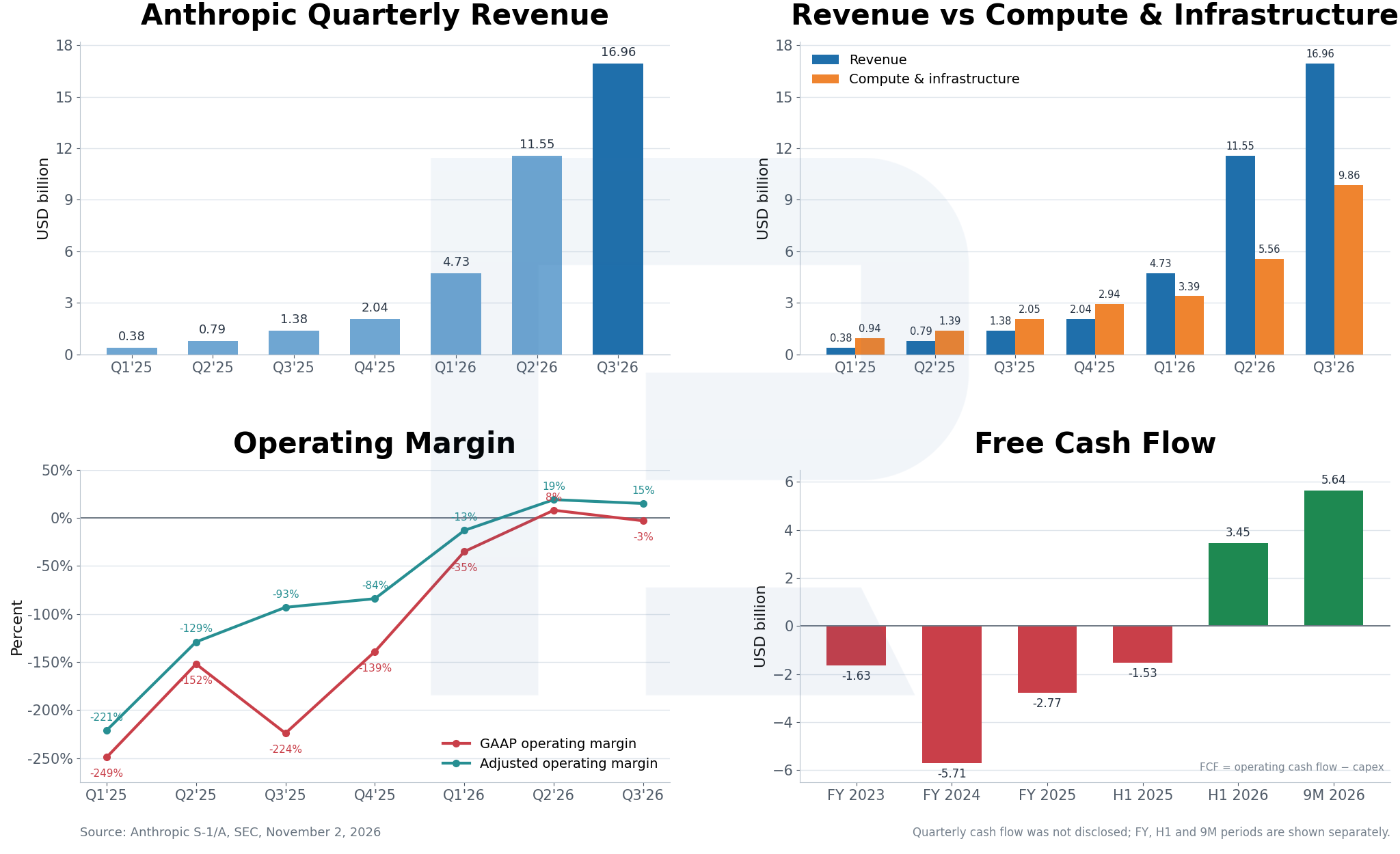
The main reason for the weaker result was extra computing capacity. In Q3 the company spent 5 billion USD on short-term contracts, which cost much more than long-term agreements. Non-cash costs of about 2 billion USD for a charitable programme also weighed on the result. Q2 was the first profitable quarter, and Q3 showed that Anthropic cannot yet hold a positive margin.
Compute Costs and Margins
Over the nine months, spending on computing and infrastructure rose from 4.38 to 18.81 billion USD. Its share of revenue fell from 172% to 57%, because sales grew faster than costs.
Q3 moved the other way. Compute costs rose to 9.86 billion USD, and their share of revenue went from 48% in Q2 to 58%. Anthropic's profitability can swing noticeably with the timing of new servers and the price of each contract.
For the nine months the operating loss was 1.26 billion USD, an operating margin of -4%. Adjusted operating income reached 4.08 billion USD, a 12% margin. The adjusted figure leaves out share-based pay and some other non-cash costs, so it shows the core business more clearly and leaves part of the company's costs out of view.
The GAAP net loss reached 104.04 billion USD. The main cause was a 94.32 billion USD charge for the revaluation of convertible instruments. Other expenses and losses added 12.08 billion USD, partly offset by 2.36 billion USD of interest income. These charges are accounting entries, and the company did not spend that cash. Without most of them, adjusted net income came to 5.59 billion USD.
Staff Costs
Over the nine months, staff costs rose from 1.03 to 4.86 billion USD, while their share of revenue fell from 40% to 15%. Three factors drive the growth:
- Competition for AI engineers. Researchers who build leading language models are scarce. To hire them from Google, OpenAI and Meta, Anthropic pays high base salaries and signing bonuses.
- Pay in shares. A large part of the 4.86 billion USD is share-based compensation. As the valuation rises ahead of the IPO, each new grant is booked at a higher value. The charge raises reported costs, and no cash leaves the company for it.
- A larger commercial team. Anthropic has grown from a research lab into a large commercial company. It has hired sales teams for enterprise clients, lawyers and compliance staff for the checks that come with a listing.
Partner Payments to Amazon and Alphabet
Amazon and Alphabet are Anthropic's investors, its computing suppliers and sales channels for Claude at the same time. Over the nine months, spending on sales, marketing and partnerships rose from 322 million to 5.53 billion USD, or 17% of revenue. The main driver was a 4.8 billion USD rise in fees paid to sales and cloud partners.
When a company buys Claude through a cloud platform, Anthropic books the revenue and pays part of it to the platform for distribution. These fees sit apart from compute costs. The model helps Anthropic reach clients quickly and ties it closer to Amazon and Alphabet. New terms, higher fees or a conflict of interest could cut its profit, and both partners develop their own AI products that compete with Claude.
The Biggest Long-Term Risk: 895 Billion USD of Commitments
At 30 September 2026 Anthropic held 95.6 billion USD in cash and 36.3 billion USD in short-term investments. Much of it came from investors: financing brought in 110.74 billion USD over the nine months, and the total capital raised reached 141.1 billion USD.
Future commitments matter more. Counting short-term agreements, leases, contracts that have not started yet and contracts signed after 30 September, Anthropic has committed to spend 895.4 billion USD. Almost all of it is for computing and infrastructure, and about 447.5 billion USD falls due by the end of 2030.
Anthropic has to pay tens of billions of USD a year for servers, while most of its revenue depends on how much clients use Claude. If a competitor releases a much stronger model and clients move, revenue could fall fast while the payments stay. The company would then have to raise new money, borrow more or issue new shares, which would dilute existing shareholders.
What Does Anthropic Need to Earn to Justify the IPO Price?
In May 2026 Anthropic was valued at 965 billion USD. For the IPO, 1.5 to 2 trillion USD is under discussion.
Q3 2026 revenue reached 16.96 billion USD, up 46.7% on the quarter. Growth slowed from 144% in Q2, largely because the base is now larger. In USD terms quarterly revenue rose by 5.4 billion USD, more than the company's whole revenue for 2025. Revenue for the last 12 months came to 35.28 billion USD, so at 1.5 to 2 trillion USD Anthropic would cost about 43 to 57 times its yearly revenue. Nvidia, for comparison, was valued at about 16.6 times its yearly revenue at the close on 3 November 2026.
Three scenarios show how far the valuation depends on growth. Each one starts from Q3 2026 revenue of 16.956 billion USD and uses a 17% net margin, Anthropic's adjusted net margin for the first nine months of 2026.
| Indicator | Negative | Base | Optimistic |
|---|---|---|---|
| Quarterly revenue growth | 20% | 47% | 80% |
| Revenue in 2027 | 131.1 billion USD | 286.1 billion USD | 652.2 billion USD |
| Net margin | 17% | 17% | 17% |
| Net income in 2027 | 22.3 billion USD | 48.6 billion USD | 110.9 billion USD |
| Earnings multiple | 25 | 30 | 35 |
| Possible value | 0.56 trillion USD | 1.46 trillion USD | 3.88 trillion USD |
The growth rates and earnings multiples are the author's assumptions. The scenarios are hypothetical and show how the value depends on revenue growth.
- Negative scenario. Quarterly growth slows to 20%. Revenue for 2027 reaches 131.1 billion USD and profit 22.3 billion USD. At 25 times earnings the company would be worth about 557 billion USD, well below the IPO price, even with the business still growing.
- Base scenario. Growth holds at about 47% a quarter. Revenue reaches 286.1 billion USD and profit 48.6 billion USD. At 30 times earnings the company would be worth about 1.46 trillion USD, close to an IPO price of 1.5 trillion USD. A price of 2 trillion USD would need a margin of about 23% or fast growth continuing into 2028.
- Optimistic scenario. Growth speeds up to 80% a quarter as AI agents spread and companies spend more on Claude. Revenue for 2027 reaches 652.2 billion USD and profit 110.9 billion USD. At 35 times earnings Anthropic could be worth 3.88 trillion USD, about 159% above a 1.5 trillion USD IPO price and 94% above 2 trillion USD.
On these numbers, a price of about 1.5 trillion USD is covered if growth and margin hold at today's level. A price of 2 trillion USD needs higher profitability, or a faster spread of Claude, to leave room for gains.
Open a RoboForex Account
Register in a few minutes and trade stocks, indices and currencies from one account.
Should You Buy Anthropic Stock at the IPO?
The Anthropic IPO gives direct access to one of the leaders of the AI market, and the high valuation makes the decision a close call. Here are the main arguments on each side.
Arguments for Buying Anthropic Stock
- Very fast revenue growth. Q2 2026 revenue reached 11.56 billion USD, and Q3 added another 46.7%, to 16.96 billion USD. The 5.4 billion USD added in one quarter is more than the company's whole revenue for 2025.
- More large clients. Clients that brought at least 100,000 USD over the past 12 months grew from more than 950 to more than 11,900. Among them are more than 1,900 clients above 1 million USD and about 250 above 10 million USD.
- More efficient computing. In the first nine months of 2025 compute costs were 172% of revenue, a year later 57%. In Q3 2026 the share rose to 58% from 48% in Q2 because of extra expensive capacity, and it stays far below last year's level.
- Positive adjusted profit. In Q3 2026 adjusted operating income was 2.46 billion USD, a 15% margin. The GAAP operating result was a 567 million USD loss because of costly short-term compute contracts and non-cash charity costs.
- Positive cash flow. Free cash flow for the first nine months of 2026 was about 5.64 billion USD, against an outflow of 2.14 billion USD a year earlier. The company now pays for current costs and equipment from its own cash, while future lease and infrastructure payments are outside this figure.
- Strong position with large companies. Every Fortune 10 company, more than half of the Fortune 500 and more than 30% of the Global 2000 bring Anthropic at least 100,000 USD over 12 months. That leaves room for these clients to spend more on AI.
- A rare listing. Almost no listed company has building frontier AI models as its main business. Anthropic shares would give direct exposure to this market without going through Amazon, Microsoft or Alphabet.
What to Weigh Before Buying at the IPO
- A high IPO price. A valuation of 1.5 to 2 trillion USD already prices in very fast growth.
- Slower growth. Quarterly revenue grew 144% in Q2 and 46.7% in Q3. Growth is still exceptional, and a further slowdown could weigh on the valuation.
- Huge computing commitments. Total commitments reached about 895.4 billion USD, and 447.5 billion USD of it falls due by the end of 2030. Some payments are owed whether or not the capacity is used.
- Large partner fees. Spending on sales, marketing and partnerships rose from 322 million to 5.53 billion USD over nine months, mostly because fees to cloud and sales partners grew by 4.8 billion USD.
- Strong competition. Anthropic competes with OpenAI, Alphabet, Meta and developers of open models. Cheaper AI services can bring more users and lower the profit on each request.
- Reliance on Amazon and Alphabet. Both are investors, computing suppliers and sales channels for Claude, and both develop their own models, so their interests and Anthropic's can differ.
- Dilution. After the IPO part of the convertible instruments turns into ordinary shares. New shares can be issued for staff and to fund growth. Anthropic also plans to transfer 5% of its shares to a public benefit trust, with its stake rising by 2 percentage points each time the company's value grows by 50%.
- A public benefit company. Anthropic is registered as a Public Benefit Corporation. Its management has to weigh shareholders' interests, the company's effect on society and the safe development of AI, and it can take decisions that lower profit for the sake of safety or public goals.
- Calls to slow AI development. In September 2026 Dario Amodei published the essay We Must Pace the Frontier, calling on leading companies to slow the pace at which AI capabilities improve. His main reason is the risk of losing control over ever more capable systems. The valuation needs fast growth, while the company's chief executive accepts a deliberate slowdown.
What Past IPOs Suggest for the Anthropic IPO
To see how listings like this one traded, we compared Anthropic with past IPOs on three features: a high price to sales ratio (P/S), strong hype among investors and a large share of the offering for retail buyers. Returns are counted from the opening price on the first trading day.
IPOs With a High P/S
The first group holds technology companies that listed at a P/S above 30.
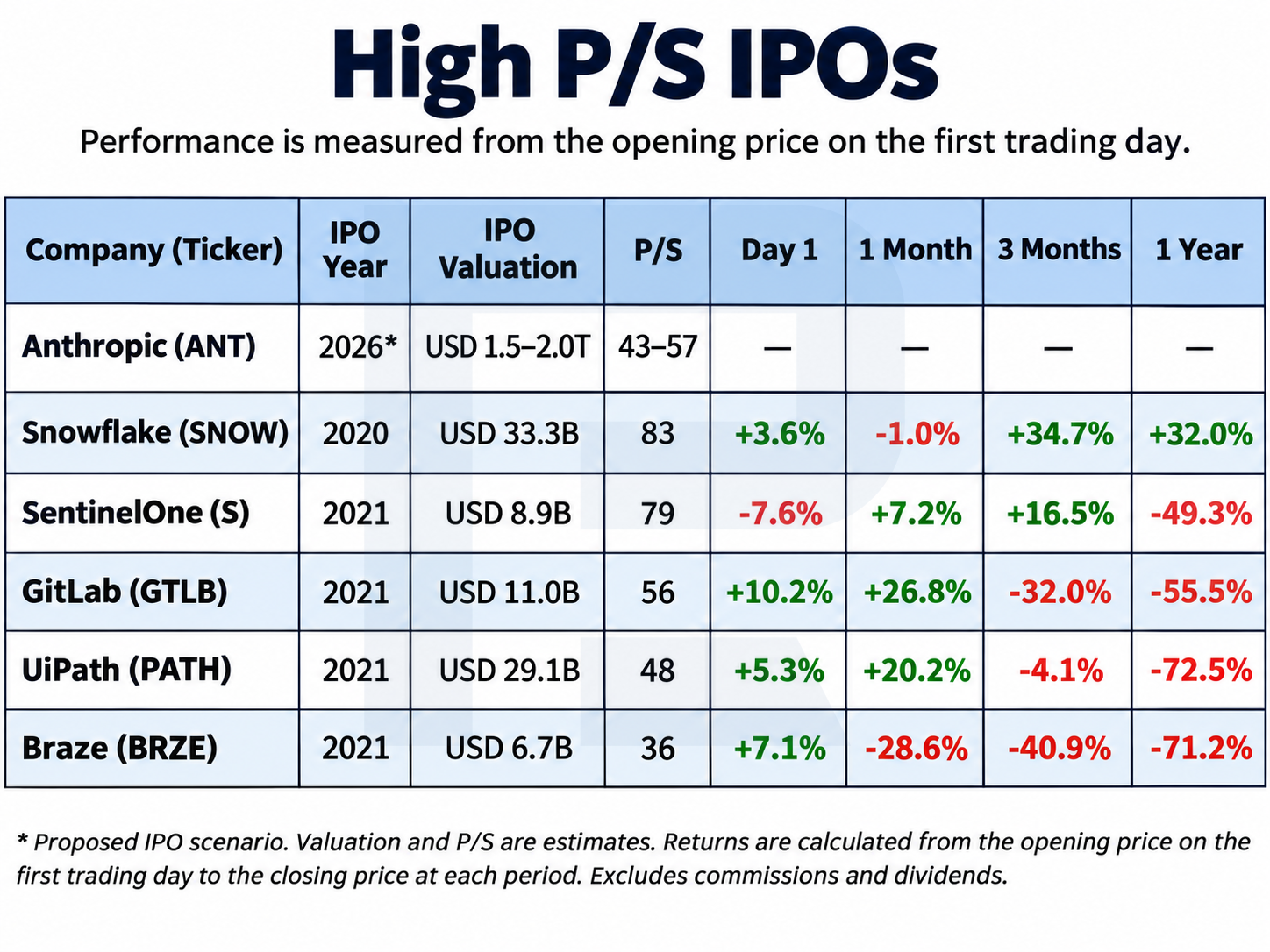
A high P/S did not stop shares from rising on the first day: four of the five companies closed it with a gain. After a month three of them still traded above the opening price. After a year four of the five had lost value, and some fell more than 70%.
By then the companies had published several quarterly reports, their lock-up periods had ended and investors could compare real results with the expectations at the IPO. A high P/S raises the bar for future growth, even when the shares do well right after the listing.
IPOs With Strong Hype
The second group holds listings that drew huge interest from investors hoping to profit from a popular business.
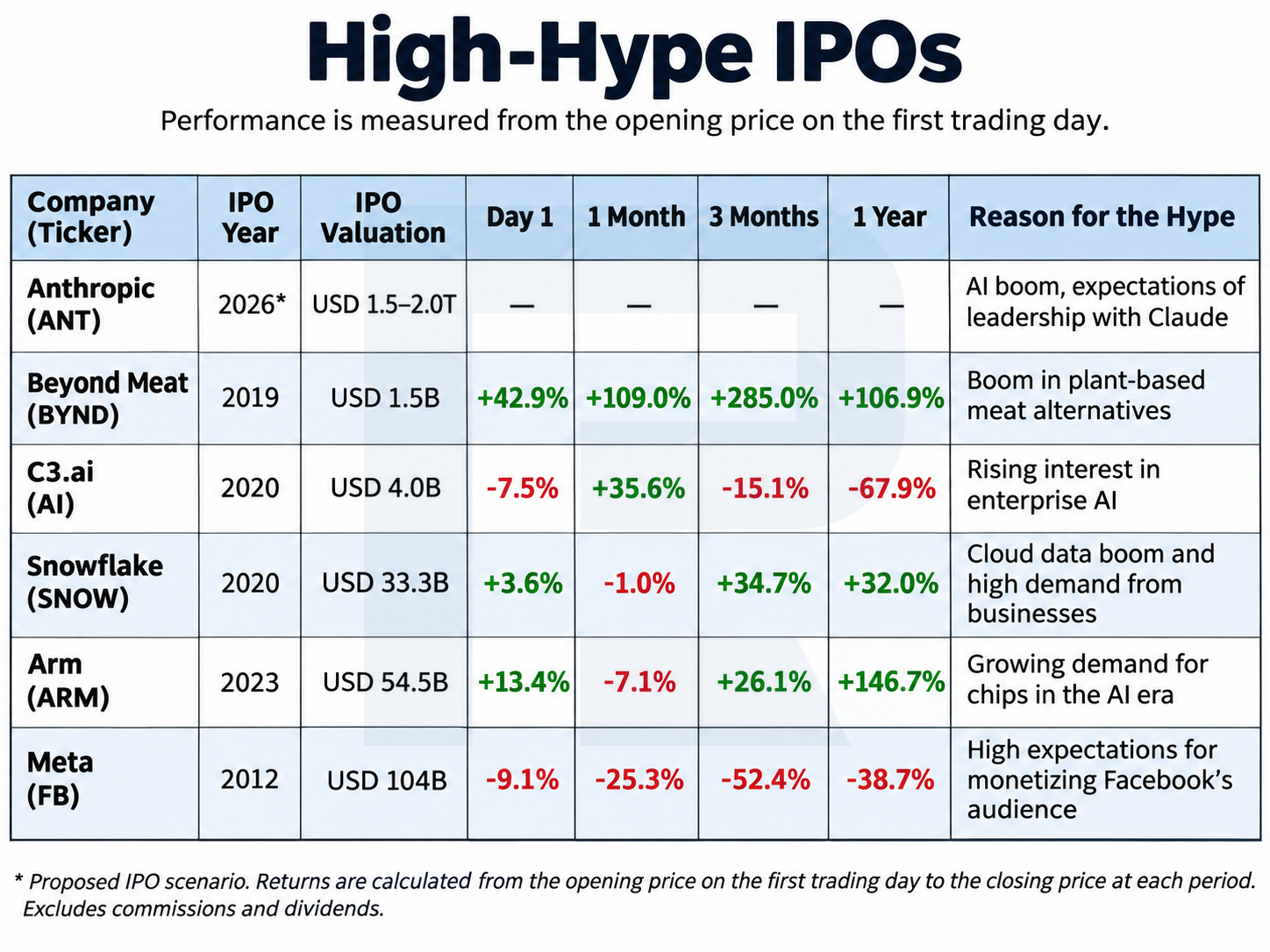
The results are mixed. Three of the five companies closed the first day with a gain, and the same three were still up a year later, despite corrections along the way. Hype can support a stock well past the first day, and when a company falls short of expectations, the early interest can turn into selling quickly.
IPOs With a Large Retail Allocation
The third feature is the share of the offering that goes to individual investors. Bloomberg reported on 28 October that Anthropic is weighing a retail allocation of about 15 to 20% of the offering, with JPMorgan leading US retail sales. That is unusually high for the US market, where the split between institutions and individual investors has historically been about 90 to 10. Trading apps, the popularity of crypto and the AI boom have pushed underwriters to bring in more private investors.
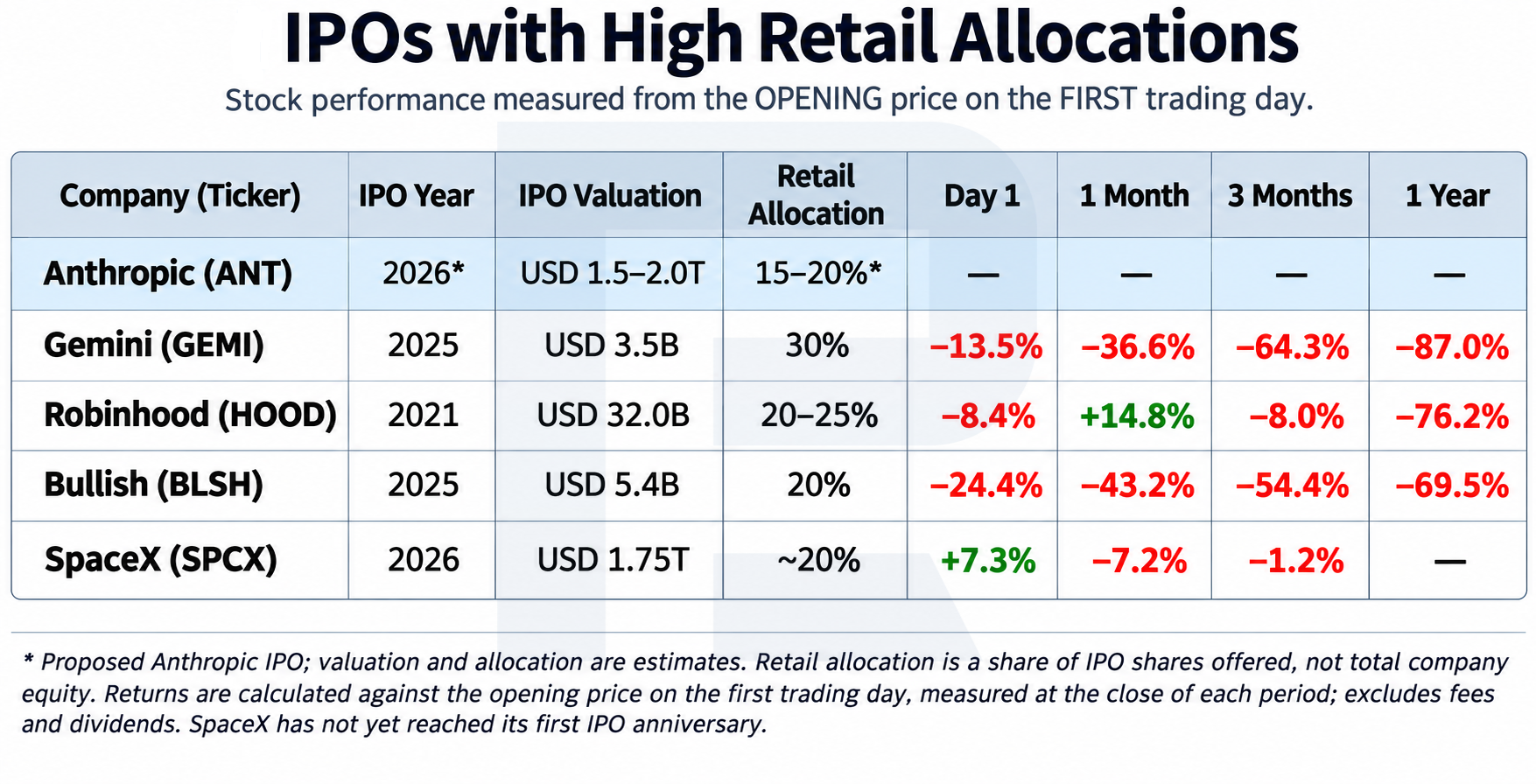
These listings did much worse. Of the four companies, only SpaceX closed the first day higher. After a month three of the four traded below the opening price, and after three months all four were below it. All three companies with a full year of trading show a loss over that year.
Strong retail demand can help a company list at a high price, and that demand often fades once trading starts. The shares can then come under heavy pressure, especially when results fall short of the valuation at the IPO.
Across the three groups, a high P/S or strong hype on its own did not stop shares from rising later, and a large retail allocation gave the price no support. What decided the outcome was the valuation at the listing and whether the company's results justified it.
Where to Trade Anthropic Stock
Once the IPO is priced and ANT starts trading on Nasdaq, Anthropic shares will be available on StocksTrader, the RoboForex platform for stocks. The first weeks after a large listing often bring sharp moves, as the IPO tables above show, so size each position for a large swing and check the next quarterly report against the expectations built into the price.
Trade Anthropic Stock on StocksTrader
ANT after the Nasdaq listing, with US stocks and ETFs on one platform at RoboForex.
Conclusion
Anthropic comes to the stock market as one of the leaders in AI. Revenue and the number of large clients are growing very fast, the share of revenue spent on computing is falling, the company earned a GAAP operating profit in Q2 2026 and its free cash flow is positive. Claude could become the base of a large corporate platform for software development, automation and AI assistants.
A valuation of 1.5 to 2 trillion USD equals 43 to 57 times yearly revenue and prices in nearly flawless growth. Growth is already slowing, Q3 ended in an operating loss, and the computing commitments, the reliance on Amazon and Alphabet and possible dilution add to the risk. Past high-profile IPOs show that hype and a high P/S can lift a stock on the first day and give no promise for the years after. At about 1.5 trillion USD the price is covered by today's growth rate, and at about 2 trillion USD a buyer pays in advance for most of the company's future success.
FAQ
When is the Anthropic IPO?
No date is set in the filings. Anthropic published its prospectus on 26 October 2026, so under SEC rules the road show can start on 10 November at the earliest. Reuters reported that marketing to investors is expected in the week of 9 November and that pricing could follow in mid-November 2026.
What is the Anthropic stock symbol?
Anthropic has applied to list its class A shares on the Nasdaq Global Select Market under the ticker ANT. The shares start trading under this symbol once the IPO is priced.
How much is Anthropic worth?
In May 2026 Anthropic was valued at 965 billion USD in its Series H round. For the IPO a valuation of 1.5 to 2 trillion USD is under discussion. The amended S-1/A of 2 November 2026 still leaves the share price, the share count and the amount raised blank.
Can retail investors buy Anthropic stock at the IPO?
Yes. The filing names Charles Schwab, Fidelity, Robinhood, Trade-PMR, SoFi and E*TRADE as channels for individual investors. The size of the retail part of the offering is not stated yet.
Is Anthropic profitable?
Not on a GAAP basis so far. Q2 2026 brought an operating profit of 974 million USD, and Q3 an operating loss of 567 million USD. For the first nine months of 2026 adjusted operating income was 4.08 billion USD and the GAAP net loss 104.04 billion USD, most of it from non-cash revaluations of financial instruments.
What are the main risks of the Anthropic IPO?
The price assumes very fast growth, while quarterly growth slowed from 144% in Q2 to 46.7% in Q3. Anthropic has committed to spend 895.4 billion USD, mostly on computing, relies on Amazon and Alphabet, which also compete with it, and its shareholders face dilution from converted instruments and new shares.
- NVIDIA Funds OpenAI, OpenAI Buys NVIDIA Chips: What the Circular Deal Means for NVDA Stock: how money moves between AI developers and their chip suppliers.
- Oracle Stock Down 60% From Its Peak: Can the Bloom Energy Deal Trigger a Reversal in ORCL?: what heavy AI spending does to a large company's stock.
Update log
- 3 November 2026. First version. Company figures from the S-1/A of 2 November 2026. Next update when the price range is filed.
Any forecasts contained herein are based on the author's independent analysis and reflect their personal opinion. These articles should not be construed as trading recommendations or a call to action. The authors and RoboForex accept no responsibility for the results of any trades made on the basis of these recommendations and reviews. Past performance is not indicative of future results. Trading stocks and CFDs involves a high risk of capital loss.