Neocloud Stocks: What CoreWeave's Debt Tells You About the AI Buildout
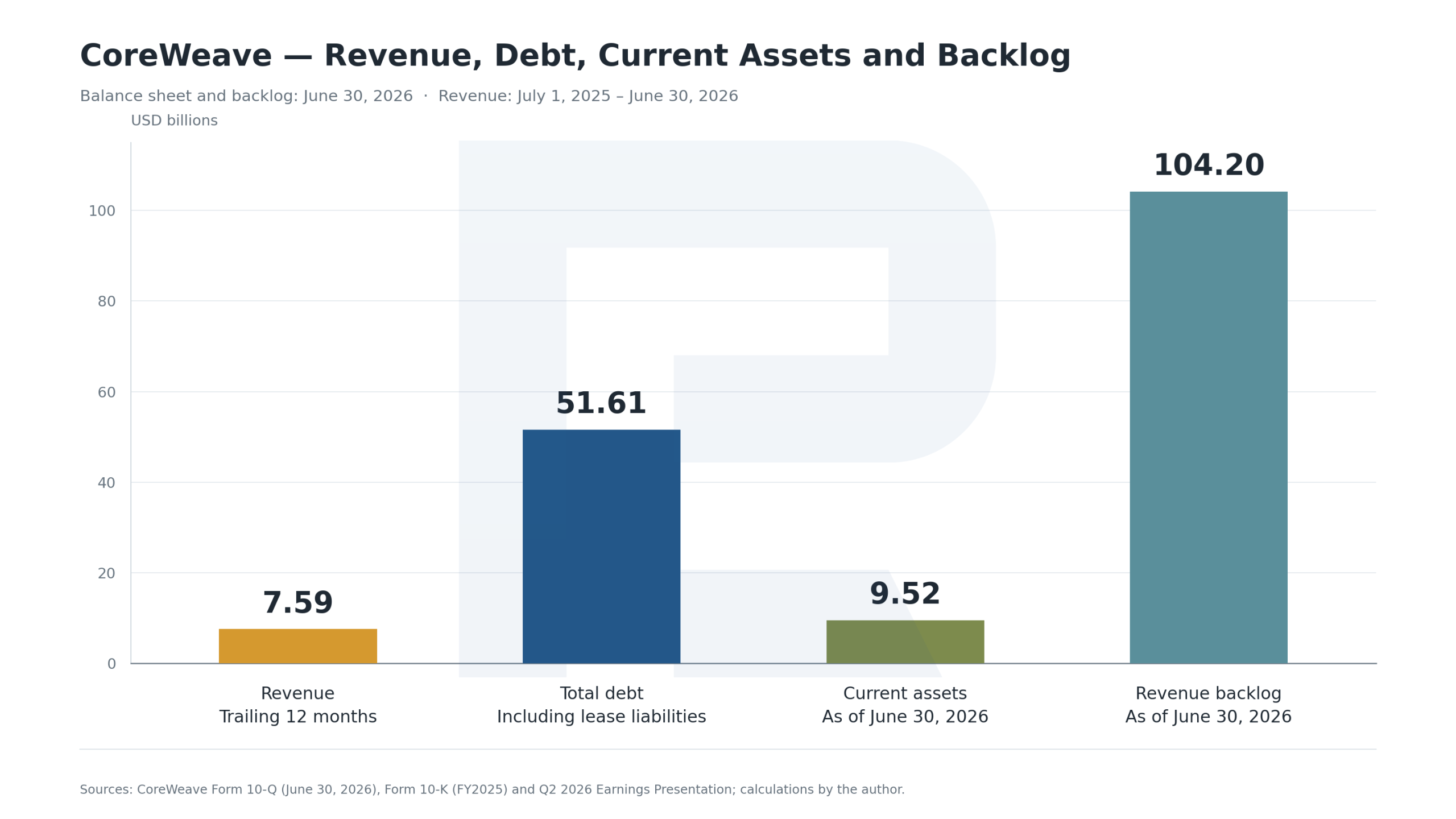
Neocloud stocks are shares of companies such as CoreWeave, Nebius and IREN that rent out GPU computing power for artificial intelligence. They grow fast on borrowed money: CoreWeave carried 51.61 billion USD of debt and lease obligations at 30 June 2026, and in mid-October some of its bonds yielded 15 to 16%.
TL;DR
- Neoclouds pay for GPUs and data centres up front and get paid over several years, so they keep raising loans, bonds and new shares.
- In Q2 2026 CoreWeave's adjusted operating income covered 20% of its net interest expense, and its CDS priced in about 63% default risk over five years.
- Before you buy a neocloud stock, check five numbers: CDS spread, bond yield, interest cover, top client share and debt due within 12 months against cash.
Last updated: 28 October 2026
This article explains how the six listed neoclouds pay for their growth, what backs CoreWeave's loans and how to read the same numbers in any company's filings. Market figures are as of 26 October 2026, company figures come from the Q2 2026 reports.
Follow Stock Markets in RoboForex MobileTrader
Quotes, charts and orders in one app, on your phone or in Telegram.
What Are Neocloud Stocks?
A neocloud is a cloud provider built for AI workloads: it rents out GPU computing power by the hour or under contracts that run for months or years. Neocloud stocks are shares of the listed companies in this business. A neocloud puts thousands of graphics processors into large data centres and takes care of buying the hardware, cooling it, connecting it and keeping it running. Its clients can launch an AI project quickly without building their own server rooms.
For investors, neocloud stocks form a separate group of AI stocks. Their returns depend on demand for GPUs, the cost of financing and how fully each company fills the capacity it has built.
Growth here is expensive. A neocloud spends billions long before it earns a profit. If a GPU delivery slips or a site waits for its grid connection, the servers start later, while interest and repayments on existing debt fall due on schedule.
How Do Neoclouds Differ From Hyperscalers?
Neoclouds concentrate on AI computing. Hyperscalers such as Microsoft, Amazon and Google run broad cloud platforms and earn money from many other businesses. The big platforms also rent capacity from neoclouds, so they are their clients and their competitors at the same time.
| Feature | Neoclouds | Microsoft, Amazon and Google |
|---|---|---|
| Main product | GPUs and services for AI workloads | Cloud, databases, applications, storage and other services |
| Clients | AI developers, companies, the large cloud platforms | Companies, developers, government bodies |
| Contracts | Hourly use and capacity reserved for months or years | Pay as you go and multi-year commitments |
| Funding | Debt, shares, client prepayments, project investors | Cash flow from many businesses, debt, leases and partner projects |
| Main weak point | Few large clients and a constant need for new capital | The size of AI spending and whether the whole programme pays back |
Neocloud Companies: CoreWeave and Its Competitors
The listed group falls into two types with different business models. GPU cloud operators own the processors and earn by renting them out, so their results depend on how much each GPU earns over its life. Infrastructure owners build and lease data centre campuses, so their income depends on long leases and on tenants paying on time.
| Company | Ticker | Origin and current model | Largest disclosed AI counterparties |
|---|---|---|---|
| CoreWeave | CRWV | Started in crypto mining, now a specialised AI cloud | Microsoft, OpenAI, Nvidia |
| Nebius | NBIS | Software platform turned AI cloud | Microsoft, Meta |
| IREN | IREN | Started in bitcoin mining, now runs its own data centres and a GPU cloud | Microsoft, Nvidia |
| Applied Digital | APLD | Builds and leases campuses, runs a cloud business through ChronoScale | CoreWeave; Microsoft through the announced ChronoScale project |
| TeraWulf | WULF | Power infrastructure, bitcoin mining and sites leased for AI | Fluidstack, Core42, Anthropic |
| Cipher Digital | CIFR | Formerly Cipher Mining, develops campuses for high-performance computing | Amazon Web Services, Fluidstack; Google backs part of Fluidstack's obligations |
CoreWeave, Nebius and IREN depend most on the economics of renting out GPUs. Applied Digital, TeraWulf and Cipher Digital depend more on infrastructure and long data centre leases.
How Much Debt Does CoreWeave Carry?
CoreWeave carried 51.61 billion USD of financial debt and lease obligations at 30 June 2026, according to its Q2 2026 report published on 11 August. Financial debt made up 35.07 billion USD, operating lease liabilities 16.32 billion USD and finance lease liabilities 0.22 billion USD.
The revenue backlog reached 104.2 billion USD. That is revenue expected under signed contracts, and CoreWeave has to deliver the computing and pay the costs of it before the backlog turns into cash. A large order book leaves today's cash needs in place.
What Are CoreWeave's Lenders Signalling?
The clearest signs of stress come from the credit market: the yield on CoreWeave's bonds, the cost of insuring its debt and the money it needs from outside. Data published by 26 October shows this picture:
| Indicator | Figure | What it means |
|---|---|---|
| Bond yield | Some issues traded at yields of 15 to 16% in mid-October | Lenders want a very high reward for the risk, so new unsecured debt gets harder to raise |
| Default risk priced into the CDS | About 63% over five years, against about 30% a year earlier, per LSEG data on 15 October* | The market's estimate of default risk has more than doubled in a year |
| Debt principal | 35.55 billion USD at 30 June against 21.6 billion USD at the end of 2025, up 65% in six months | Financial obligations are growing fast |
| Funding gap | First half of 2026: operating cash flow 3.66 billion USD, cash capital expenditure 14.12 billion USD | A shortfall of about 10.45 billion USD after these investments, covered with outside money |
*The 63% is an estimate derived from CDS prices. It measures how the market prices the risk, which differs from an actual probability of bankruptcy.
Profit against interest tells the most. In Q2 2026 CoreWeave earned 128 million USD of adjusted operating income and paid 640 million USD of net interest expense, five times as much. Over the year interest expense rose 140%, while this profit fell 36%. The quarterly figures show how the gap opened.
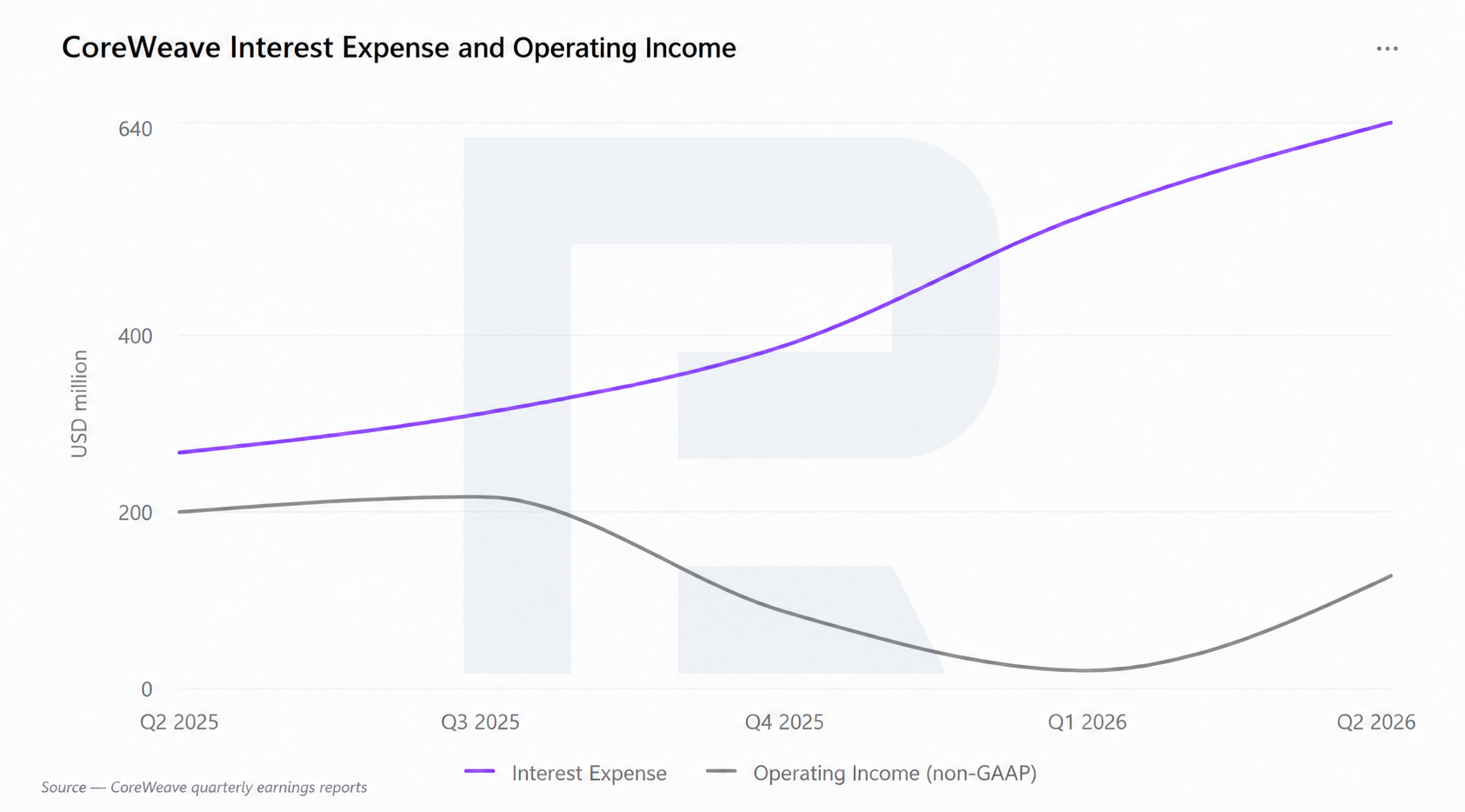
Operating income is counted after equipment depreciation, so this ratio on its own does not mean CoreWeave cannot pay. It does leave a thin safety margin for a company carrying this much debt.
Nebius also needs outside capital. In the first half of 2026 its cash capital expenditure was 8.13 billion USD against 4.50 billion USD of operating cash flow, a gap of 3.63 billion USD, according to its Q2 2026 results.
The most indebted companies now depend on a steady flow of new financing. A delayed build or tighter terms on new loans would be enough to force a share sale, an asset sale or a debt restructuring.
How Do Neocloud Stocks Pay for GPUs?
Neoclouds rarely pay for GPUs from their own cash. They use loans, bonds, new shares, client prepayments and financing secured on future contracts. Each company mixes them differently, and the cycle usually runs in four steps.
- 1Sign a large contract. The neocloud agrees to supply computing to Microsoft, Meta, OpenAI or another large client. A multi-year contract proves future demand and helps raise money for the build.
- 2Raise capital. The company takes loans, issues bonds or sells new shares. Some loans are secured on the GPUs being bought, on the data centre buildings and on future client payments. Some clients pay in advance, which helps fund the construction.
- 3Buy GPUs and build. The money goes on Nvidia accelerators and other hardware, power connections, server halls and switching the capacity on.
- 4Repay from client payments. Once the capacity runs, contract payments cover interest, loan repayments, leases and other fixed costs. What is left funds the next expansion.
The weak point is timing. Billions go into hardware and construction at once, and the client pays over several years. That is why even a large backlog leaves a neocloud dependent on steady access to financing.
What Protects CoreWeave's Lenders?
Lenders hold the GPUs as collateral and have two more layers of protection. The first is take-or-pay contracts in the backlog: clients pay for the capacity they reserved whether they use it or not. In Q2 2026 contracts with client commitments produced 98% of CoreWeave's revenue. The company expected to recognise about 40% of its 30 June backlog as revenue over the next two years and the rest later.
The second is an agreement under which Nvidia buys CoreWeave's unused computing capacity. The initial order is worth 6.3 billion USD and runs to 13 April 2032, provided CoreWeave meets the service delivery and availability requirements and the other terms of the contract. The deal supports CoreWeave's future revenue. The risk that the hardware loses value and the duty to service the debt stay with CoreWeave.
Why Are Investors Worried About Neocloud Stocks?
Investors fear that some neoclouds have borrowed so much that even strong demand for AI may not be enough to repay the debt. A delayed build, cheaper GPU rental or tighter credit could each cause serious trouble.
The debt market moved first. In mid-October some CoreWeave bonds (ISIN USU2069EAE06) yielded 15 to 16%. On 26 October a warning from Elon Musk about possible bankruptcies and consolidation in the sector added to the selling. His comment is one industry figure's opinion. The fall in the bonds shows that the lenders who fund these companies share the doubt.
Five reasons stand behind the worry:
- Growth keeps calling for new money. In Q2 2026 CoreWeave generated 679 million USD of operating cash flow and spent 6.42 billion USD in cash on equipment and other fixed assets. To deliver its orders it has to keep building, and to keep building it has to keep raising money.
- A backlog still has to become cash. A contract worth several billion USD usually runs over several years. Future revenue has to pay for hardware, power, rent, staff and interest. Take-or-pay contracts protect the operator as long as it meets the contract terms, switches the hardware on in time and the client stays able to pay.
- GPUs may earn less, sooner than planned. A GPU can run for many years. The question for the operator is what rent it fetches once faster, more power-efficient generations arrive. When rents fall, hardware bought at the old, higher price brings in less, and a fast change of generations can push a heavily indebted neocloud towards default.
- The same few buyers. Microsoft produced about 67% of CoreWeave's revenue in 2025. In Q2 2026 the largest client produced 36% of revenue and the three largest 72%, and the quarterly filing does not name them. If one of these clients cuts new orders or moves computing to its own data centres, CoreWeave's growth could slow noticeably.
- Financial ties pass problems along. Chipmakers, neoclouds and lenders are linked through investments, loans and contracts. Nvidia is CoreWeave's hardware supplier, a shareholder and a buyer of its capacity. Trouble at the operator could cut the supplier's sales, lower the value of shareholders' stakes and cause losses for lenders. A forced sale of pledged GPUs would lower the value of the same hardware at other companies, and tighter bank lending would also hit operators that still pay on time.
How Do Other Neoclouds Pay for Their Data Centres?
The sector relies on four ways of raising money: loans secured on GPUs and contracts, convertible bonds with client prepayments, loans secured on data centres with a hyperscaler standing behind the tenant, and secured notes issued against a campus. Each carries its own level of risk and its own collateral.
| Company | Main funding sources | Balance sheet debt without leases | Contracts, prepayments and partner support |
|---|---|---|---|
| CoreWeave | Loans secured on GPUs and contracts, ordinary and convertible bonds | 35.07 billion USD, 30 June 2026 | Client payments and prepayments; Nvidia's commitment to buy unused capacity on the contract terms |
| Nebius | Convertible bonds, shares, secured loans | 8.55 billion USD, 30 June 2026 | Large contracts with Microsoft and Meta, client prepayments |
| IREN | Convertible bonds, GPU financing, shares | 7.59 billion USD, 30 June 2026 | Microsoft contract with a prepayment of 20% of its value |
| TeraWulf | Loans secured on data centres, convertible bonds | 5.21 billion USD, 30 June 2026 | Alphabet backs part of Fluidstack's lease payments |
| Cipher Digital | Loans secured on data centre buildings, other borrowings | 5.54 billion USD, 30 June 2026 | Alphabet backs part of the lease at the Barber Lake data centre |
| Applied Digital | Secured campus notes, loans, preferred equity | 6.38 billion USD, 31 August 2026 | Long leases with CoreWeave and other tenants |
If demand for AI computing falls for a long time, shareholders of CoreWeave, Nebius and IREN carry the most risk. Lower GPU rental prices and fewer new orders would cut their revenue and cash flow, while the debt payments stay fixed.
What Does CoreWeave’s Debt Tell You About the AI Buildout?
CoreWeave's debt shows how far neoclouds depend on outside financing and on future client payments. Strong AI demand still leaves room for trouble with servicing the debt.
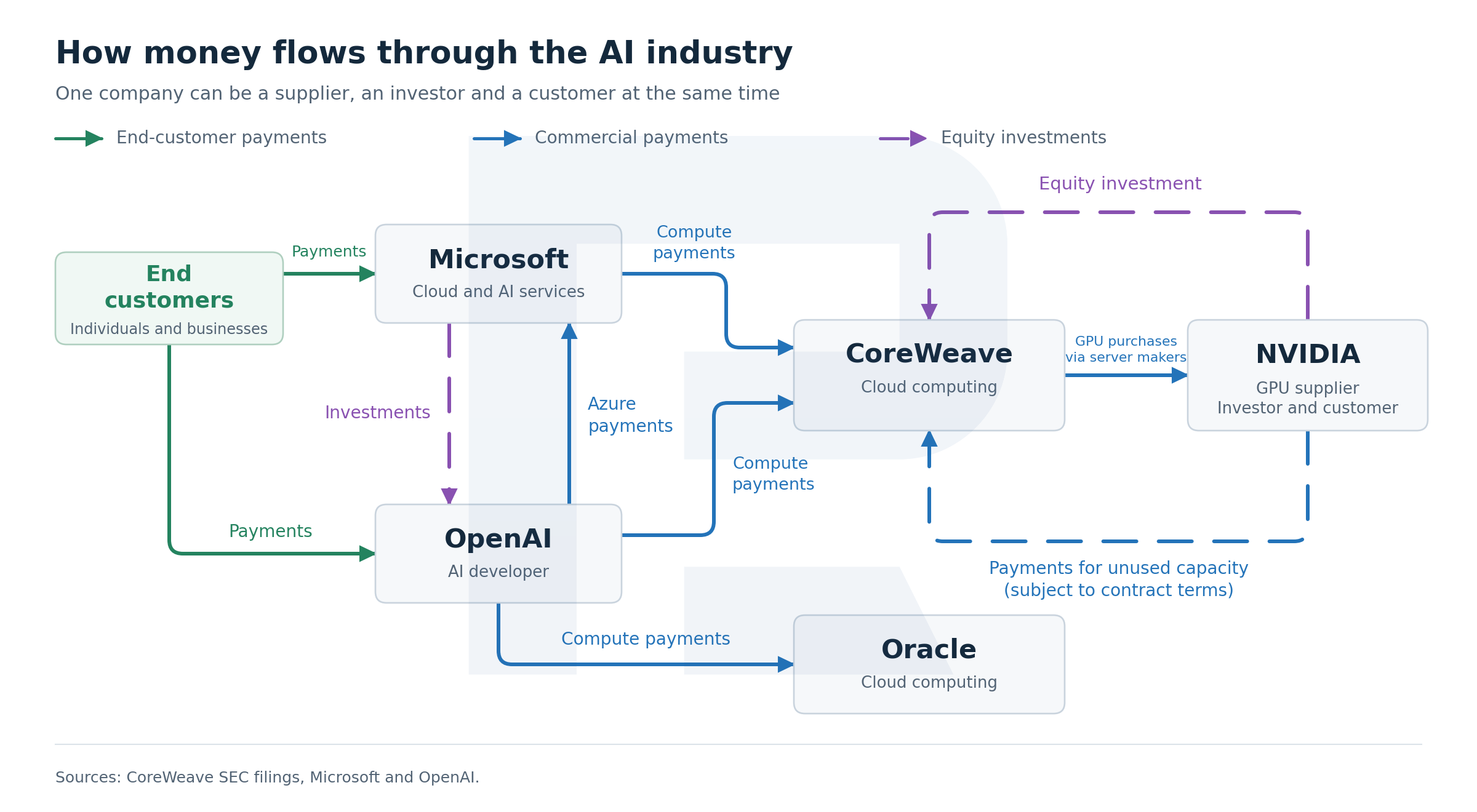
The diagram shows investments mixed with commercial payments. Microsoft invests in OpenAI, and OpenAI pays for Azure, CoreWeave and Oracle. CoreWeave buys Nvidia chips through server makers. Nvidia owns CoreWeave shares and has agreed to pay for unused capacity on the contract terms. End users pay Microsoft and OpenAI, and that money keeps demand flowing down the chain. Nvidia runs a similar loop with OpenAI, explained in What the Circular Deal Means for NVDA Stock.
The danger starts when purchases funded by mutual investments grow faster than these end payments. Then a cut in new orders from one large client can hit its partners' revenue and their access to credit. The companies hold up as long as they turn orders into enough cash to run the contracts and repay the debt.
What Happens If a Large Client Cuts Spending?
Take a hypothetical case. Microsoft sharply cuts the computing it buys from outside operators, and at the same time financing for its partners gets harder to find. Providers lose new orders and face pressure on prices when contracts come up for renewal. Forced GPU sales lower the value of the collateral. If banks then stop new lending, companies with large near-term payments have three options: sell assets, issue shares on poor terms or default. Existing contracts can delay the fall in revenue, while the cash needed for construction is still needed. For shareholders this scenario means the risk of losing a large part of the capital invested.
A study by the Bank for International Settlements published on 1 October 2026 found direct financial ties in 15.2% of supplier and customer pairs in AI computing and infrastructure. The figure measures how tightly the largest players are linked, and it says nothing about how much of global AI demand is artificial. With ties this close, a financial or commercial problem at one large company can travel along the chain to the others.
In September CoreWeave reported higher prices on new short-term rental contracts. For shareholders, the test is whether these deals bring in enough cash to cover the large fixed payments on existing debt.
How Do Big Tech Companies Keep Data Centre Debt Off Their Books?
Large technology companies also use partners' money to build data centres. In October 2025 Meta announced the Hyperion joint venture with funds managed by Blue Owl. Meta holds 20% and its partner 80%. The buildings and long-lived infrastructure were valued at about 27 billion USD, and the partner raises part of the money through bonds. During the first 16 years of operation Meta has to cover part of any fall in the campus's value under certain conditions.
The risk reaches large clients too. In July 2026 S&P cut Oracle's credit rating to BBB-, the lowest investment grade step, because of the financial load from its AI expansion. When a client finds it harder to pay, the projects that rely on its money get riskier as well. How Oracle's stock has priced this load is covered in Oracle Stock Down 60% From Its Peak.
How Does the GPU Write-Off Period Affect Profit and Debt Risk?
The period over which a company writes off its GPUs sets how much profit it reports. CoreWeave spreads the cost of its hardware over six years, and Nebius extended its period from four to five years from 2026. Accountants call this period the useful life. A long useful life on paper keeps the yearly cost low, and it gives no promise that the servers stay rented, rental prices hold or the GPUs keep their market value.
Yearly depreciation on 1 billion USD of GPUs
Written off over 6 years
167 million USD
Written off over 3 years
333 million USD
Illustrative example, straight-line depreciation. Bar lengths are to scale.
Take hardware bought for 1 billion USD. Written off evenly over six years, it costs about 167 million USD a year in depreciation. If the GPUs age faster and have to be written off over three years, the yearly charge doubles to about 333 million USD. That difference can turn a reported profit into a large loss, while the cash for the chips is already spent and the bank debt still has to be repaid.
The pace of technology makes this a real risk. If Nvidia releases GPUs that make computing much cheaper, older hardware loses its edge and clients stop paying the old rent. Utilisation falls and the servers stop paying for themselves sooner than planned. At the same moment used GPUs get cheaper on the market, so when the company needs cash to cover losses, banks lend less against collateral that has lost value.
Open a RoboForex Account
Register in a few minutes and trade stocks, indices and currencies from one account.
How Can You Check a Neocloud’s Debt Yourself?
Compare the debt a company has to repay soon with the cash it holds and the income its clients are bound to pay. The data comes from official filings, loan agreements and credit market prices.
US-listed companies file quarterly reports on Form 10-Q, annual reports on Form 10-K and material events on Form 8-K, all searchable in SEC EDGAR. Nebius files its quarterly results on Form 6-K and its annual report on Form 20-F.
| What to check | Where to find it | What it shows | Warning level |
|---|---|---|---|
| CDS spread | Professional terminals and databases: Bloomberg Terminal, LSEG Workspace, Cbonds | What it costs a lender to insure against the company's default | A sharp rise. Above 1,000 basis points the market reads the company as under severe stress |
| Bond yield | Bond platforms and trackers: Koyfin, Cbonds, BondStats, TradingView | The return the market wants for holding the company's bonds | A sharp rise against government bonds and similar issuers |
| Interest cover | Income statement | Whether operating income covers the interest on the debt | Below 1: the business earns less than it pays in interest |
| Top client share | Revenue note or customer concentration note | How much revenue is at stake if one buyer leaves or cuts spending | Above 50%, most revenue comes from one client; a smaller share can still matter |
| Debt due in 12 months against cash | Balance sheet, debt maturities and restricted cash notes | Whether the cash on hand covers the debt due within a year | Above 1: cash falls short and the company needs new loans or prepayments |
CoreWeave's Five Numbers
Here are the same five checks run on CoreWeave:
| Indicator | Value | Reading |
|---|---|---|
| CDS spread | 1,148 basis points, 26 October 2026 | Warning Clear credit stress |
| Bond yield | 15.58%, 26 October 2026 | Warning The market prices the debt as high risk |
| Interest cover | 0.20x, Q2 2026 | Warning Adjusted operating income covers 20% of net interest expense |
| Top client share | 36% for the largest client, 72% for the three largest, Q2 2026 | Watch Below the 50% line for one client, high for the top three |
| Debt due in 12 months against cash | 1.36x, 30 June 2026 | Warning Cash falls short of the short-term debt |
CoreWeave is past the warning level on four of the five checks. Its adjusted operating income does not cover net interest, and its cash is smaller than its short-term financial debt. The company depends on incoming client payments and on drawing its credit lines.
Which Dates Should Neocloud Investors Watch?
The next readings of these five numbers come with the quarterly reports, and CoreWeave's repayment schedule shows when the largest sums fall due.
| When | What happens | What to check |
|---|---|---|
| November 2026 | Q3 2026 reports from CoreWeave, Nebius, IREN and the other neoclouds. Exact dates were not announced as of 28 October | The five checks above against the Q2 figures: interest cover, top client share, debt due in 12 months against cash |
| Rest of 2026 | 4.41 billion USD of CoreWeave debt principal falls due | Whether repayments come from client payments or from new borrowing |
| 2027 | 6.18 billion USD of CoreWeave debt principal falls due | New bond issues and their yields, which show what refinancing costs |
| By mid-2028 | CoreWeave expects to recognise about 40% of its 30 June 2026 backlog as revenue | Revenue growth against the backlog, quarter by quarter |
| 13 April 2032 | Nvidia's commitment to buy CoreWeave's unused capacity ends | How much of the 6.3 billion USD order Nvidia has used up |
Where to Trade Neocloud Stocks
All six companies from this article trade on StocksTrader, the RoboForex platform for stocks: CoreWeave (CRWV), Nebius (NBIS), IREN (IREN), Applied Digital (APLD), TeraWulf (WULF) and Cipher Digital (CIFR). Before you open a position, run the company through the five checks above. These stocks move sharply on news about debt and financing, so size each trade for a large move after a quarterly report.
Trade Neocloud Stocks on StocksTrader
CRWV, NBIS, IREN, APLD, WULF and CIFR on one platform at RoboForex.
Conclusion
Neocloud stocks can lose value even while demand for AI stays high. The companies buy hardware and build data centres now, get paid over several years and repay debt on a fixed schedule, so a large backlog still leaves them short of cash. If GPU rental gets cheaper and credit tightens, CoreWeave, Nebius and IREN face the most pressure and may have to sell assets, issue shares or renegotiate payments. Applied Digital, TeraWulf and Cipher Digital are exposed through tenants who may struggle to pay. A freeze in data centre construction would also hit chipmakers such as Nvidia and their suppliers.
The bond market already prices this risk: on 26 October CoreWeave's bonds yielded 15.58% and its CDS stood at 1,148 basis points. Before you buy any neocloud stock, run its latest 10-Q through the five checks above.
FAQ
What are some neocloud stocks?
The group includes CoreWeave, Nebius and IREN, plus the infrastructure owners Applied Digital, TeraWulf and Cipher Digital. The first three rent out computing on their own GPUs. The other three mainly build campuses and collect lease payments, which changes what backs their debt and where the risk sits.
Why did neocloud stocks fall in October 2026?
Investors grew worried about debt and the cost of financing construction. CoreWeave's bonds fell, their yields rose to 15 to 16% and the cost of insuring its debt went up. The pressure spread to other companies in the sector whose plans also depend on cheap capital and future computing revenue.
Is CoreWeave a neocloud?
Yes. CoreWeave runs a specialised cloud for the computing needed to train and run AI models. It buys the hardware, places it in data centres and serves clients. It funds its growth with secured loans, bonds, shares and client prepayments, so checking it means looking at utilisation, contracts and debt together.
Is IREN a neocloud?
Yes. IREN is building its own GPU cloud and AI infrastructure while it moves away from bitcoin mining. It funds this with client prepayments, secured hardware financing, convertible bonds and share sales. Owning its sites leaves the corporate debt and the cost of buying and replacing hardware in place.
Will neoclouds survive?
Results will differ by company. Gartner expects more than 80% of neocloud providers to stop operating independently by 2030 because of cost pressure and weak differences between business models. That includes mergers and changes of owner as well as closures, so it does not mean 80% of the companies go bankrupt. For shareholders, the deal price and the size of possible losses decide the outcome.
What is the difference between a hyperscaler and a neocloud?
A hyperscaler runs a large cloud platform with a wide range of services, and Microsoft, Amazon and Google also have other large businesses. A neocloud usually specialises in AI computing. That focus lets it add capacity quickly and makes it more sensitive to financing terms, GPU utilisation and the budgets of a few large clients.
When does CoreWeave have to repay its debt?
Repayments are already under way. At 30 June 2026 about 7.51 billion USD sat in the current portion of its debt. The principal schedule showed 4.41 billion USD for the rest of 2026 and 6.18 billion USD for 2027. Later final maturities on some loans leave these earlier repayments in place.
What does a CDS spread above 1,000 basis points mean?
It means that protection against certain credit events is expensive and lenders are seriously worried. 1,000 basis points equals a spread of 10 percentage points. Turning the quote into a probability of default takes further assumptions, including how much lenders recover after a default and the terms of the specific CDS.
- NVIDIA Funds OpenAI, OpenAI Buys NVIDIA Chips: What the Circular Deal Means for NVDA Stock: the circular money flow from Nvidia's side.
- NVIDIA Turns One Deal Into Two Revenue Streams: What Firmus Means for NVDA Stock: a neocloud deal seen from the chipmaker.
- Oracle Stock Down 60% From Its Peak: Can the Bloom Energy Deal Trigger a Reversal in ORCL?: the large client behind much of the AI debt.
Update log
- 28 October 2026. First version. Company figures from the Q2 2026 reports, market data as of 26 October 2026. Next update after the Q3 2026 reports.
Any forecasts contained herein are based on the author's independent analysis and reflect their personal opinion. These articles should not be construed as trading recommendations or a call to action. The authors and RoboForex accept no responsibility for the results of any trades made on the basis of these recommendations and reviews. Past performance is not indicative of future results. Trading stocks and CFDs involves a high risk of capital loss.