Anthropic IPO News: Orders Hit Six Times the Offer. Can ANT Beat the Weak 2026 IPOs?

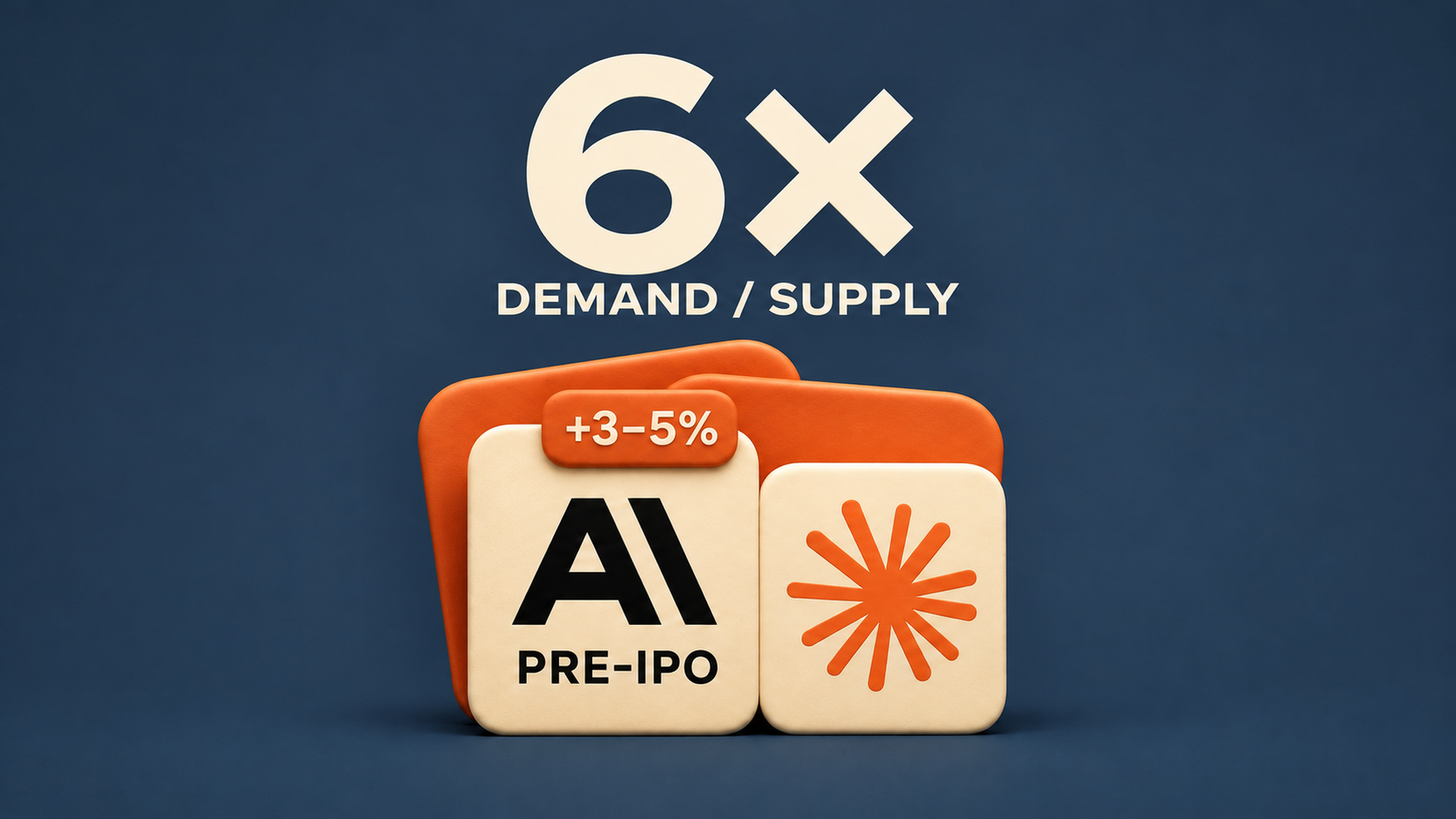
The latest Anthropic IPO news is about demand: orders are about six times the shares on offer. The company goes public in a market where tech companies raise record sums and buyers of 2026 IPOs mostly sit on losses. Amazon, Alphabet, Microsoft and Meta have sharply increased bond sales, borrowing costs are rising, and six of the seven largest offerings on US exchanges this year trade below their IPO price. The real test for Anthropic starts once trading opens.
TL;DR
- Amazon, Alphabet, Microsoft and Meta sold 2.55 times more USD bonds from January to 13 November than in all of 2025.
- Investors want more pay for risk: Meta's premium over US Treasuries on five-year bonds roughly doubled between April and November.
- Six of the seven largest 2026 IPOs on US exchanges trade below their offer price.
- Six-times demand supports the Anthropic IPO, while a higher price and funds' heavy AI holdings could limit buying after the debut.
Last updated: 16 November 2026
This post covers how the cost of money for tech companies has changed, how the largest 2026 IPOs have performed and what this means for ANT. The filed terms are in our post on the Anthropic IPO date, and the full story of the listing is in our Anthropic IPO guide.
Follow Stock Markets in RoboForex MobileTrader
Quotes, charts and orders in one app, on your phone or in Telegram.
Investors Want More Pay for Risk
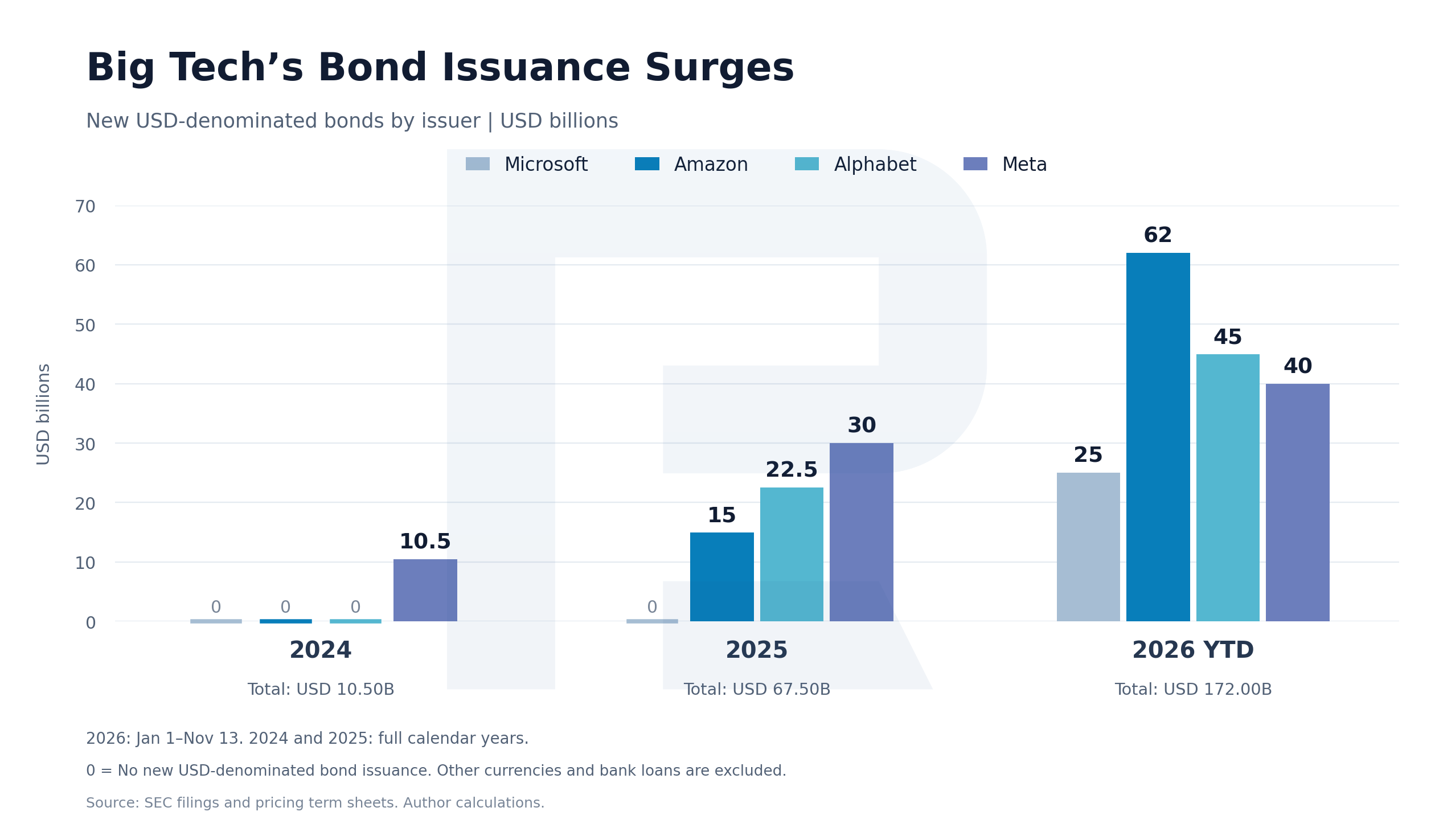
Over the past three years the largest tech companies have sharply increased the money they raise, partly to build out AI. The USD bonds of Amazon, Alphabet, Microsoft and Meta show the scale of this race.
In 2024 the four companies sold bonds worth 10.5 billion USD, all of it from Meta. In 2025 the total reached 67.5 billion USD, and from the start of 2026 to 13 November it came to 172 billion USD. With the year not yet over, that is already 2.55 times the full 2025 amount.
The interest the companies pay on new bonds has gone up too. At Amazon the weighted average yield of new fixed-rate USD bonds rose from 4.71% in 2025 to 5.19% in 2026, at Alphabet from 4.99% to 5.30% and at Meta from 5.15% to 6.07%. Microsoft sold no USD bonds in 2025, and its 2026 issues came at 5.61%.
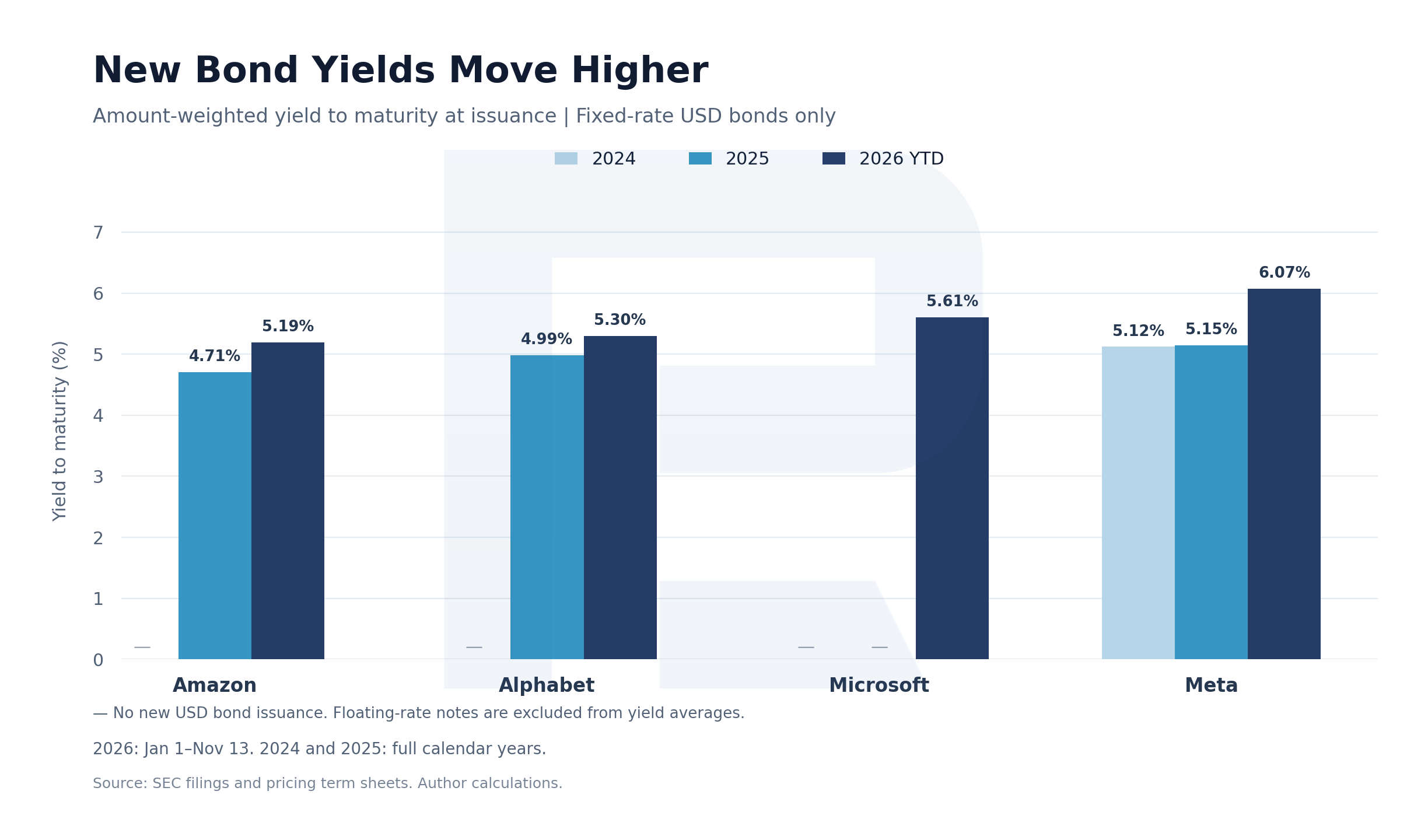
Part of this rise comes from changes in base rates and in bond maturities. To see whether investors want more for the risk of the companies themselves, look at the premium over US government bonds. It shows how much extra buyers want for holding corporate debt.
Meta is a telling example. When it sold five-year bonds in April 2026, the premium was 0.53 percentage points. At a new five-year issue in November it reached 1.10 percentage points. The premium more than doubled while the company's credit ratings stayed high, Aa3 at Moody's and AA- at S&P. Higher Treasury yields explain part of Meta's higher borrowing cost. The rest is a higher price investors now charge for Meta's own risk.
Money keeps flowing into the tech sector, and market participants look harder at the terms. Meta's case shows that even a high credit rating no longer secures a company its previous funding terms. Interest in AI holds up, and investors want more pay for the risk they take. For the Anthropic IPO this means that belonging to the AI industry is no longer enough. The company has to convince buyers that its growth can turn into steady profit and justify the share price, a question we looked at in our post on whether Anthropic is profitable.
The Largest 2026 IPOs Have Disappointed Buyers So Far
Rising risk premiums in the bond market show that investors have become stricter about funding terms for tech companies. They also look harder at a company's valuation before its IPO. If much of the expected success is already in the offer price, buyers find it harder to earn once trading starts. The largest deals of 2026 show this risk: of the seven largest offerings on US exchanges, six closed below their IPO price on 13 November.
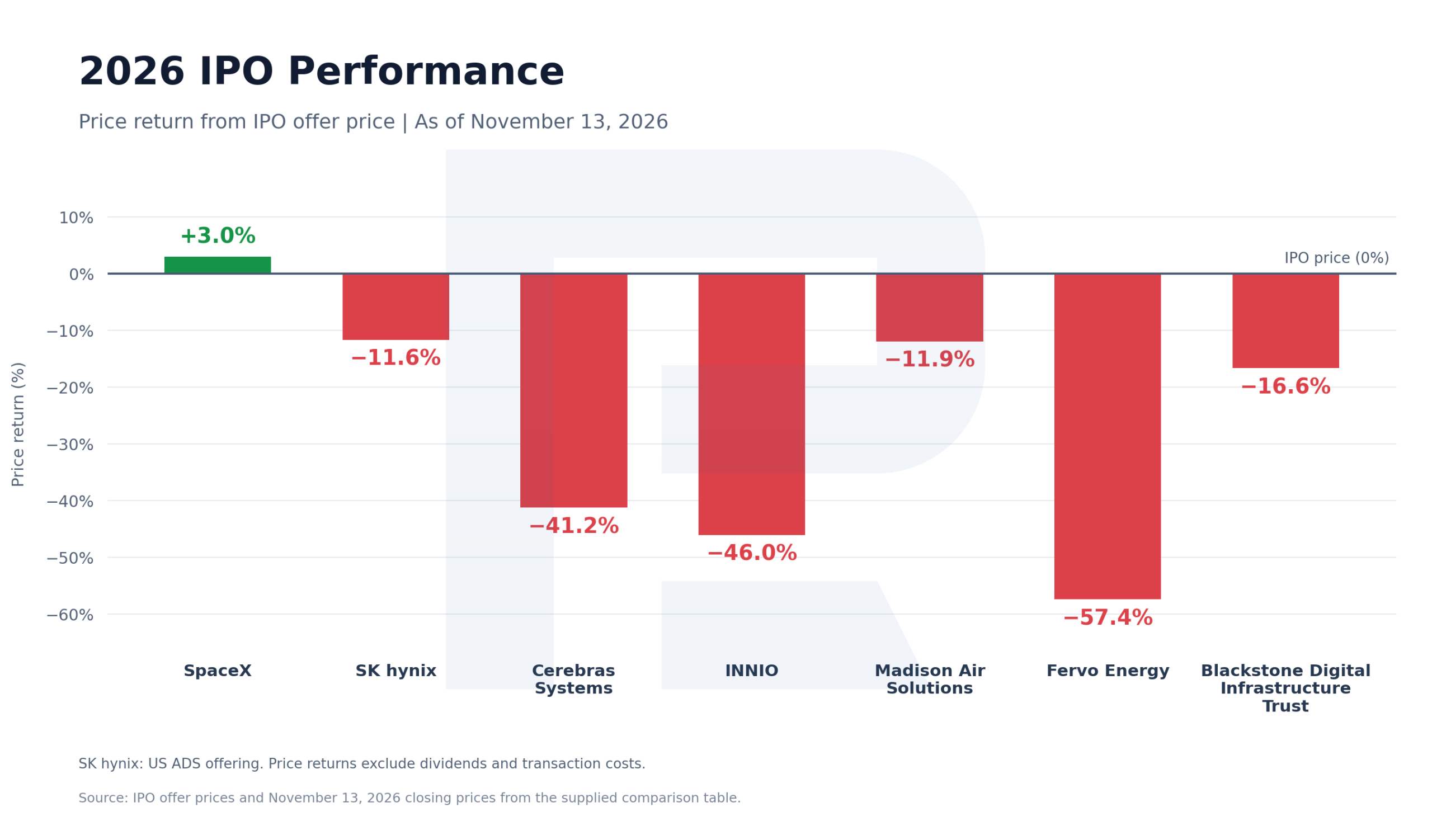
The losses are deepest at Cerebras Systems (CBRS), INNIO (INNIO) and Fervo Energy (FRVO): their shares are 41% to 57% below the offer price. Even SpaceX, the largest deal of the year, holds a gain of only about 3%. For investors who bought after the first jump in the share price, the result could be even worse.
The market is tired of the large volume of new stocks and bonds, the Financial Times writes. At the same time investors doubt that AI spending will pay off and that starting valuations are justified. Some fund managers prefer to hold on to cash and buy the shares they like more cheaply after the IPO.
For a wider picture, compare the average return of the largest IPOs since 2018.
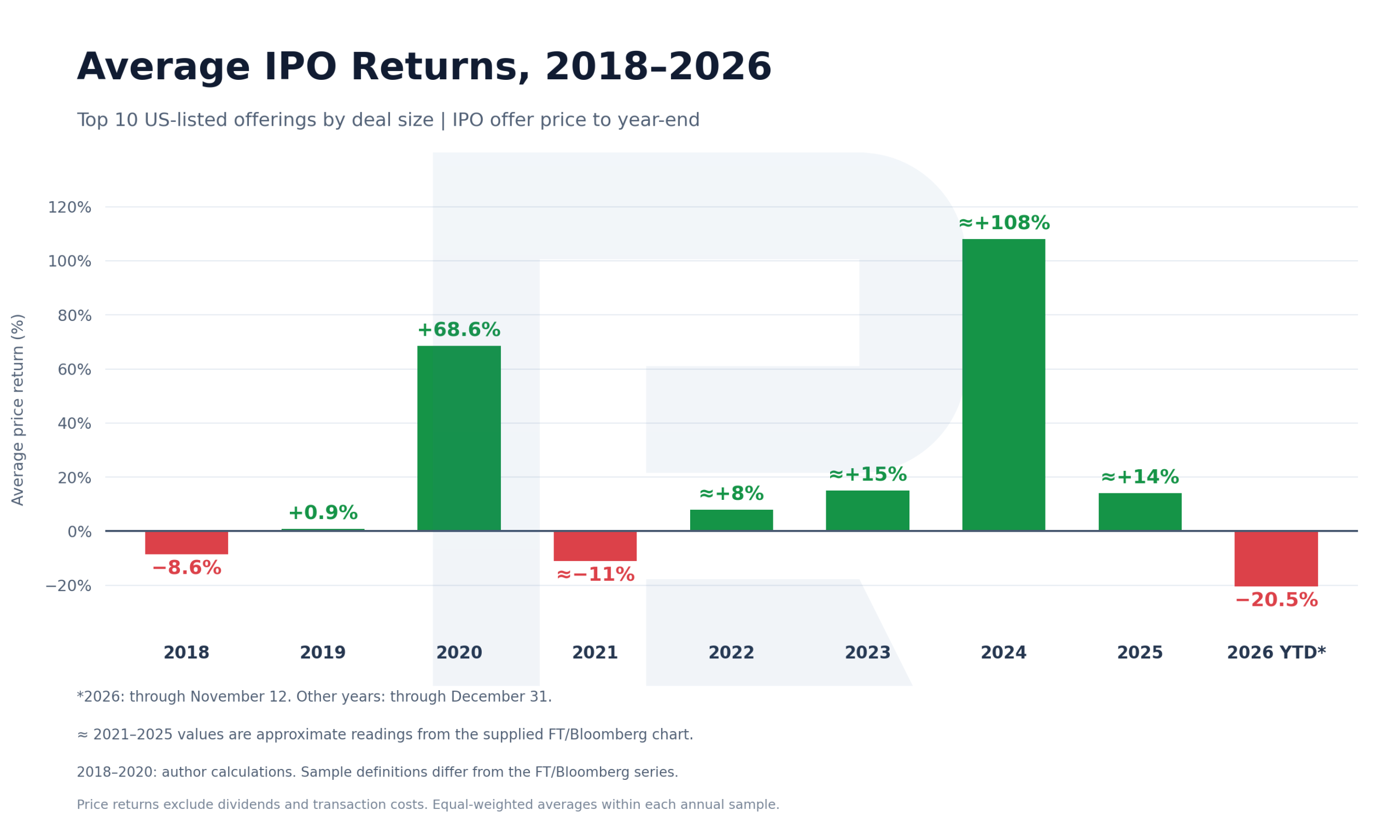
On this chart 2026 is the weakest year of the period, with an average loss of 20.5%, though the year is not over yet. The figure covers the ten largest deals, so it differs from the seven above. This raises the stakes for Anthropic: the company comes to a market where investors have already taken losses on other large offerings.
Even investors who want to take part in the Anthropic IPO may first have to free up money, for example by selling at a loss shares of earlier IPOs they bought after trading began. That step is easier when the new investment looks more attractive than the old one. A valuation of about 1 trillion USD at the top of the range, covered in our post on the Anthropic market cap, could be an extra argument for moving capital into Anthropic. The higher the final price, the harder it will be to convince buyers that the upside justifies the new risk.
Trade Anthropic Stock on StocksTrader
ANT after the Nasdaq listing, with US stocks and ETFs on one platform at RoboForex.
What the Anthropic IPO News Means for ANT After the Debut
Anthropic comes to the listing with strong demand: orders are about six times the shares on offer, Bloomberg reported. Bankers are weighing a price above the 70 to 78 USD range, as covered in our post on the Anthropic stock price. The oversubscription shows interest in getting shares on IPO terms. It does not guarantee the same buying power at a higher market price after the debut.
This is where the risk of portfolios already full of AI comes in. A fund that holds large positions in chip developers, cloud companies and data centre owners may see Anthropic as one more bet on the same industry. Even an attractive business may get a small weight in the portfolio if the manager wants less dependence on one investment story.
After so much capital raising, the reasons to diversify carry more weight:
- Funds with a large share of AI holdings may limit concentration, send new money to other sectors and buy less of the next AI deal.
- Higher yields on bonds raise the return investors expect from stocks, especially when the business is expensive.
- Losses on earlier offerings may lead investors to wait for a lower price after the debut and skip the first rush.
This does not mean all funds will leave AI at once. For ANT to keep rising after trading opens, it needs new demand from buyers ready to add shares at the market price. If early participants start taking profit and large managers choose to diversify, the initial shortage of shares could quickly turn into selling pressure.
Conclusion
The data above point to tougher competition for capital and stricter selection of investments. Tech companies keep getting funding, and investors want higher bond yields and a convincing case for share valuations. The weak results of large offerings show that raising money on a strong growth story and earning a profit for buyers are two separate tasks.
Anthropic goes public while interest in AI is still huge and some investors have already paid too much for it. Funds will compare ANT with cheaper shares of other companies, with bond yields and with opportunities outside the tech sector.
Six-times demand gives Anthropic a strong position in setting the offer terms. If the company uses the excitement to push the price as high as possible, it keeps most of the advantage buyers count on. After trading starts, new investors will need a reason to pay even more, while early participants can already take profit.
The main risk of the Anthropic IPO is a gap between the success of the deal for the company and its result for shareholders. Demand allows a large deal, and the experience of other 2026 IPOs calls for care about the entry price. The more of Anthropic's future success is priced into ANT at the open, the harder further growth in the share price will be.
FAQ
How have the largest 2026 IPOs performed?
Of the seven largest offerings on US exchanges in 2026, six traded below their offer price at the 13 November close. Fervo Energy was down 57.4%, INNIO 46.0% and Cerebras Systems 41.2%. SpaceX was up about 3%.
What is the latest Anthropic IPO news?
Orders for the Anthropic IPO are about six times the 825 million shares on offer, Bloomberg reported. The price range is 70 to 78 USD a share, bankers are weighing a price above it, and ANT is expected to start trading on Nasdaq this week.
Why do higher bond yields matter for the Anthropic IPO?
Higher yields on tech companies' bonds raise the return investors expect from stocks. When debt pays more, an expensive stock needs a stronger growth case to attract buyers.
What is the main risk for ANT after the listing?
If the offer price already includes much of Anthropic's future success, new buyers will need a reason to pay more after the open, while early participants can take profit. Funds with heavy AI holdings may also buy less.
- Anthropic Stock Price at the IPO Could Top 78 USD: Why Banks Weigh a Higher Price: how demand moves the offer price and the total raised.
- Anthropic Market Cap at the IPO: How Expensive Is ANT at 1.02 Trillion USD?: the P/S ratio against large tech companies.
- Anthropic IPO: What the S-1 Shows and Should You Buy ANT Stock?: the listing, valuation scenarios and lessons from past IPOs.
Any forecasts contained herein are based on the author's independent analysis and reflect their personal opinion. These articles should not be construed as trading recommendations or a call to action. The authors and RoboForex accept no responsibility for the results of any trades made on the basis of these recommendations and reviews. Past performance is not indicative of future results. Trading stocks and CFDs involves a high risk of capital loss.