Bank of England Rate Hike on 17 December: The Data to Watch
Will there be a second Bank of England rate hike on 17 December? On 24 November Monetary Policy Committee member Megan Greene said disinflation, the slowdown in inflation, has stalled, above all in wages, and that the Bank needs to raise rates to get ahead of inflation risks, FXStreet reported. Markets and economists disagree on the timing, and two UK data releases land in the two days before the decision.
TL;DR
- Bank Rate is 4% after the 5 November hike. The next decision is due on Thursday, 17 December.
- On 18 November markets priced about 80% for a December hike, while 64 of 65 economists in a Reuters poll expected a hold and a hike in February 2027.
- Pay data on 15 December and November inflation on 16 December test the two pressures Greene pointed to: wages and energy costs reaching other prices.
Last updated: 27 November 2026
Follow GBP/USD in RoboForex MobileTrader
Quotes, charts and orders in one app, on your phone or in Telegram.
What Megan Greene Said About Rates
Greene spoke at a SIGNUM roundtable in London on 24 November. Her case rests on pay. In her view wage growth is stuck around 3.5%, while pay growth consistent with the 2% inflation target is about 3%. Firms expect to raise pay by 3.6%, which she called too much, and she said the spare capacity in the labour market has probably been used up.
She also set a bar for a bigger move. A half-point hike, she said, would need firm evidence that higher energy prices are passing into wages and prices. Only a reversal in the data or a change in the war could change her view. The Bank has not published a text of her remarks, so FXStreet's report is the source here.
Where the Bank Stands After the November Hike
On 5 November the Bank published its decision to raise Bank Rate by 0.25 percentage points to 4%. The committee voted 8 to 1, and the one dissenting member wanted 0.5 points. According to the November Monetary Policy Report, energy prices driven by the conflict in the Middle East are the main source of inflation. Consumer price inflation rose from 2.6% in June to 3.5% in September, and the Bank projects about 5% by the second quarter of 2027.
The Bank says its path is not set in advance. At each meeting the committee checks whether energy costs are passing into wages and other prices, what economists call second-round effects. The report also sets out a scenario with tighter policy if energy prices jump again and those effects grow stronger.
October inflation came in at 3.6%, slightly below the 3.7% expected, Daily Sabah reported. The split inside that figure matters for December: core inflation, which leaves out energy, food, alcohol and tobacco, was 2.8%, while services inflation, the price rise for things like rents, travel and haircuts, was 3.7%.
Pay runs 0.5 points above Greene's 3% mark, inflation 1.6 points above the 2% target
Annual change, %. October 2026 CPI; pay as quoted by Megan Greene on 24 November. The dark tick marks the reference level for each group.
| Measure | Annual change |
|---|---|
| Pay, reference 3% (Greene) | |
| Wage growth, Greene's estimate | about 3.5% |
| Pay rises firms expect | 3.6% |
| Inflation, target 2% | |
| Services inflation, October 2026 | 3.7% |
| Headline inflation, October 2026 | 3.6% |
| Core inflation, October 2026 | 2.8% |
- Headline inflation is 1.6 points above the 2% target.
- Wages run 0.5 points above the 3% Greene sees as consistent with the target, firms' pay plans 0.6 points.
- Core inflation leaves out energy and sits 0.8 points above the target, half the headline gap.
Source: Daily Sabah (October CPI, 18 November 2026), FXStreet (Megan Greene, 24 November 2026). Data as of 24 November 2026.roboforex.com/blog
Headline inflation is high because of energy, and core inflation is lower. The question the Bank asks at each meeting is whether energy costs are spreading into pay and services prices, and those are the numbers already running at 3.5% to 3.7%.
Bank of England Rate Hike Expectations: Markets Against Economists
The two main readings of December point in different directions, and they come from different dates.
| Who | Date | 17 December | Further out |
|---|---|---|---|
| Markets | 18 November, after October CPI | About 80% chance of a hike, down from 90% | Three to four quarter-point hikes by the end of 2027 |
| Economists, Reuters poll | Reported 13 November | 64 of 65 expect a hold | A hike in February 2027 |
Sources: Daily Sabah for market pricing and the Reuters poll as retold by Mortgage Introducer. Neither figure reflects Greene's remarks on 24 November, and we have no market pricing from after that date.
Both camps expect the rate to go higher, and they differ on timing: the poll points to February, market pricing pointed to December. Whichever reading the data on 15 and 16 December supports, the other group has the most to adjust.
What Must Happen for a Second Rate Hike
Greene's remarks and the Bank's report point to three things to check before the decision.
| What to check | Latest reading | What would support a hike |
|---|---|---|
| Pay growth | About 3.5%, against about 3% consistent with the target (Greene). Firms expect pay rises of 3.6% | Pay growth holding near 3.5% or rising |
| Energy costs reaching other prices | October: headline 3.6%, services 3.7%, core 2.8% | Services and core inflation rising in November |
| Energy prices | The main source of inflation, linked to the Middle East conflict (Bank of England) | A new jump in energy prices, the Bank's tighter scenario |
Two of the three get a fresh reading in the days before the vote. Energy prices move every day, and firms' pay plans have no update among the releases below.
Pay and inflation data land in the two days before the vote
- 15 December, 07:00 UKUK labour market with average weekly earnings (ONS), the next scheduled UK pay figuresCompare with 3.5% and 3%
- 16 December, 07:00 UKConsumer price inflation for November (ONS)Services against 3.7%, core against 2.8%
- 17 DecemberRate decision, Monetary Policy Summary and minutes (Bank of England)Vote split, 8 to 1 in November
Source: ONS, GOV.UK and Bank of England release calendars, checked 26 November 2026.
The committee will vote with both releases in hand. The Bank's calendar lists no Monetary Policy Report for December, so the minutes and the vote split are where the committee explains its decision.
Three Scenarios for 17 December
Scenario 1. A hike to 4.25%
If pay growth holds near 3.5% on 15 December and services or core inflation rise on 16 December, then the data backs the case Greene made for raising rates, the outcome markets favoured on 18 November.
Scenario 2. A hold, then February
If pay growth slows toward 3% and November inflation eases, then the committee has room to wait, the path most economists in the Reuters poll expected.
Scenario 3. A half-point move
If energy prices jump again and the data shows firm evidence of energy costs passing into pay and prices, then the condition Greene set for 0.5 points is met. One member already voted for 0.5 points in November.
These scenarios for the decision carry no probabilities of their own. The technical view on the pound follows below.
GBP/USD Technical Analysis Before the Bank of England Decision
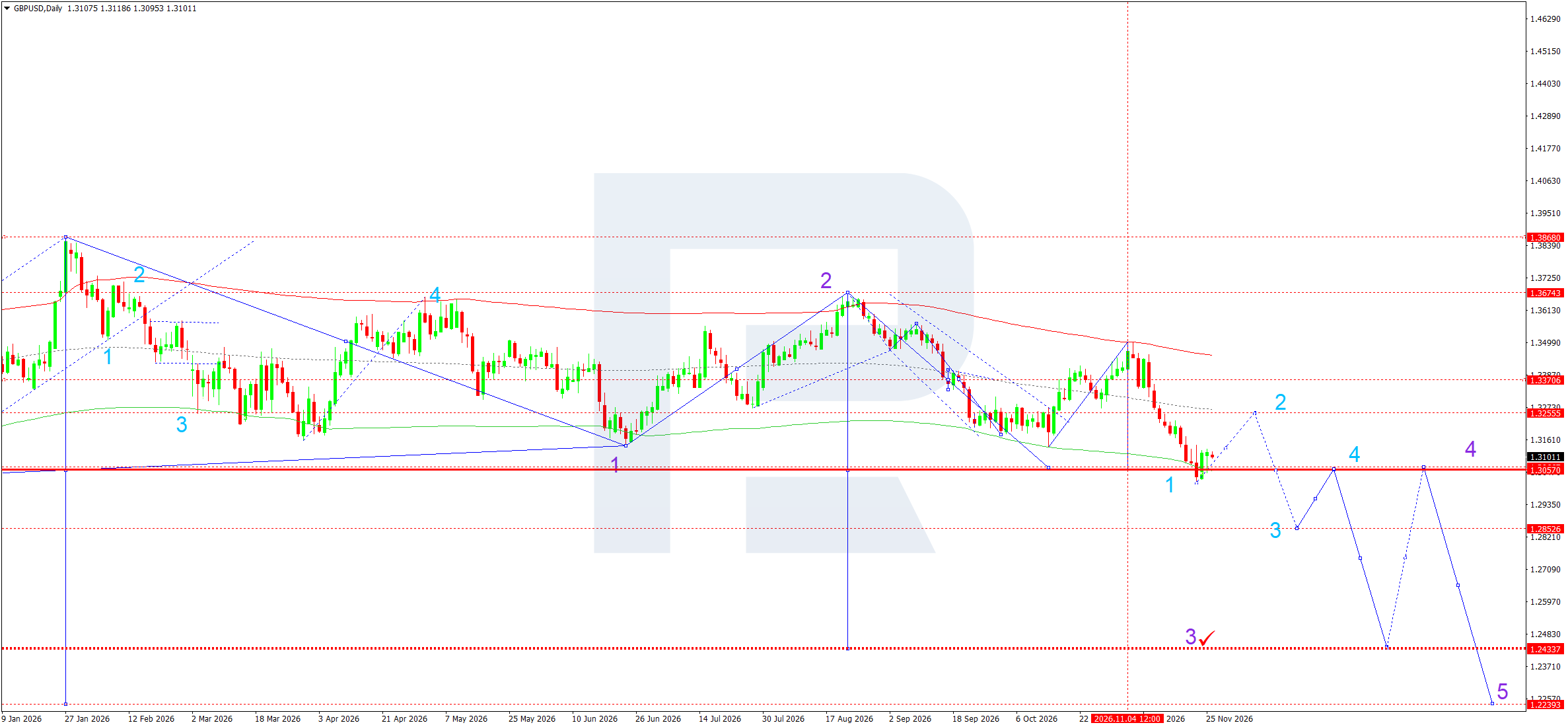
The levels and the trade scenario below come from RoboForex analysts, measured on 26 November 2026 with GBP/USD near 1.3100. They read the daily chart with Elliott waves: the pair is in a medium-term downtrend, the first leg of a new decline has run to about 1.3012, and a correction is now under way.
How GBP/USD Reacted to UK Inflation and Greene's Remarks
After the October inflation figures on 18 November the pair kept falling, and the pound made no lasting turn higher. Around 24 November the four-hour chart shows a local recovery from the lows near 1.3012, in line with Greene's call for higher rates. Buyers have not changed the downward structure so far, and the analyst treats the rebound as a correction inside the trend.
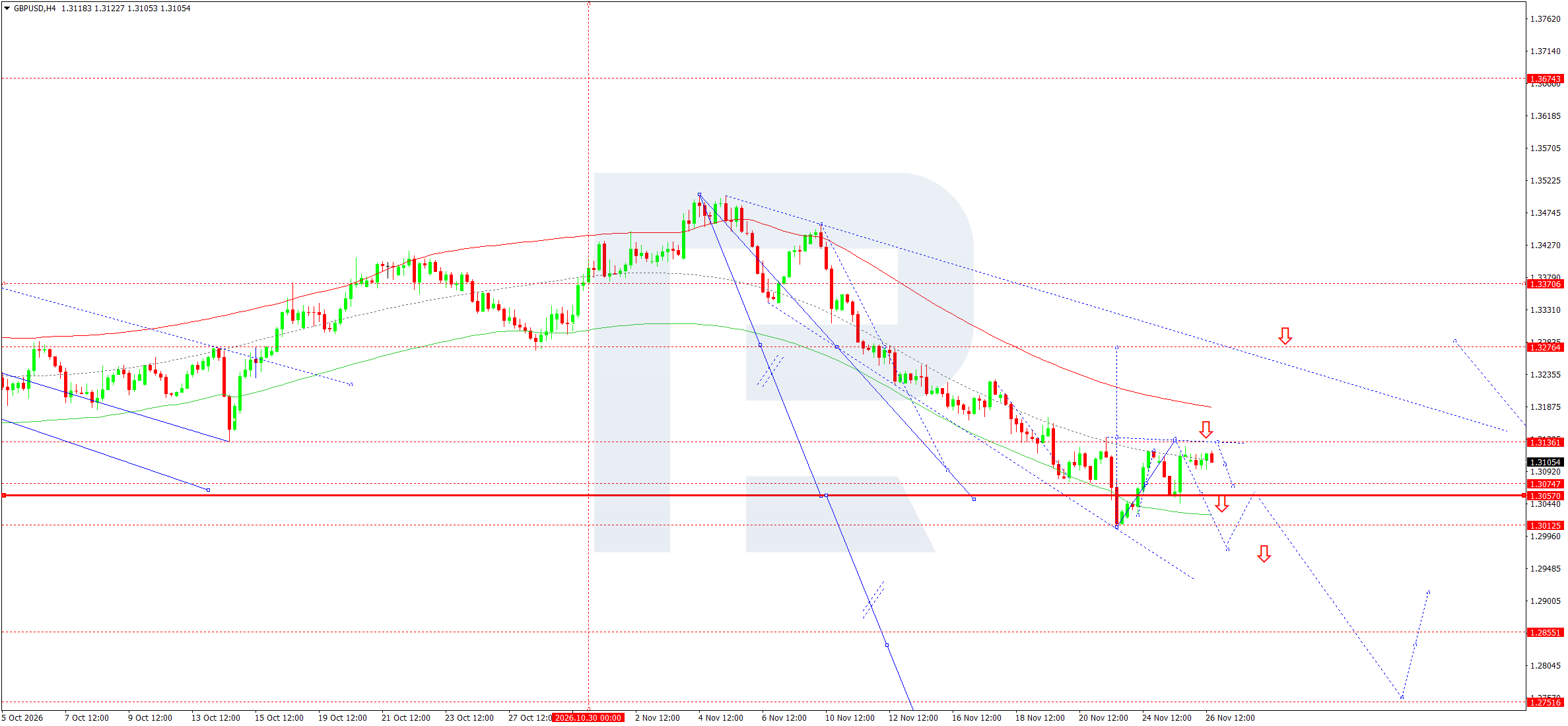
GBP/USD Levels to Watch Before 17 December
| Level, GBP/USD rate | Type | Timeframe | Why it matters |
|---|---|---|---|
| 1.3274 | Resistance | H4 | Upper target if the correction extends |
| 1.3136 | Resistance | H4 | Where the current correction is expected to end |
| 1.3100 | Current price | 26 November, analysis date | Approximate price at the time of analysis |
| 1.3076 | Support | H4 | Lower edge of the expected consolidation range |
| 1.3043 | Support | H4 | A firm break below confirms the downtrend has resumed |
| 1.2855 | Target | D1 | Intermediate target of the decline |
| 1.2755 | Target | H4 | Target of the next leg down |
The analyst expects the correction to end near 1.3136, then a drop toward 1.3076 and a period of consolidation. A firm move below 1.3043 would confirm that the decline has resumed, with 1.2755 as the target on the four-hour chart.
Trade Scenario: Selling After the Correction
The scenario waits for the correction to reach 1.3136 with a pending order and avoids selling at the current price. The Bank's tone points to higher rates, and the chart structure still points down: the analyst sees a continued decline as more likely than a rise.
| Parameter | Value | Reasoning |
|---|---|---|
| Direction | Sell | The downward wave structure on the daily chart |
| Order | Sell Limit at 1.3136 | The level where the four-hour correction is expected to end |
| Stop Loss | 1.3274 | Above the expected end of the correction at 1.3136, at the level of an extended correction |
| Take Profit | 1.2755 | The target of the next leg down on the four-hour chart |
| Risk to reward | 1 to 2.76 | 138 pips of risk against 381 pips of target |
| Horizon | 2 to 3 weeks | Up to the decision on 17 December |
Once the price falls back to 1.3100 after the order is filled, the analyst would move the stop to the entry level. If the price then turns higher again and the stop at entry is hit, the next level to look for a sale is 1.3274. If the correction stops short of 1.3136, the order stays unfilled and the scenario does not start. The target at 1.2755 may not be reached before 17 December. This is an educational example of how a pending order is built around levels, and it carries the forecast disclaimer at the end of the article.
Next Bank of England Rate Decision: How to Follow It
The vote split on 17 December says as much as the rate itself. In November one member asked for 0.5 points. More members voting for a hike, or for a bigger one, would show the committee leaning toward a faster pace, even if the rate is left at 4%.
Rate decisions tend to move the pound most when the result differs from what the market prices. Our guide on how to trade GBP/USD covers how the pair reacts to UK data, and the RoboForex Market Analysis section publishes forecasts on major pairs. For the mechanics behind the decision, read how interest rates work.
Conclusion
A second Bank of England rate hike on 17 December depends on pay and services prices. Greene says wages are stuck around 3.5% against about 3% consistent with the target, and a half-point move would need more evidence from her. Markets leaned toward December, economists toward February. The releases on 15 and 16 December show which reading the data supports.
FAQ
When is the next Bank of England rate decision?
Thursday, 17 December 2026. The Bank publishes the Monetary Policy Summary and the minutes that day. Its calendar lists no Monetary Policy Report for December.
Is the Bank of England rate expected to go up?
Both markets and economists expect higher rates, and they differ on timing. Markets priced a December hike as likely on 18 November, while most economists in a Reuters poll expected February 2027.
Why have UK interest rates gone up?
Inflation rose from 2.6% in June to 3.5% in September, driven mainly by energy prices linked to the conflict in the Middle East, according to the Bank of England. On 5 November the Bank raised Bank Rate by 0.25 points to 4% and projected inflation of about 5% by the second quarter of 2027.
What is the Bank of England base rate now?
Bank Rate is 4%, set on 5 November 2026 by an 8 to 1 vote. The one dissenting member voted for a 0.5-point increase.
Could the Bank of England raise rates by 0.5 points?
One member voted for 0.5 points in November. Megan Greene said on 24 November that a half-point hike would need solid proof that energy costs are reaching wages and prices. The Bank's report includes a scenario with tighter policy if energy prices jump again.
What GBP/USD levels matter before the Bank of England decision?
Our analyst marks resistance at 1.3136 and 1.3274 and support at 1.3076 and 1.3043, measured on 26 November 2026. A firm break below 1.3043 would confirm the downtrend, with targets at 1.2855 on the daily chart and 1.2755 on the four-hour chart.
- How Do Interest Rates Work?: why central banks raise rates when inflation climbs.
- CPI in Forex Trading: What It Is and How It Moves Prices: how to read headline, core and services inflation.
- How to Trade the GBP/USD Currency Pair: how the pound trades against the US dollar.
Any forecasts contained herein are based on the author's independent analysis and reflect their personal opinion. These articles should not be construed as trading recommendations or a call to action. The authors and RoboForex accept no responsibility for the results of any trades made on the basis of these recommendations and reviews. Past performance is not indicative of future results. Trading currencies and CFDs involves a high risk of capital loss.