Ethereum Foundation AI Security Plan: What Changes and When

The Ethereum Foundation AI plan puts protocol security first. On 23 November the foundation said it now treats artificial intelligence as a more urgent risk to Ethereum's cryptography than quantum computers, and that it has doubled its protocol security team, according to its blog. This article sets out what the foundation said, which dates belong to which group, what changes for wallets, staking pools and node operators, and which ETHUSD levels RoboForex analysts are watching.
TL;DR
- The foundation's post "PQAI #0" of 23 November calls AI a more urgent risk than quantum computers and says the protocol security team has doubled. It gives no headcount.
- Three dates circulate for a quantum-resistant Ethereum: 2027 from Ethlabs, a separate group, December 2028 proposed by Justin Drake, and 2029, the foundation's internal target. The schedule is due for review in January 2027.
- Security work takes priority over other features. Wallets, multisigs, staking pools and BLS-based tools will need rework, and larger signatures put home-node requirements under watch.
- On the daily chart ETH moved together with bitcoin and showed no separate reaction to the post. The educational scenario from RoboForex analysts sells on a return to 1,810 after a failed test of 1,844.35, with a target of 1,545.
Last updated: 27 November 2026
Follow Markets in RoboForex MobileTrader
Quotes, charts and orders in one app, on your phone or in Telegram.
What the Ethereum Foundation Said About AI and Quantum Risk
The post "PQAI #0: Preparing Ethereum for a post-quantum, post-AI world" appeared on the foundation's blog on Monday, 23 November, written by Kev Wedderburn. A second part, "PQAI #1", followed on 24 November and covers Keccak-256, the hash function Ethereum uses. The foundation says it has doubled its protocol security team and moved protocol hardening to the top of its list. Neither the post, The Block nor Decrypt gives the size of the team.
The three main texts describe the AI risk in different terms, and the difference matters for how serious the change sounds.
| Source | How it describes the AI risk |
|---|---|
| Ethereum Foundation blog, 23 November | Mostly about AI models finding bugs in production software faster than people can review the code |
| Decrypt, 24 November | AI could find mathematical shortcuts against elliptic-curve cryptography without any quantum hardware |
| The Block, 24 November | Quotes the foundation's caveat that the shift does not mean AI will break the foundations of cryptography |
Read together, the foundation's own text speaks mostly about the speed at which software flaws are found, while Decrypt's summary reaches further, into the mathematics of the signature scheme. All three compare urgency. The security team doubled five months after the June restructuring, when the foundation cut 54 positions, so the security work grew while the organisation as a whole shrank.
Is Ethereum Quantum Resistant? The Hash-Based Plan
Ethereum is not quantum resistant today: its signatures rely on elliptic-curve cryptography, the kind a large enough quantum computer could break. The plan described by The Block proposes to move three parts of the network to hash-based cryptography, which is considered resistant to quantum attacks:
- signatures that validators use in consensus;
- user accounts, which means migrating wallets;
- commitments for blobs, the data packages that layer 2 networks post to Ethereum.
What the November post adds is an order of priorities: AI moves ahead of quantum computers in urgency, and protocol security moves ahead of other features.
Timelines for Quantum Resistance: 2027, December 2028 and 2029
Coverage of the plan quotes three target years. They come from three different sources, and only one of them is the foundation's own target.
Only 2029 is the Ethereum Foundation's own target; 2027 and 2028 are proposals
- January 2027The schedule is reviewedReview
- 2027Target named by Ethlabs, a group outside the foundationProposal
- December 2028Proposed by Justin Drake at Devcon in MumbaiProposal
- 2029The foundation's internal targetInternal target
Source: The Block, 24 November 2026.
The foundation's target stays 2029, and the earlier dates are proposals. Two years separate the Ethlabs date from the foundation's, and Drake's December 2028 sits about a year before the foundation's target. The January 2027 review is the next scheduled review of the timeline, so it is the date to watch for anyone tracking the schedule.
What the Security Priority Pushes Back
The foundation's post is direct about the cost: features that have been in development for a long time will wait. The post also says Ethlabs removed Quick Slots, a proposal for shorter block times, from the plans for the Hegotá upgrade.
The next upgrade in line, Glamsterdam, was on test networks with no mainnet date set, according to the ethereum.org roadmap page as last updated on 16 October. Its two headline changes are enshrined proposer-builder separation (ePBS), which builds the split between the parties that assemble blocks and those that propose them into the protocol, and block-level access lists (BALs), which tell nodes in advance which parts of the state a block touches.
What Changes for Wallets, Staking Pools and Node Operators
Hash-based signatures are larger than the ones Ethereum uses today, and that change reaches beyond the protocol. The foundation's post names the groups that will have to adapt.
| Who | What changes |
|---|---|
| Wallet users | Accounts would move to new signatures, so wallets would need a migration path |
| Multisig wallets | Need rework for the new signature type |
| Staking pools and validators | Validator consensus signatures would change, and pool software would have to follow |
| Tools built on BLS signatures | Need rework, since BLS is the scheme validators use today |
| Home node operators | Larger signatures mean more data; the foundation says it is watching hardware requirements for home nodes |
For an ETH holder the practical change sits in the wallet. A self-custody user would at some point need to move to a new account type. Staking pools and validators are on the list too. Neither the foundation's post, The Block nor Decrypt links the plan to the ETH price, and we do not draw that link either.
Did the Ethereum Foundation Cut 20% of Staff?
A Telegram post on 24 November reported a 20% staff cut alongside the security news. The foundation did announce a cut of about 20%, in June. On 23 June 2026 the foundation's management wrote that it was parting ways with 54 colleagues, "roughly 20% of the EF", and reorganised into five clusters, for the protocol, access, user, community and institutional layers, plus one for operations and one for management.
The November posts, The Block and Decrypt mention no new cut. One related figure did appear in The Block: membership of Protocol Guild, a separate organisation that funds core developers, fell 9.5% to 172. Protocol Guild is independent of the foundation.
ETHUSD Technical Analysis After the Ethereum Foundation Post
The levels and the trade scenario below come from RoboForex analysts. They read the ETHUSD CFD daily chart at 04:30 Cyprus time on 27 November 2026, with the price at 1,731.75 USD. The medium-term trend points down. The price is trying to recover and stays below the middle line of the Bollinger Bands. MACD is below zero, and its downward momentum is fading. Stochastic sits in the neutral zone and gives no clear signal.
Did ETH React to the 23 November Post?
The daily closes show no separate move on the day of the post. ETH gained in the two days before it and then moved by less than 2% a day.
ETH moved less after the 23 November post than in the two days before it
Daily change in the ETH-USD close, %, 21 to 26 November 2026. Yahoo closes at 00:00 UTC.
| Day | Daily change, % |
|---|---|
| 21 November | +3.9% |
| 22 November | +2.3% |
| 23 November, post published, close 1,708.85 USD | -0.7% |
| 24 November | -1.8% |
| 25 November | +0.8% |
| 26 November, close 1,687.74 USD | -0.2% |
- Post published on 23 November; close 1,708.85 USD.
- From the 23 November close to 26 November ETH lost 1.2%.
Change = close / previous close - 1, our arithmetic. The 20 November close of 1,619.43 USD is the base for 21 November.
Source: Yahoo Finance, ETH-USD daily history. Data as of 26 November 2026. Past performance is not indicative of future results.roboforex.com/blog
The two days before the post moved more, 3.9% and 2.3%, so the 1.2% fall that followed cannot be tied to the security news.
The analysts also compared the ETHUSD and BTCUSD daily charts from the same terminal. Day by day the candles of the two CFDs match: a long upper shadow on 23 November, a down candle on 24 November, a long lower shadow on 25 November and a rebound since. Bitcoin stood at 61,607.16 USD at 04:36 Cyprus time on 27 November.
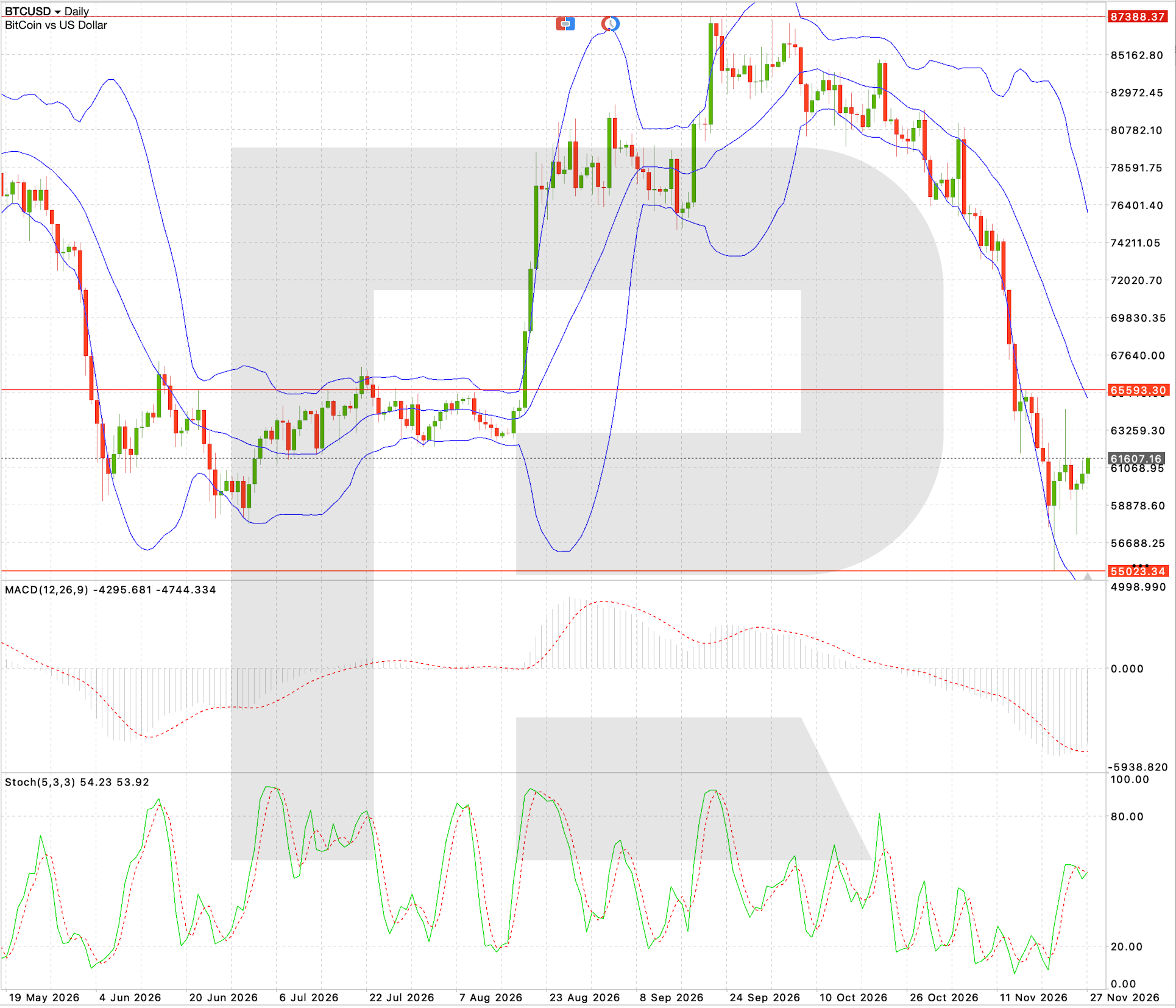
The indicators match too. On both charts MACD is below zero with fading momentum, Stochastic is back in the neutral zone, and the price trades below the middle Bollinger line. ETH moved with the crypto market as a whole, and the chart gives no grounds to tie its moves to the protocol security news. The comparison is visual, from daily CFD candles, so it gives no percentage changes.
ETHUSD Support and Resistance Levels
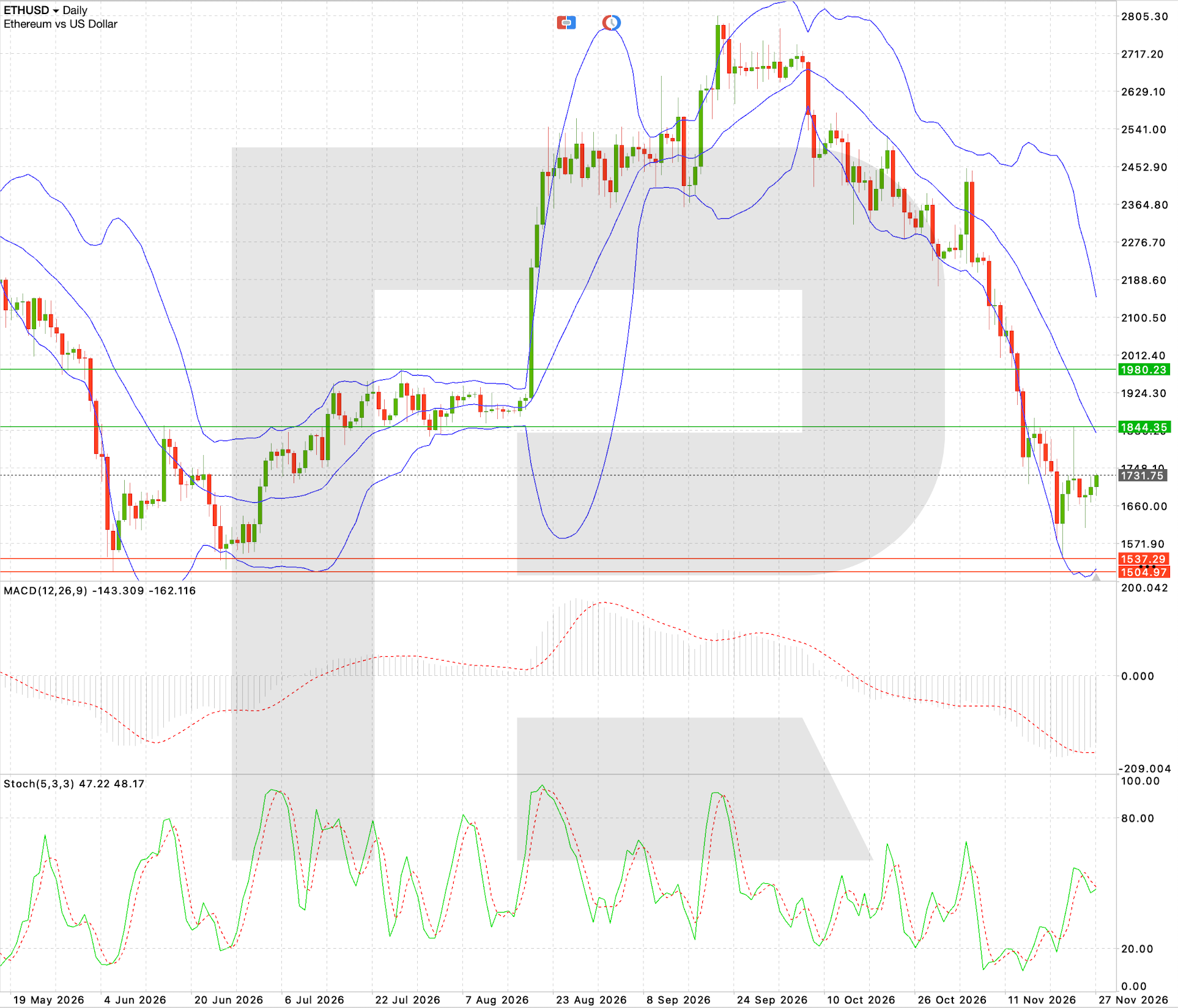
| Level, USD | Type | Why it matters |
|---|---|---|
| 1,980.23 | Resistance | A horizontal support broken earlier, now acting as resistance inside the downtrend |
| 1,844.35 | Resistance | A former support near the middle Bollinger line that may cap the current recovery |
| 1,731.75 | Current price | Price at the time of analysis, 27 November, 04:30 Cyprus time |
| 1,537.29 | Support | Near the local lows of June 2026, where buying may pick up |
| 1,504.97 | Support | The next support, near the lower Bollinger band |
ETHUSD Trade Scenario: Selling After a Failed Test of Resistance
The scenario waits for the recovery to test 1,844.35 and fail, then for the price to fall back to 1,810.00. Until that happens there is no entry.
| Parameter | Value | Reasoning |
|---|---|---|
| Direction | Sell | The medium-term downtrend on the daily chart |
| Entry | 1,810.00 USD | A return to this level after a failed test of 1,844.35 can signal that the decline is resuming |
| Stop Loss | 1,880.00 USD | Above the nearest resistance; a move to this level would put the continued decline in doubt |
| Take Profit | 1,545.00 USD | Slightly above support at 1,537.29, where buying may pick up |
| Risk to reward | 1 to 3.79 | 70 USD of risk against 265 USD of target, before trading costs |
| Horizon | 1 to 2 weeks | Counted from the moment the entry is triggered |
The analysts treat the current rebound as a correction inside the downtrend. On the way to the target, the area around 1,600 may slow the decline. The main risk to the scenario is a broader recovery across the crypto market. If the price never reaches 1,844.35 and turns lower, the entry is not triggered and the scenario does not start. This is an educational example of how entry, stop and target are set around chart levels, and it carries the forecast disclaimer at the end of the article.
How to Follow Ethereum Foundation AI and Post-Quantum Work
Two dates frame the next steps. The first is January 2027, when the timeline is reviewed. The second is a mainnet date for Glamsterdam. Further posts in the PQAI series on the foundation's blog are the first place where changes will appear.
For the wider crypto market, our post on bitcoin ETF flows before the Fed meeting covers the spot ETF flows behind recent crypto moves, and the RoboForex Market Analysis section publishes regular forecasts.
Conclusion
The Ethereum Foundation AI decision changes the order of work: protocol security first, other features later. The foundation's own target for quantum resistance stays 2029, while 2027 and December 2028 are proposals from Ethlabs and from Justin Drake. The changes that reach users run through wallets, multisigs, staking pools and node hardware, and the January 2027 review is the next point where the schedule can move. On the ETHUSD chart the coin still moves with bitcoin, and the analysts' scenario waits for a failed test of 1,844.35 before a sale toward 1,545.00.
FAQ
Is Ethereum quantum resistant?
Not yet. Its signatures use elliptic-curve cryptography. The plan proposes to move validator signatures, user accounts and blob commitments to hash-based cryptography, with the Ethereum Foundation's internal target set for 2029.
Why does the Ethereum Foundation see AI as a more urgent risk than quantum computers?
In its post of 23 November the foundation says AI models find bugs in production software faster than people can review the code. It calls AI more urgent and, as quoted by The Block, does not claim AI will break the foundations of cryptography.
When will Ethereum become quantum resistant?
The foundation's internal target is 2029. Justin Drake proposed December 2028 and Ethlabs, a separate group, names 2027. The schedule is due for review in January 2027.
Did the Ethereum Foundation cut 20% of its staff in November?
The 20% cut was announced on 23 June 2026, when the foundation parted ways with 54 colleagues and reorganised. The November posts, The Block and Decrypt report no new cut.
What is Quick Slots and what happened to it?
Quick Slots is a proposal for shorter block times. According to the Ethereum Foundation's post, Ethlabs removed it from the plans for the Hegotá upgrade.
- How to Read Bitcoin ETF Flows Through the Fed Meeting on 8-9 December: the signals that show when a run of outflows ends.
Any forecasts contained herein are based on the author's independent analysis and reflect their personal opinion. These articles should not be construed as trading recommendations or a call to action. The authors and RoboForex accept no responsibility for the results of any trades made on the basis of these recommendations and reviews. Past performance is not indicative of future results. Trading currencies and CFDs involves a high risk of capital loss.