Fed Meeting October and Three More Central Banks: Market Week Ahead (October 26 – 30)

The Fed meeting in October leads a week with four central bank decisions in three days. The Fed announces its rate on Wednesday, October 28, 2026, at 2:00 p.m. Eastern Time, and is expected to keep it at 4.00%, so the press conference matters more than the number. The Bank of Canada decides on the same day and is seen raising its rate to 2.50% from 2.25%. This issue covers US 500, EUR/USD, USD/JPY and USD/CAD.
The ECB follows on Thursday with its rates expected to stay at 2.65% and 2.50%, and the Bank of Japan closes the series on Friday with its rate seen at 1.25%. Between them, the US publishes its first estimate of third-quarter GDP and Core PCE inflation on Thursday, and the eurozone releases its own GDP and German inflation on Friday. The gap between what each central bank signals about its next steps can set the direction for the major currency pairs for the weeks ahead.
Where the Market Stands Going Into the Week
The dollar goes into the week mixed. EUR/USD holds near 1.1216, close to the lows of a decline that started at the August highs. USD/JPY slipped to 157.07 from 158.01 a week ago after another failed attempt to break 159.03. USD/CAD fell to 1.4007 from 1.4096 and has given back most of its rise to the 1.4250 to 1.4300 area in early October. US 500 trades near 7,647 after a pullback from 7,800 to 7,850, and it still holds above its rising trendline.
The common theme is tightening. In September the ECB raised its key rate to 2.65% and its deposit rate to 2.50%, the Fed lifted its rate to 4.00%, and the Bank of Japan moved to 1.25%. The Bank of Canada is the exception: it has held at 2.25% for seven meetings in a row, and in a Reuters poll on October 21 to 23, 19 of 34 economists expected it to start raising rates this week.
Most of the decisions are already in the price, which raises the bar for guidance. A Fed that keeps the door open to another hike, or a Bank of Japan that holds without a clear signal, widens the expected rate gap in favour of the dollar. A firmer ECB or a Bank of Canada that calls this week the start of a cycle would narrow it.
Key Events of the Week
| Date | Event | Instruments | Importance |
|---|---|---|---|
| Mon, Oct 26 | Germany Ifo business climate (October) | EUR/USD | ●● Medium |
| Tue, Oct 27 | US durable goods orders | US 500, USD Index | ●● Medium |
| Wed, Oct 28 | Bank of Canada rate decision and Monetary Policy Report | USD/CAD, Canadian dollar | ●●● High |
| Wed, Oct 28 | Fed rate decision and press conference | US 500, USD Index, US Treasuries | ●●● High |
| Thu, Oct 29 | US GDP (Q3, first estimate), Core PCE, personal income and spending | US 500, USD Index | ●●● High |
| Thu, Oct 29 | ECB rate decision and press conference | EUR/USD, euro | ●●● High |
| Fri, Oct 30 | Bank of Japan rate decision | USD/JPY, Japanese yen | ●●● High |
| Fri, Oct 30 | Eurozone GDP (Q3, flash) and Germany inflation (October) | EUR/USD, euro | ●●● High |
Instant Access to Global Markets with RoboForex MobileTrader
28
Oct
Overnight Rate, Forecast
2.50%
Previous
2.25%
Why It Matters
The Bank of Canada announces its decision at 9:45 a.m. Eastern Time against mixed signals. Inflation risks remain, while a weak labour market limits how far the central bank can tighten. The forecast calls for a 25 basis point hike to 2.50%, the first move after seven meetings on hold. In a Reuters poll on October 21 to 23, 19 of 34 economists expected that hike. The Monetary Policy Report published with the decision carries updated forecasts for inflation, growth and the rate path. For the Canadian dollar, the key question is whether the central bank presents the October move as the start of a new tightening cycle or as a one-off adjustment.
Market Reaction
A hike to 2.50% is already in the forecast, so the decision alone may bring a limited reaction. A firmer tone from the Bank of Canada would support the Canadian dollar and add pressure on USD/CAD. A hold at 2.25% or cautious growth forecasts could set up a recovery in the pair.
Market Sentiment
We keep a moderately negative view on USD/CAD. On the daily chart, the pair trades around 1.4007 after a sharp reversal from resistance at 1.4250 to 1.4300. The price has broken the middle Bollinger Band and moved toward the lower band, a sign that sellers are gaining strength. The MACD line has slipped just below zero and sits under its signal line, so the earlier upward momentum is fading fast. The stochastic is in oversold at 17.70 and 12.15, which leaves room for a short technical bounce. In the scenario, a hold below 1.3980 opens the way to 1.3780. The nearest resistance is around 1.4080, and a return above it would raise the chance of a recovery toward 1.4190 and then 1.4250.
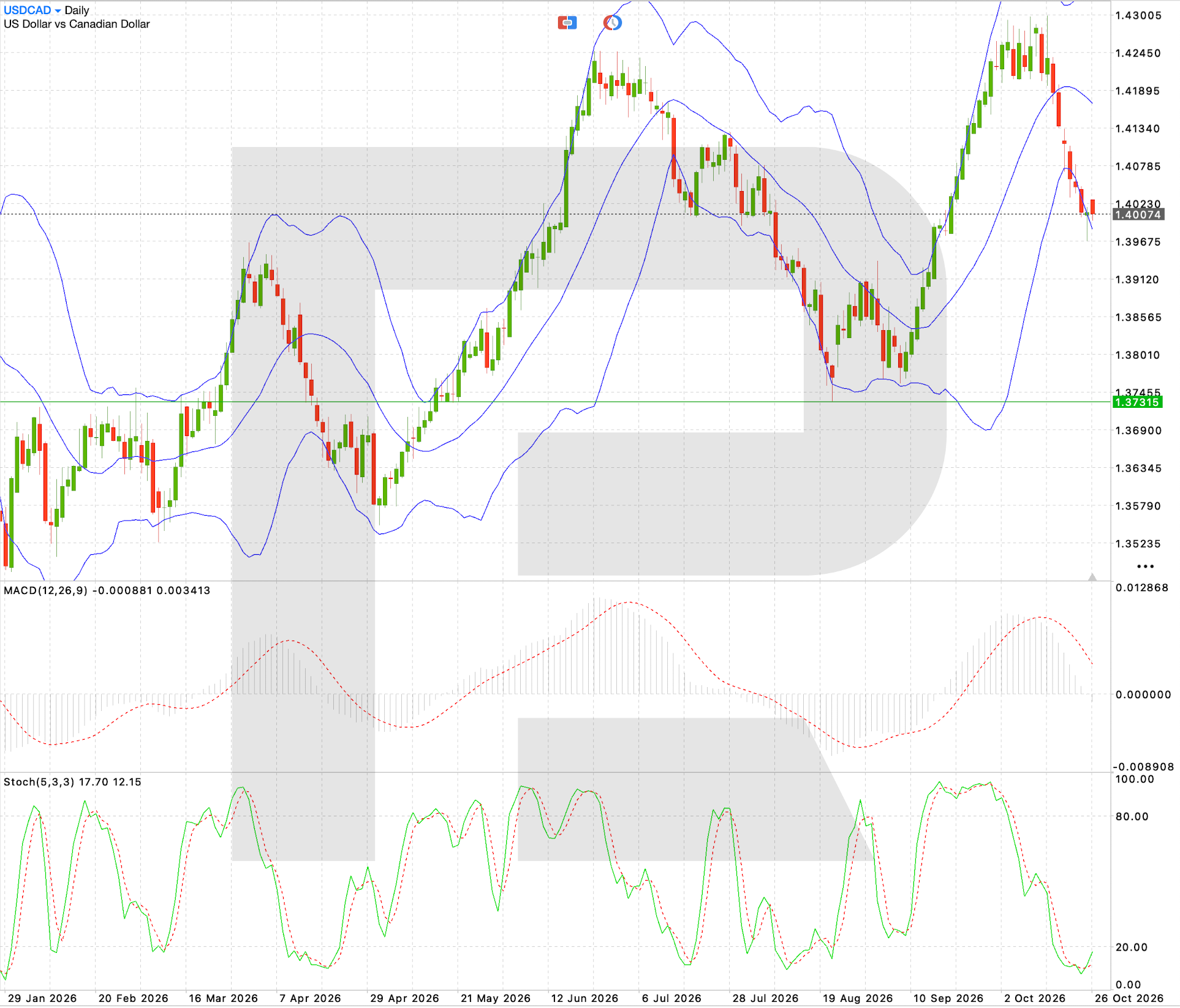
Key Levels and Trade Parameters — USD/CAD
| Parameter | Value |
|---|---|
| Resistance | 1.4080 / 1.4190 |
| Support | 1.3980 / 1.3780 / 1.3732 |
| Entry, Sell Stop | 1.3980 |
| Stop loss | 1.4080 |
| Take profit | 1.3780 |
| Risk to reward | 1:2.0 |
28
Oct
Fed Funds Rate (Wed, Oct 28), Forecast
4.00%
Previous
4.00%
US GDP Q3 (Thu, Oct 29), Forecast
3.1%
Previous
2.2%
Core PCE m/m (Thu, Oct 29), Forecast
0.3%
Previous
0.2%
Why It Matters
The Fed meeting in October runs on Tuesday and Wednesday, October 27 and 28, with the decision on Wednesday at 2:00 p.m. Eastern Time and the press conference half an hour later. The rate is expected to stay at 4.00%, so investors will focus on how the Fed assesses inflation risks and what it says about the next meeting. On Thursday the US publishes its first estimate of third-quarter GDP and Core PCE, the Fed's preferred measure of underlying inflation. Growth is seen speeding up to 3.1% from 2.2%, and Core PCE is expected to rise 0.3% in a month after 0.2%. That mix makes the Fed's task harder: the economy grows while price pressure holds firm. For stocks, it keeps the market sensitive to Treasury yields and to the cost of capital. This is the first meeting after the September hike to 4.00%, and it brings no new economic projections, so the statement and the press conference carry all the new guidance.
Market Reaction
A hold with a firm tone from the Fed, especially next to strong GDP and Core PCE above 0.3%, could support the dollar and bond yields and add pressure on US 500. Softer comments and moderate inflation would support stocks. A sharp slowdown in GDP would read as a risk to corporate earnings, and the market would treat it as a negative for stocks even if it lowers rate expectations.
Market Sentiment
We see the short-term outlook for US 500 as moderately negative. On the daily chart, the index trades near 7,647 after a pullback from the 7,800 to 7,850 area. The price has dropped below the middle Bollinger Band and is testing the lower band, which lines up with the rising trendline. The MACD line has turned negative at about -8.44, below its signal line at 11.23, a sign that upward momentum is fading. The stochastic has fallen to 18.67 with the fast line below the slow one near 37.69: the index is close to oversold, but there is no signal of a turn higher yet. The key level is 7,625. A break of the rising trendline and a hold below it set up a decline toward 7,425. A return above 7,750 cancels the bearish scenario and opens the way for a retest of 7,850.
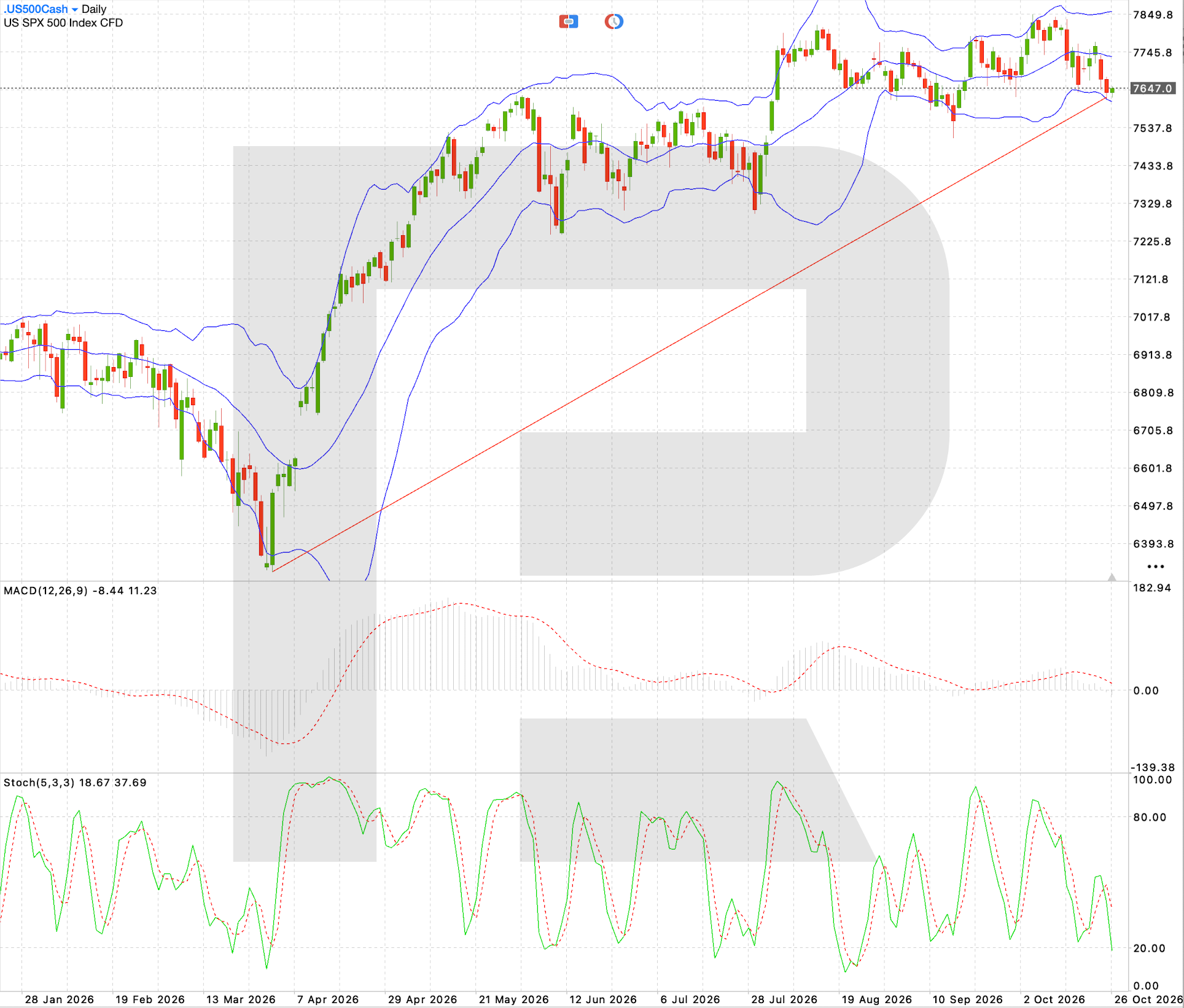
Key Levels and Trade Parameters — US 500
| Parameter | Value |
|---|---|
| Resistance | 7750 / 7850 |
| Support | 7625 / 7535 / 7425 |
| Entry, Sell Stop | 7625 |
| Stop loss | 7750 |
| Take profit | 7425 |
| Risk to reward | 1:1.6 |
29
Oct
ECB Key Rate (Thu, Oct 29), Forecast
2.65%
Previous
2.65%
ECB Deposit Rate (Thu, Oct 29), Forecast
2.50%
Previous
2.50%
Eurozone GDP Q3 q/q (Fri, Oct 30), Forecast
0.1%
Previous
0.6%
Germany Inflation y/y (Fri, Oct 30), Forecast
3.3%
Previous
3.3%
Why It Matters
The ECB meets as growth in the eurozone slows. The key rate is expected to stay at 2.65% and the deposit rate at 2.50%, so the main question is how long the central bank plans to keep current financing conditions. On Friday the flash estimate of third-quarter GDP is seen showing growth slowing to 0.1% from 0.6%. German inflation adds a second test, with the annual rate expected to hold at 3.3%. That leaves the euro in a difficult spot: weak growth limits its upside, while firm inflation keeps the ECB from turning to easing any time soon.
Market Reaction
Firmer comments from the ECB together with GDP above 0.1% could support EUR/USD. If the central bank focuses on the risk of a slowdown and the flash data confirms weak growth, pressure on the euro could build. The comparison with the Fed matters too: a wider expected rate gap in favour of the US would weigh on EUR/USD.
Market Sentiment
We keep a moderately negative view on EUR/USD. On the daily chart, the pair trades around 1.1216 after a long decline from the August highs. The price sits below the middle Bollinger Band and stays inside a descending channel. The MACD remains below zero, with the main line at about -0.00563 above the signal line at -0.00729: selling pressure is easing, but with both lines below zero it is too early to talk about a trend reversal. The stochastic has dropped to 36.13 after turning down from near 70, and the fast line sits below the slow one near 50.50, which points to the risk of a new decline after the recent pause. In the scenario, a break of support at 1.1150 extends the decline toward 1.0950. A hold above 1.1250 would weaken the bearish momentum, and a return to 1.1350 would make a deeper upward correction more likely.
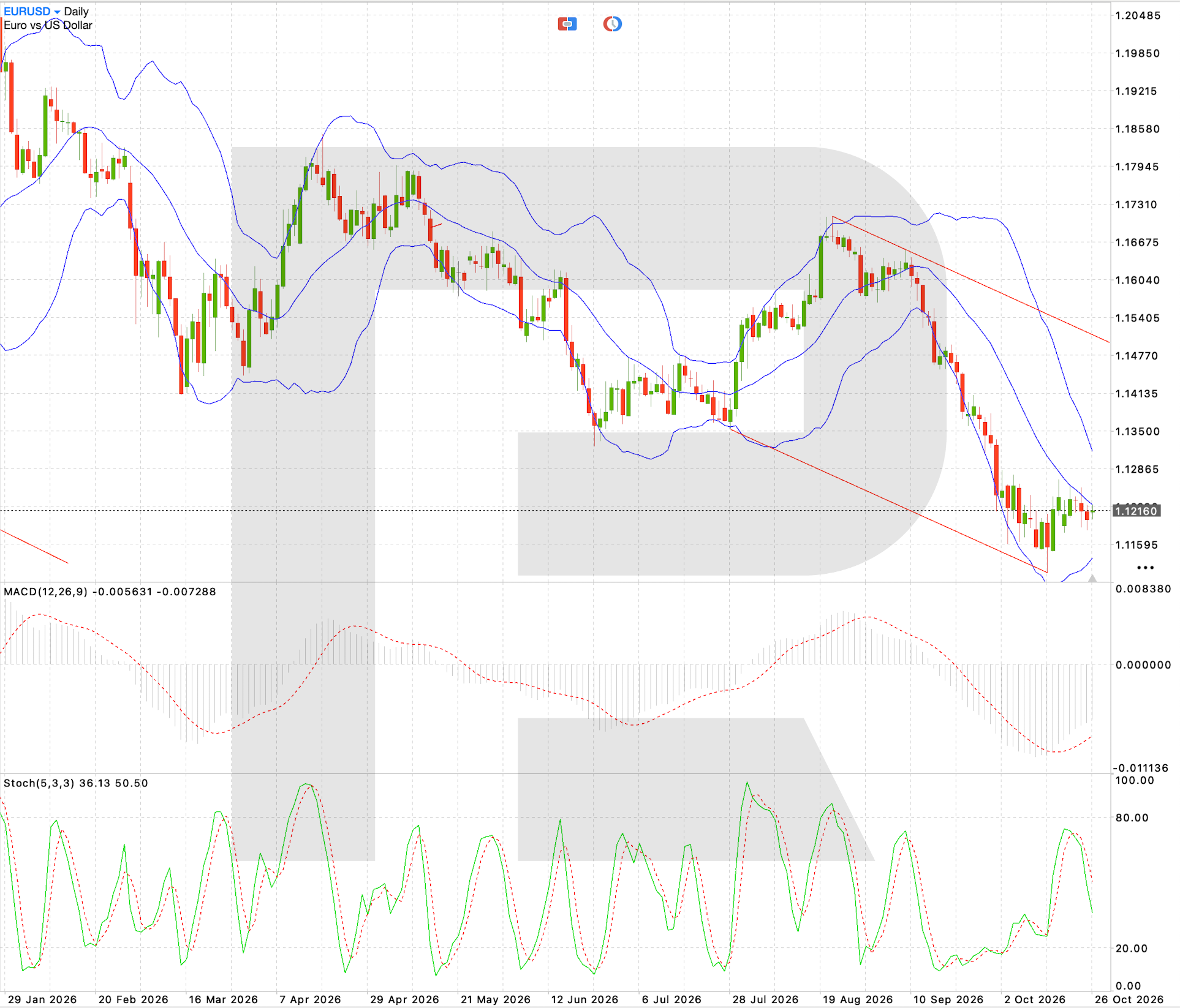
Key Levels and Trade Parameters — EUR/USD
| Parameter | Value |
|---|---|
| Resistance | 1.1250 / 1.1350 |
| Support | 1.1150 / 1.1050 / 1.0950 |
| Entry, Sell Stop | 1.1150 |
| Stop loss | 1.1250 |
| Take profit | 1.0950 |
| Risk to reward | 1:2.0 |
30
Oct
Policy Rate, Forecast
1.25%
Previous
1.25%
Why It Matters
The Bank of Japan closes the week of central bank decisions. Its rate is expected to stay at 1.25%, so the focus moves to what it says about inflation, domestic demand and the next steps in normalising policy. Japan's economy remains sensitive to import prices and the exchange rate, and expensive energy can keep inflation up even while consumer spending grows slowly. Consumer confidence comes out on Thursday, with the index expected to rise to 35.6 from 35.4. A strong reading would add to the case for steady domestic demand ahead of the meeting.
Market Reaction
A hold with firm signals about further hikes would support the yen and could speed up the decline in USD/JPY. A more cautious Bank of Japan, especially next to a firm Fed, would set up a recovery in the pair. The main driver stays the gap between the expected rate paths in the US and Japan.
Market Sentiment
We keep a moderately negative forecast for USD/JPY. On the daily chart, the pair trades around 157.07 after a decline from resistance at 159.03. An attempt to hold above the middle Bollinger Band failed, and the price is back in the lower half of the range. The MACD line is at about -0.0496, below its positive signal line at 0.1639, a sign that short-term selling pressure is building. The stochastic has dropped to 26.03 and 26.33, close to oversold, which leaves room for a technical bounce but gives no clear signal of a recovery yet. In the scenario, a break of 156.60 opens the way to 153.80, with interim support around 155.90. A return above 158.00 would ease the selling pressure, and a hold above 159.03 would confirm a new upward move.
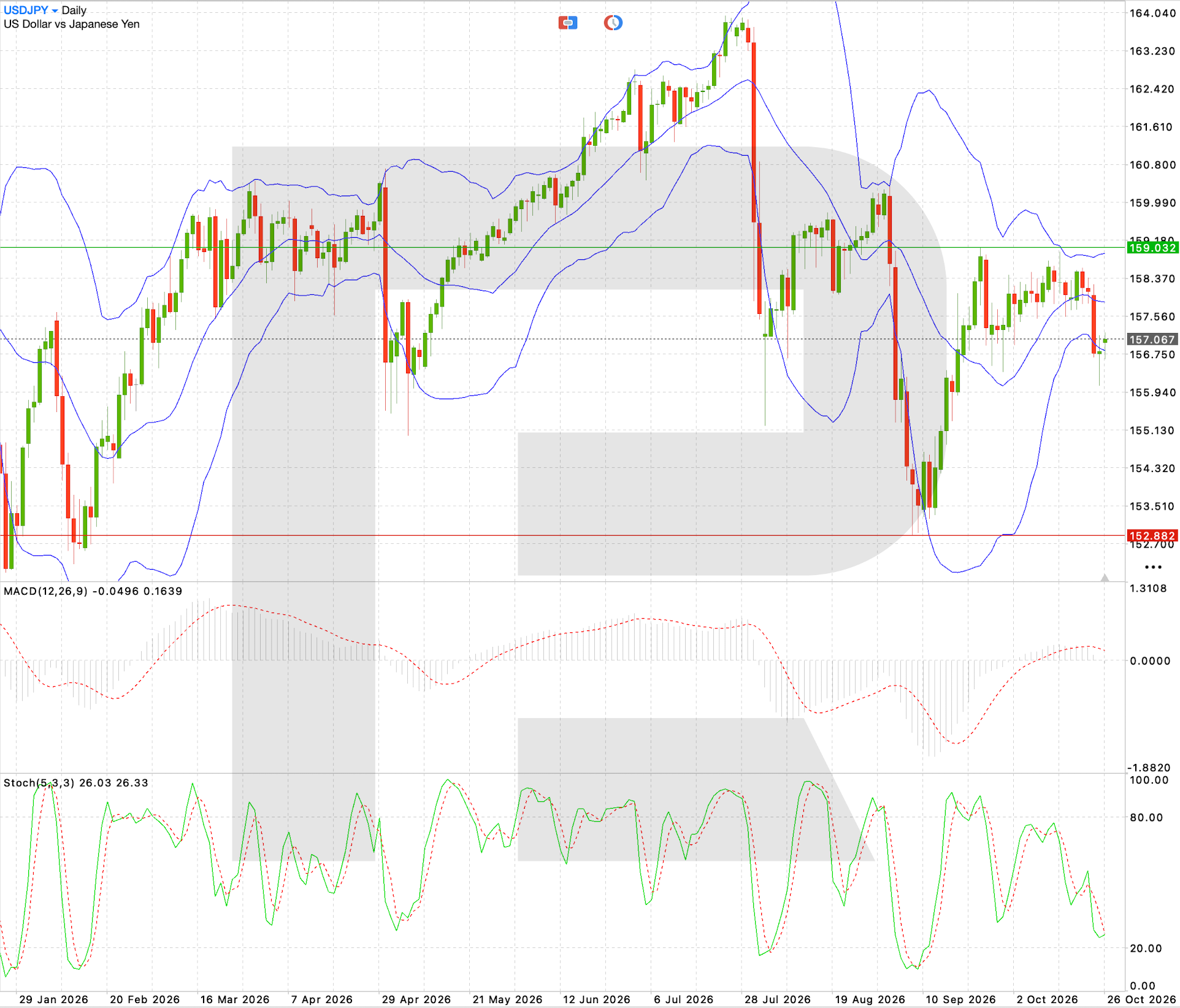
Key Levels and Trade Parameters — USD/JPY
| Parameter | Value |
|---|---|
| Resistance | 158.00 / 159.03 |
| Support | 156.60 / 155.90 / 153.80 |
| Entry, Sell Stop | 156.60 |
| Stop loss | 158.00 |
| Take profit | 153.80 |
| Risk to reward | 1:2.0 |
What Else to Watch
Germany's Ifo business climate on Monday is expected to slip to 89.5 from 89.9, another sign of caution among German companies. US durable goods orders on Tuesday are seen up 0.4% after no change, a read on industrial demand. On Wednesday the GfK consumer climate in Germany is expected to fall to -32 from -30.6. US personal income and spending come out on Thursday, both forecast at 0.3% for the month. On Friday France, Spain, Germany and Italy publish their own flash GDP figures together with inflation data, and China's manufacturing PMI follows on Saturday with a forecast of 50.3 after 50.1, which can set the tone for Monday's open.
Track the forecast and the actual figure for each release, since the gap between consensus and the outcome is what tends to move prices the most. Learn more about how to read the economic calendar and trade the news.
Conclusion
The Fed meeting in October and US GDP with Core PCE decide where US 500 goes from its rising trendline: a hold below 7,625 sets up a decline toward 7,425, and a return above 7,750 cancels it. The Bank of Canada opens the series the same day, and a hike with a firm tone supports a move in USD/CAD below 1.3980 toward 1.3780, while a return above 1.4080 points to a recovery.
The ECB and the Bank of Japan complete the week. Weak eurozone growth and a cautious ECB support a break of 1.1150 in EUR/USD toward 1.0950, with 1.1250 as the level that cancels it. In USD/JPY, a break of 156.60 opens the way to 153.80, and a return above 158.00 weakens the bearish case. USD/CAD, US 500 and USD/JPY are close to oversold on the stochastic, so sharp pullbacks are possible during the press conferences, and each scenario needs a confirmed break first.
FAQ
Will the Fed change rates at the October 2026 meeting?
The Fed is expected to keep its rate at 4.00% on October 28, 2026, after lifting it to 4.00% on September 16. The press conference and the US GDP and Core PCE data on October 29 will shape expectations for the next meeting.
When is the Fed meeting in October 2026?
The Fed meets on Tuesday and Wednesday, October 27 and 28, 2026. The rate decision comes out on Wednesday at 2:00 p.m. Eastern Time, and the press conference starts half an hour later. The rate is expected to stay at 4.00%.
Why does the ECB decision matter for EUR/USD?
The ECB sets the cost of borrowing in the eurozone, and its signals shape expectations for the rate gap between Europe and the US. A firmer ECB can support the euro, while concern about growth can add pressure on EUR/USD.
How could the Bank of Canada decision move USD/CAD?
Tighter policy from the Bank of Canada usually supports the Canadian dollar and pushes USD/CAD lower. If the central bank holds at 2.25% against the expected hike, or gives soft forecasts, the pair could recover.
What could push USD/JPY lower?
Stronger expectations of another Bank of Japan hike, a firmer tone from the central bank or lower US bond yields can support the yen. On the chart, a break of support at 156.60 would confirm the bearish scenario.
Which levels matter most this week?
Key support is 1.1150 for EUR/USD, 156.60 for USD/JPY and 1.3980 for USD/CAD. For US 500, the focus is on 7,625 and the rising trendline. A break of these levels could signal a further decline.
Any forecasts contained herein are based on the author's independent analysis and reflect their personal opinion. These articles should not be construed as trading recommendations or a call to action. The authors and RoboForex accept no responsibility for the results of any trades made on the basis of these recommendations and reviews. Past performance is not indicative of future results. Trading stocks and CFDs involves a high risk of capital loss.