EMA Scalping Strategy: Two Moving Averages, Settings and Trading Rules

An EMA scalping strategy uses two exponential moving averages on a short chart to time quick trades. In the version described here, a fast 7-period EMA and a slow 14-period EMA on the M5 or M15 chart confirm a chart pattern or a level break, set the exit and leave the stop behind the nearest swing.
TL;DR
- Add EMA 7 and EMA 14 (Exponential, applied to Close) to an M5 or M15 chart.
- Enter when a pattern or a level break is confirmed by EMA 7 crossing EMA 14, and place the stop loss behind the nearest local low or high.
- Exit on the opposite crossover, and test the rules on history and a demo account before you trade live.
Trading strategies with moving averages are popular among traders because MAs are simple and efficient instruments of technical analysis. This article covers the two-EMA strategy, compares it with other popular EMA settings and adds a ribbon variant for the one-minute chart.
What Is an EMA Scalping Strategy?
An EMA scalping strategy is a short-term trading system that takes many small trades and uses crossovers of exponential moving averages to time them. An EMA gives more weight to the latest prices than a simple moving average, so it turns faster, which suits charts where a trade lasts minutes.
Scalping (from the Latin "scalpere", to cut) is a slang name for short-term intraday trading strategies. Their characteristic feature is a large number of trades opened in a rather short time and aiming at a relatively small profit. For scalping, such small timeframes as M1, M5 or M15 are normally used.
Leverage on Forex lets a move of a few points produce a noticeable result, in profit and in loss alike, which is one reason scalping is popular with traders who start with small deposits.
Unlike long-term strategies, scalping needs more time to be spent trading. You have to monitor the market constantly during the day, looking for trading signals and keeping an eye on open trades. A scalper needs a trustworthy trading system, firm discipline and a lot of time at the screen.
Which EMA Settings Work Best for Scalping?
No single EMA setting suits every scalper: the shorter the periods, the more signals you get and the more of them are false in a sideways market. The table compares the pairs traders use most often, from the fastest to the slowest.
| EMA setting | Usual timeframe | Signals | Who it suits |
|---|---|---|---|
| 5 and 13 EMA | M1 | The most frequent, with many false crossovers in a flat market | Traders who can watch the screen without breaks and act within seconds |
| 7 and 14 EMA (this strategy) | M5, M15 | Fewer crossovers, each one confirms a pattern or a level break | Traders who combine chart patterns with an indicator confirmation |
| 9 and 21 EMA | M5, M15 | Later and smoother than 7 and 14 | Traders who accept a later entry in exchange for fewer signals |
| 20 and 50 EMA | M15 and above | Rare, shows the direction of the trend | A direction filter: take faster crossovers only on the side of the 20 and 50 EMA |
| EMA ribbon (2 to 74) | M1, M5 | Zones of support and resistance | Traders who add positions in the direction of the trend (see the ribbon variant below) |
The 7 and 14 pair sits in the middle of this range: fast enough for M5, and with a pattern as the main reason to enter, it filters out many of the crossovers a 5 and 13 pair would trade.
How to Set Up the 7 and 14 EMA in MetaTrader
The scalping strategy with two MAs combines technical analysis patterns and important support and resistance levels with two EMAs: a fast one with period 7 and a slow one with period 14. The strategy is multicurrency and applicable to any financial instrument. The main timeframes are M5 and M15.
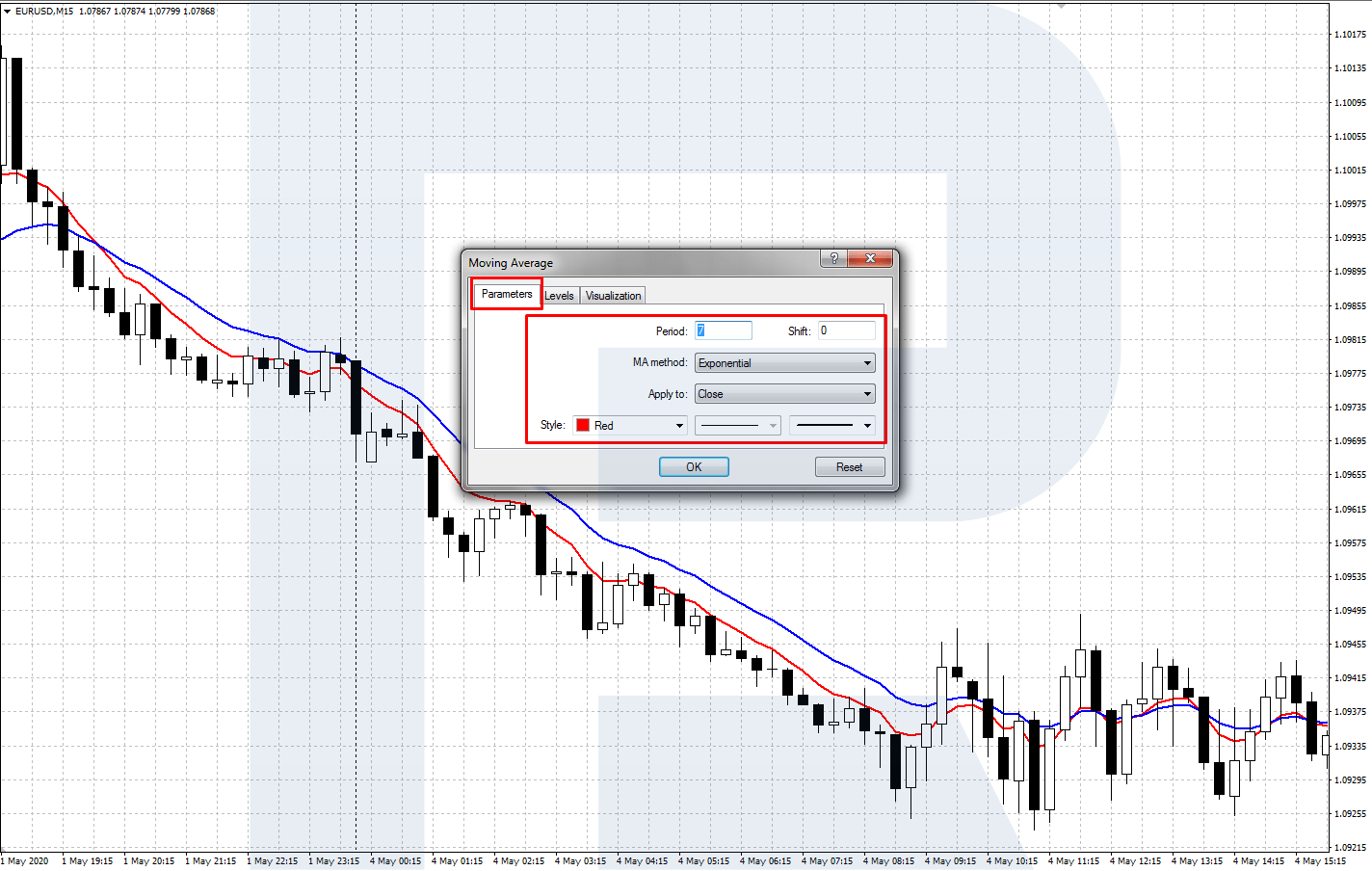
Place a fast EMA (7) (red) and a slow EMA (14) (blue) on the chart. In popular terminals, including MetaTrader 4 and MetaTrader 5, you can do this via the Main Menu: Insert > Indicators > Trend > Moving Average. In the settings window, choose periods 7 and 14, the Exponential averaging method, Applied to: Close.
EMA Scalping Rules: Entry, Stop Loss and Exit
Entering the Trade
The reason for entering a trade is a technical analysis pattern forming on the chart or an important support or resistance level being broken. Candlestick and Price Action patterns may be used too. The entry signal is confirmed by the crossing of the two MAs:
- To open a buy trade, the red EMA (7) must cross the blue EMA (14) from below and the candle must close above it.
- To open a sell trade, the red EMA (7) must cross the blue EMA (14) from above and the candle must close below it.
Placing the Stop Loss
A Stop Loss is obligatory, and it is placed right when you enter the trade:
- For a buy, the stop loss goes behind the nearest local low on the price chart.
- For a sell, the stop loss goes behind the nearest local high on the price chart.
Locking In Profit
To close your position with a profit, follow the two MAs: if the momentum is good, they let you collect the larger part of the price movement.
- Close a buy when the upward momentum is over and EMA (7) crosses EMA (14) from above.
- Close a sell when the downward momentum is over and EMA (7) crosses EMA (14) from below.
Checklist before each trade
- A pattern or a broken level gives the reason to trade.
- EMA 7 has crossed EMA 14 in the same direction, on a closed candle.
- The stop loss sits behind the nearest local low (buy) or high (sell).
- The position size keeps the loss at the stop within your risk limit for one trade.
Open a RoboForex Account
Trade currencies, indices and oil on M5 and M15 charts.
Three Examples of the EMA Scalping Strategy
Let us have a look at three trades on different markets: an index, crude oil and a currency pair.
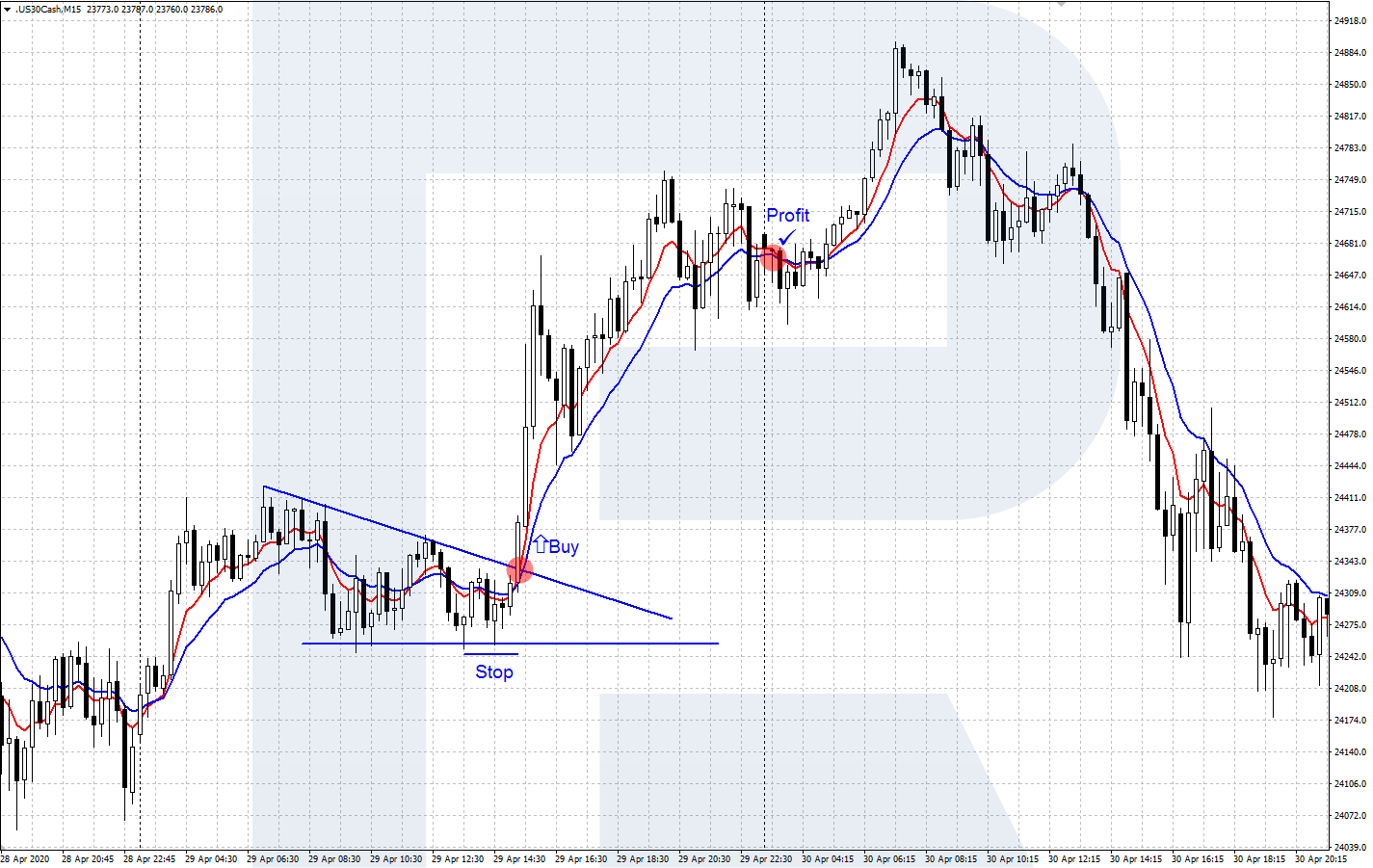
Example 1: Index (US 30)
- Instrument: US 30 (US30Cash on the chart)
- Timeframe: M15
- Trade direction: Buy
- Entry signal: a Triangle pattern, confirmed when EMA (7) crosses EMA (14) from below
- Closing: the opposite crossing of EMA (7) and EMA (14)
Example 2: Crude Oil (WTI)
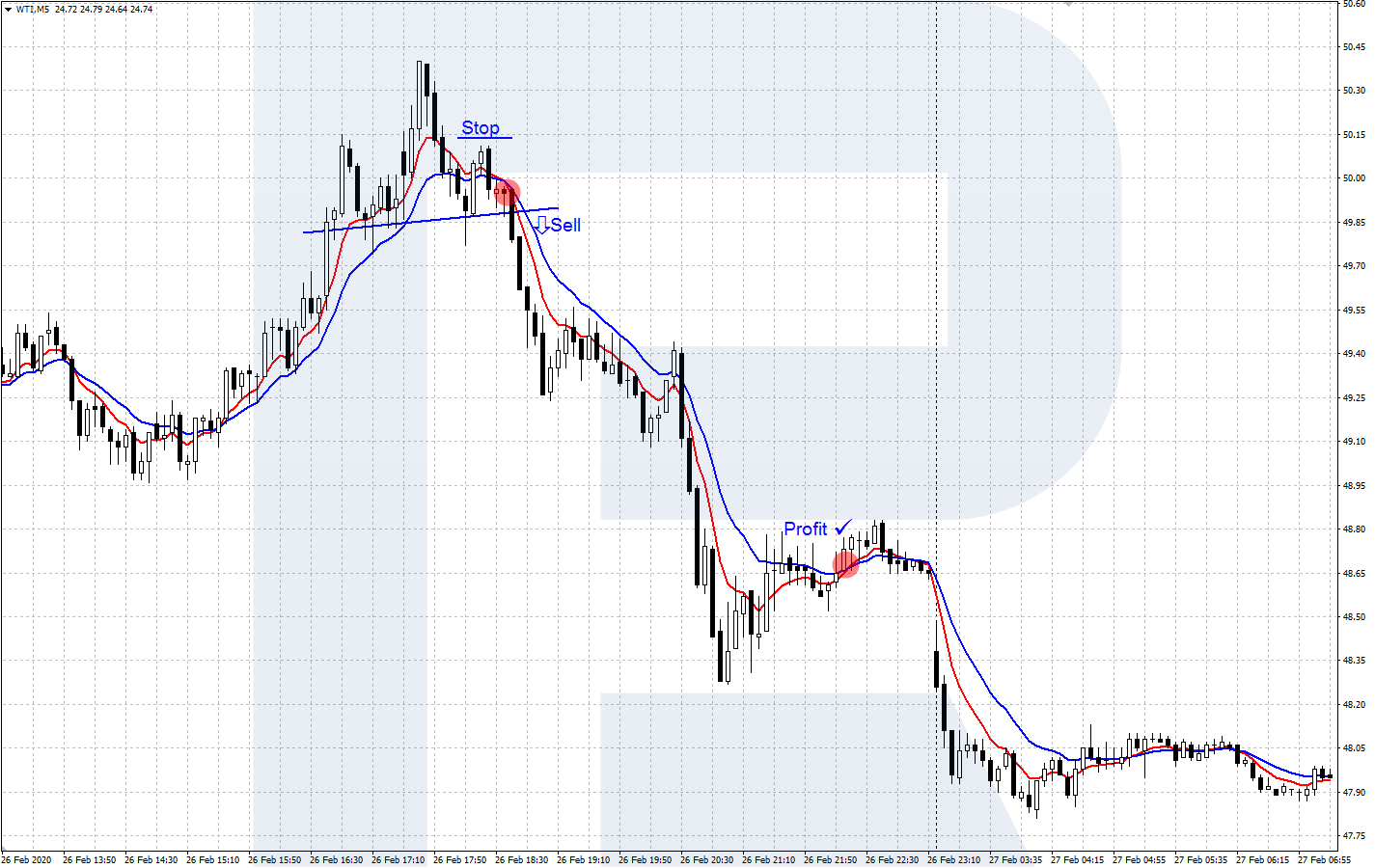
- Instrument: WTI
- Timeframe: M5
- Trade direction: Sell
- Entry signal: a reversal Head and Shoulders pattern, confirmed when EMA (7) crosses EMA (14) from above
- Closing: the opposite crossing of EMA (7) and EMA (14)
Example 3: Forex (USD/CAD)
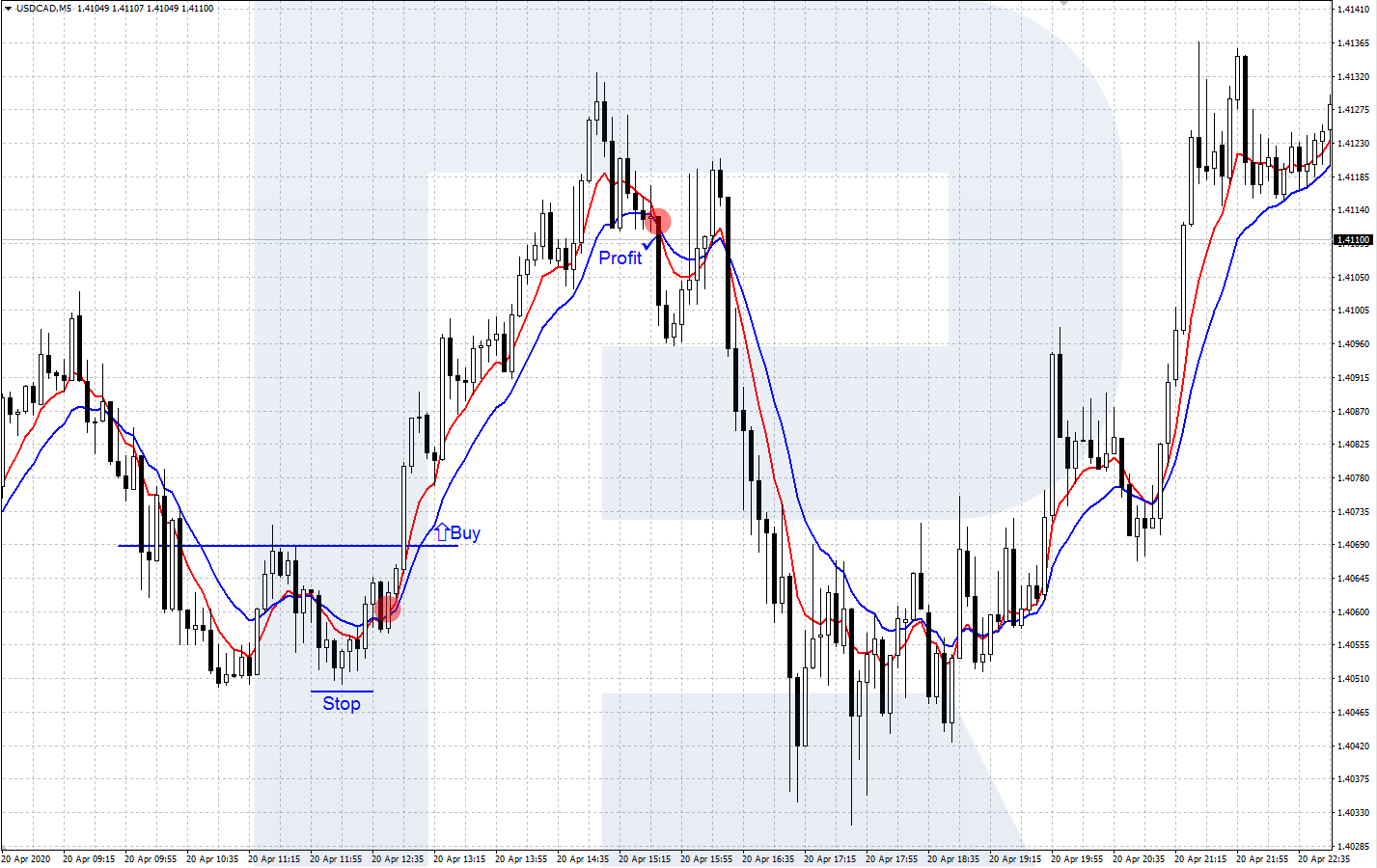
- Instrument: USD/CAD
- Timeframe: M5
- Trade direction: Buy
- Entry signal: a reversal Double Bottom pattern, confirmed when EMA (7) crosses EMA (14) from below
- Closing: the opposite crossing of EMA (7) and EMA (14)
EMA Ribbon Variant for M1 and M5 Charts
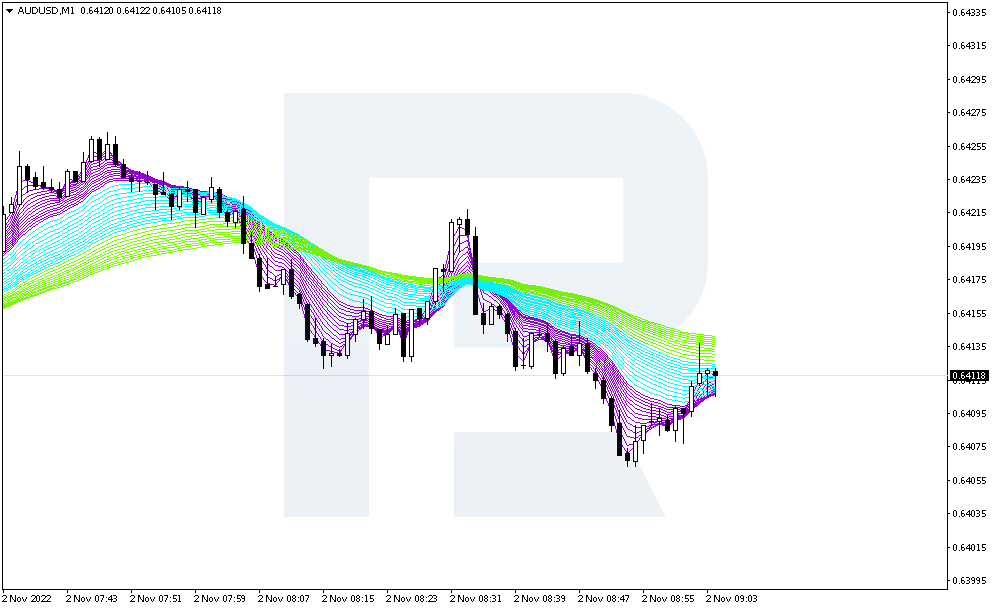
The ribbon variant replaces two lines with 38 EMAs in three colours. The bands work as zones of support and resistance, and the rules allow adding positions while the short-term trend continues. It suits the most liquid currency pairs, such as EUR/USD, GBP/USD, AUD/USD and USD/CAD, where spreads are low and every point counts.
Setting Up the Ribbon
- Purple, short-term trend: EMA with periods 2, 3, 4, 5, 6, 7, 8, 9, 10, 11, 12, 13, 14 and 15. These lines stay closest to the price.
- Blue, medium-term trend: EMA with periods 17, 19, 21, 23, 25, 27, 29, 31, 33, 35, 37, 39 and 41.
- Green, long-term trend: EMA with periods 44, 47, 50, 53, 56, 59, 62, 65, 68, 71 and 74. These lines stay furthest from the price.
Ribbon Entry Rules
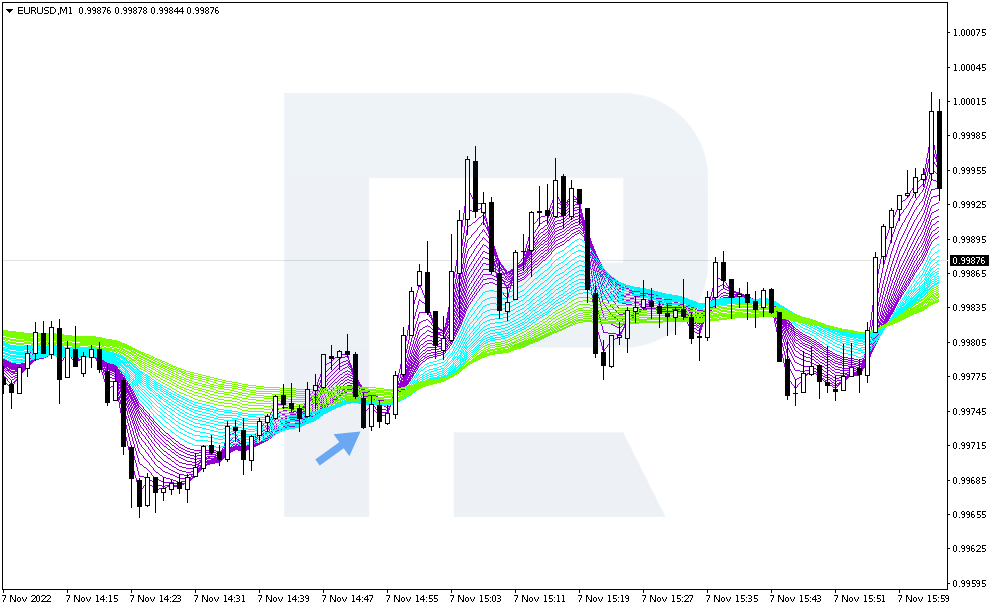
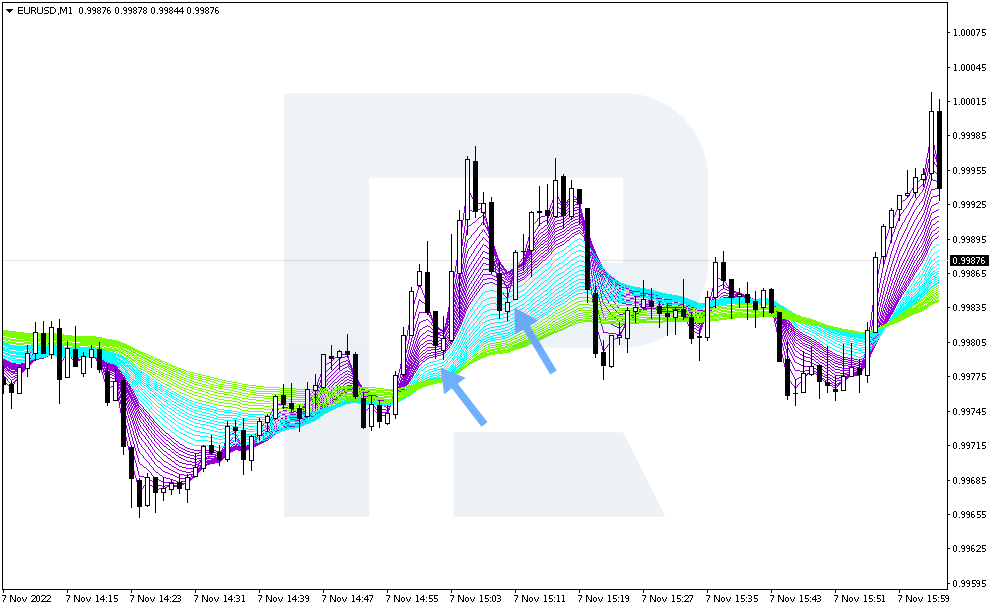
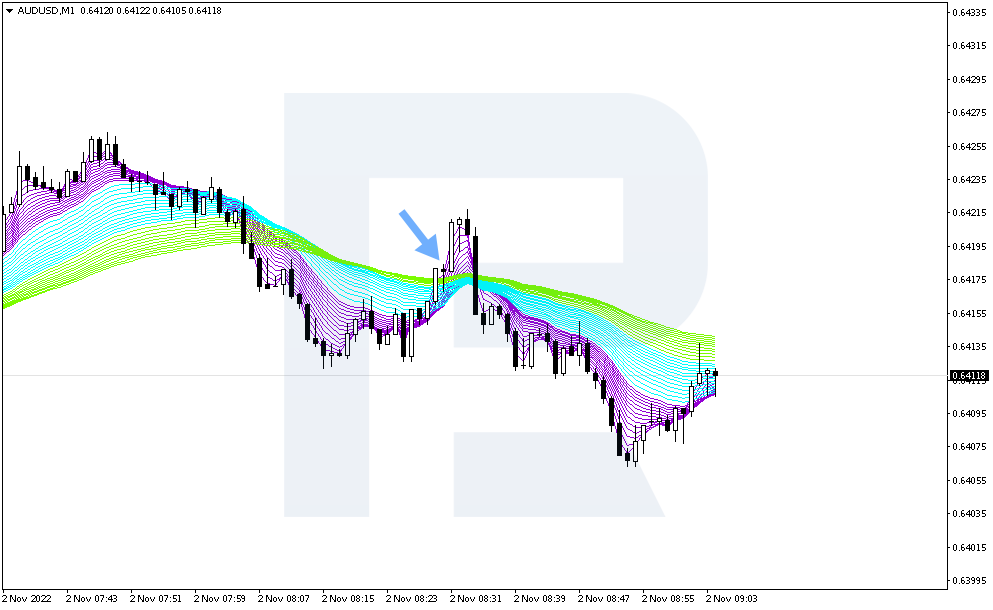
The ribbon works on pullbacks: it buys when the fast lines dip into the slow ones and sells when they rise into them.
- First buy: the purple lines cross the green lines from top to bottom on M1 or M5. Enter when the next candle opens.
- Next buys: the price tests the green or blue lines and returns to the purple lines.
- First sell: the purple lines cross the green lines from bottom to top.
- Next sells: the price tests the green or blue lines and returns to the purple lines.
What the Ribbon Stops and Targets Require
The ribbon uses fixed stops and targets in pips. On M1 the stop loss is wider than the target, so the strategy has to win most of its trades to break even. The last column shows that share, before spreads and commissions.
| Chart | Stop loss | Take profit | Win rate needed to break even |
|---|---|---|---|
| M1, first position | 12 pips | 5 to 7 pips | 63% to 71% |
| M1, next positions | 12 pips | 4 pips | 75% |
| M5, first position | 18 pips | 12 to 20 pips | 47% to 60% |
| M5, next positions | 18 pips | 7 pips | 72% |
The break-even win rate equals the stop divided by the sum of the stop and the target: 12 / (12 + 6) gives about 67% for a 6-pip target on M1. The M5 settings ask for the lowest win rate, so start your tests there.
Scalp in RoboForex MetaTrader 5
M1 to M15 charts, the full EMA toolkit and the Strategy Tester in one platform.
When Does EMA Scalping Work Best?
EMA scalping works best when the market moves in clear short swings and the spread is low. Moving averages follow the price, so they give clean signals in a directional move and frequent crossovers in a narrow sideways range.
- Active sessions. Trade the hours when your instrument is most liquid, such as the overlap of the London and New York sessions for major currency pairs. Spreads are usually lower then, and every point of spread matters on M1 and M5.
- A visible direction on a higher chart. Check M15 or H1 first and take signals on the side of that trend, or add the 20 and 50 EMA as a filter.
- Calm news calendar. Sharp moves around major releases can jump over a tight stop. Many scalpers wait a few minutes after high-impact news before the next entry.
- Room to the next level. Before entering, check that the distance to the nearest support or resistance is larger than your stop.
How to Test the EMA Scalping Strategy Before Trading Live
Test the rules in four steps, from free history to a small real account. Each step answers one question before you move to the next.
- HistoryScroll back through the chart and mark every crossover that met the rules. Count wins, losses and the average size of each.
- Demo accountTrade the same rules in real time on a demo account to check your reaction speed and the real spread.
- Cent accountMove to a cent account to trade real money in small amounts and see how you handle real results.
- Live accountGo live only with a position size that keeps each loss within the risk you set for one trade.
If you want to automate the crossover rules, an Expert Advisor can run them in the MetaTrader 5 Strategy Tester, as shown in A 15-Minute Backtest.
Conclusion
The EMA scalping strategy with the 7 and 14 EMA gives clear rules: a pattern or a level break, a crossover to confirm it, a stop behind the nearest swing and an exit on the opposite crossover. The ribbon variant adds positions in the trend on M1 and M5, with fixed stops that call for a high win rate. Scalping takes time and firm discipline, so practise on a demo or a small real account first, make sure the strategy works for you, stick to its rules and control risks.
FAQ
What is the best EMA for scalping?
There is no single best EMA. A 7 and 14 EMA pair on M5 or M15 gives a balance between speed and the number of false signals, a 5 and 13 pair suits M1, and a 9 and 21 pair gives later, smoother signals. Pick one setting and test it on history before trading.
Which EMA settings work on a 1-minute chart?
On M1 traders use fast pairs such as 5 and 13 EMA, or an EMA ribbon with periods from 2 to 74. The one-minute chart gives the most signals and the most noise, so trade only the most liquid hours and keep spreads in mind.
Is the 9 and 21 EMA good for scalping?
The 9 and 21 EMA works for scalping on M5 and M15. It reacts later than 7 and 14, so it gives fewer signals and enters a little later in the move. Traders also use it as a trend filter for faster pairs.
What timeframe is best for EMA scalping?
The two-EMA strategy in this article uses M5 and M15. M1 suits the ribbon variant and traders who can react within seconds. Many scalpers also check M15 or H1 to see the main direction.
Can I use the EMA scalping strategy on gold and indices?
Yes, the rules apply to any liquid instrument, including XAU/USD and indices such as US 30. These markets move more points per minute than major currency pairs, so place the stop by the nearest local low or high and size the position from that distance.
- What is Scalping on Forex?: the basics of scalping before you pick a system.
- How to Scalp in Forex: A Guide to Scalping: more scalping approaches to compare with the EMA crossover.
- How to Use Moving Average Indicator: Description and Trading: how EMA and SMA are calculated and read.
- How to Choose a Timeframe for Trading: match M1, M5 or M15 to your schedule.
- How to Trade the Three Moving Averages + MACD Strategy: a slower moving average system with an extra filter.
Any information provided in articles on this website is based solely on the personal opinions of the authors. These articles should not be construed as trading recommendations or a call to action. The authors and RoboForex accept no responsibility for the results of any trades made on the basis of these recommendations and reviews. Past performance is not indicative of future results. Trading stocks and CFDs involves a high risk of capital loss.